How to Handle a Narcissist’s Hoovering Tactics (With Real Examples)
You finally left. You blocked the number. You cried yourself through the first week. And then, just when you start to feel a tiny bit of peace, your phone lights up with a text from an unknown number: “I’ve been thinking about you. I know I messed up. Can we talk?”
That’s hoovering. And if you’ve been through a relationship with someone who has narcissistic traits, you already know this feeling in your gut. It’s the one where your chest tightens and your brain immediately starts negotiating with itself. “Maybe they’ve changed. Maybe this time is different.” I know, because I lived inside that loop for over a decade.
During my 12-year relationship with a partner who had both NPD and BPD traits, hoovering wasn’t just occasional. It was a pattern I could practically set a clock to. Every time I got close to walking away for good, the apologies would come flooding in. The grand gestures. The “I can’t live without you” texts at 2 a.m. And I fell for them, again and again, because I didn’t understand what was really happening. If you’re dealing with the same cycle right now, The Hoovering Protection Plan was designed for exactly this moment.
What Is Hoovering and Why Does It Work So Well?

Hoovering is a manipulation tactic where a narcissist tries to “suck” you back into the relationship after a breakup, a period of silence, or a boundary you’ve set. The name comes from the Hoover vacuum cleaner. They’re literally trying to vacuum you back in.
But here’s what nobody tells you: hoovering doesn’t always look like love bombing or desperate pleas. Sometimes it’s subtle. Sometimes it’s a casual “Hey, I found your hoodie.” Sometimes it’s them liking your Instagram story after months of silence. Sometimes it’s them telling a mutual friend how much they miss you, knowing the message will get back to you.
Why does it work? Because your nervous system has been conditioned through intermittent reinforcement to respond to their attention like a hit of dopamine. After months or years of hot and cold treatment, your brain literally craves the “good” version of them. The hoover lands right in that craving.
Real Examples of Narcissist Hoovering Texts and Tactics
Let me share some real examples. These are based on my own experience and on patterns I’ve heard from hundreds of survivors in recovery communities. If any of these sound familiar, you’re not imagining things.
The “I’ve Changed” Text: “I started therapy. I’m working on myself. I realize how much I hurt you and I want to make it right.” This one got me three separate times. The therapy lasted about two sessions each time.
The Emergency Hoover: “I’m in the hospital” or “Something happened with the dog” or “My mom is really sick.” They create urgency so you feel guilty for not responding. In my case, it was a car accident that turned out to be a fender bender. But by the time I found that out, I was already sitting across from them at a coffee shop.
The Nostalgia Bomb: “Remember that trip we took to the coast? I drove by there today and couldn’t stop thinking about us.” This is designed to trigger your happiest memories and make you forget why you left in the first place.
The Third-Party Hoover: They don’t contact you directly. Instead, they send a friend or family member to check on you, deliver a message, or casually drop their name into conversation. If you’ve experienced this, you might want to read about how flying monkeys operate in these situations.
The “Breadcrumb” Hoover: A random emoji reaction to an old message. A song shared on Spotify. A follow request from a new account. They’re not asking for anything specific. They’re just reminding you they exist. And for a trauma bonded brain, that’s enough.
Why You Keep Falling for the Hoover (It’s Not Weakness)
Can I be honest with you for a second? For years, I thought falling for hoovering meant I was weak. Stupid, even. How could I keep going back to someone who had already shown me who they were dozens of times?
But it’s not weakness. It’s biochemistry. When you’ve been in a relationship with someone who has narcissistic or BPD traits, your brain forms a trauma bond. It’s similar to an addiction. The cycle of idealization, devaluation, and discard creates a chemical rollercoaster of cortisol and dopamine that your brain becomes dependent on.
So when they hoover, they’re not just sending a text. They’re activating a deeply ingrained survival response in your nervous system. Your body remembers the relief that came after the storm. And it wants that relief again, even though you know intellectually that the storm will follow.
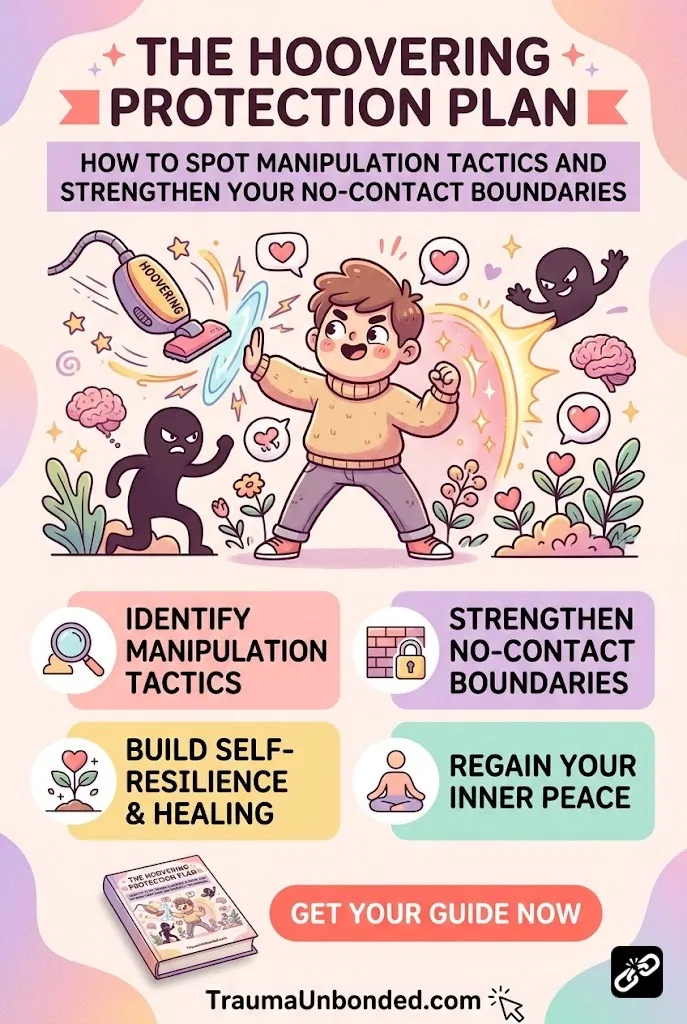
If you’ve been stuck in this cycle and want a structured way to break free, I put together something that walks you through exactly how to protect yourself step by step. You can find it here: The Hoovering Protection Plan.
How to Respond to Narcissist Hoovering (Step by Step)
Here’s what I wish someone had told me during year five of my relationship, instead of year thirteen. These are the strategies that actually work when a narcissist tries to pull you back.
1. Do not respond. Not even to say “leave me alone.” Any response, positive or negative, tells them the door is still open. Silence is the one language they cannot manipulate. I know how hard this is. Your fingers will hover over the keyboard. You’ll draft seventeen responses in your head. Let them all stay there.
2. Screenshot and save. Before you delete or block, take a screenshot. Not to reread later and spiral. But to remind yourself, on the hard days, that this is a pattern. When you doubt your decision months from now, you’ll have evidence that the cycle was still running.
3. Tell one trusted person immediately. Hoovering thrives in secrecy. The moment you share that text or voicemail with a therapist, a friend, or even a support group, you break the spell. You let someone else’s clear eyes see what your trauma bonded brain cannot.
4. Block every avenue. Phone, email, social media, gaming platforms, Venmo, LinkedIn. Yes, even LinkedIn. If you think “they wouldn’t reach out through that,” you’re underestimating how creative a narcissist can be when they’re losing their supply.
5. Reinforce your no contact commitment. Write down why you left. Read it every morning if you need to. Tape it to your bathroom mirror. I had a note on my fridge for six months that said “Remember January.” That was the month things got bad enough for me to finally leave. That note saved me from responding more times than I can count.
What Happens When You Don’t Respond to Hoovering
This is the part most people don’t talk about. When you successfully ignore a hoover, the narcissist’s behavior often escalates before it stops. They might send more messages. They might show up places they know you’ll be. They might try the “concerned friend” approach through someone in your circle.
This is called an extinction burst. It’s the same thing that happens when you stop feeding a vending machine quarters and it starts rattling. The behavior gets louder before it dies down. Knowing this in advance is half the battle. You are not doing something wrong. You are doing it exactly right. The discomfort is proof.
In my experience, the hoovering attempts came in waves. The first was about two weeks after I went no contact. The second was around the six-week mark. The third was on my birthday. Each time, I didn’t respond. And each time, the pull got a little weaker. Not because they stopped trying, but because I was changing. My nervous system was starting to regulate. My brain was starting to build new pathways that didn’t lead back to them.
Protecting Yourself Long Term After Narcissistic Hoovering
Surviving a hoover isn’t just about getting through the moment. It’s about building a life that is so grounded, so full of your own identity, that their attempts barely register anymore. That takes time. It took me the better part of two years after a 12-year relationship to get there.
Therapy helped me understand my codependency patterns and why I was so susceptible to hoovering in the first place. Journaling helped me track my emotional triggers. Reconnecting with old friends, the ones I’d been isolated from for years, reminded me who I was before the relationship swallowed me whole.
You don’t have to have it all figured out today. You just have to not respond today. And then again tomorrow. And the day after that. Each day of silence is a brick in the wall you’re building around your peace.
If you’re in the middle of this right now, wondering how to stop a narcissist from hoovering you back in, wondering if their “I’ve changed” text is real this time, wondering if you’re being too harsh by staying silent, let me tell you what I needed to hear: You are not being harsh. You are being safe. And if you want a complete framework for blocking every manipulation angle they might use, The Hoovering Protection Plan will walk you through it with scripts, checklists, and boundaries you can implement tonight.

Meet Your Guide
Helen Brooks
After surviving a 12-year NPD/BPD relationship, I dedicated over a decade to studying trauma bonding and nervous system recovery. My mission is to help you break free from the fog and reclaim your authentic self.
Ready to break the trauma bond and reclaim your life?