How to Stop Ruminating and Replaying Arguments in Your Head
You know that moment when you’re standing in the shower, and suddenly you’re back in that argument from three weeks ago? Your heart starts racing. You’re saying all the right things this time. You’re proving your point. You’re winning. Except none of it is real. I spent years trapped in this mental prison after leaving my relationship with someone who had both narcissistic and BPD traits. The arguments never truly ended because I kept them alive in my head, replaying them over and over like a broken record I couldn’t turn off.
This constant mental replaying isn’t just annoying. It’s exhausting. It steals your energy, ruins your sleep, and keeps you emotionally chained to someone who might not even be thinking about you anymore. After 12 years in that relationship, my brain was wired to anticipate conflict, defend myself constantly, and search for answers that would never come. Learning to stop ruminating became one of the most important parts of my healing journey. If you’re reading this while your mind is spinning through yet another imaginary conversation, I want you to know there’s a way out. I found it, and so can you. You can explore more practical strategies to break free from obsessive thoughts here.
Why Your Brain Won’t Let Go of Past Arguments

Your brain isn’t broken. It’s trying to protect you. When you’ve been in a relationship where reality was constantly questioned, where you were blamed for things you didn’t do, or where emotional explosions came out of nowhere, your mind goes into overdrive trying to make sense of the chaos. Rumination is your brain’s desperate attempt to find patterns, prepare for the next attack, or figure out what you could have done differently to prevent the pain.
During those 12 years, I became a master at mental gymnastics. Every conversation was analyzed. Every facial expression was studied. I’d lie awake at night reconstructing entire days, searching for the moment things went wrong. My therapist explained that this is a trauma response. When you’re subjected to gaslighting, which means having your reality constantly denied or twisted, your brain tries to hold onto the truth by reviewing it obsessively.
The other piece of this puzzle is unfinished business. Arguments with people who have narcissistic or BPD traits rarely end with resolution. There’s no closure. No apology. No acknowledgment of your pain. Your mind keeps reopening the case because it never got a verdict. It’s looking for justice in a courtroom that doesn’t exist.
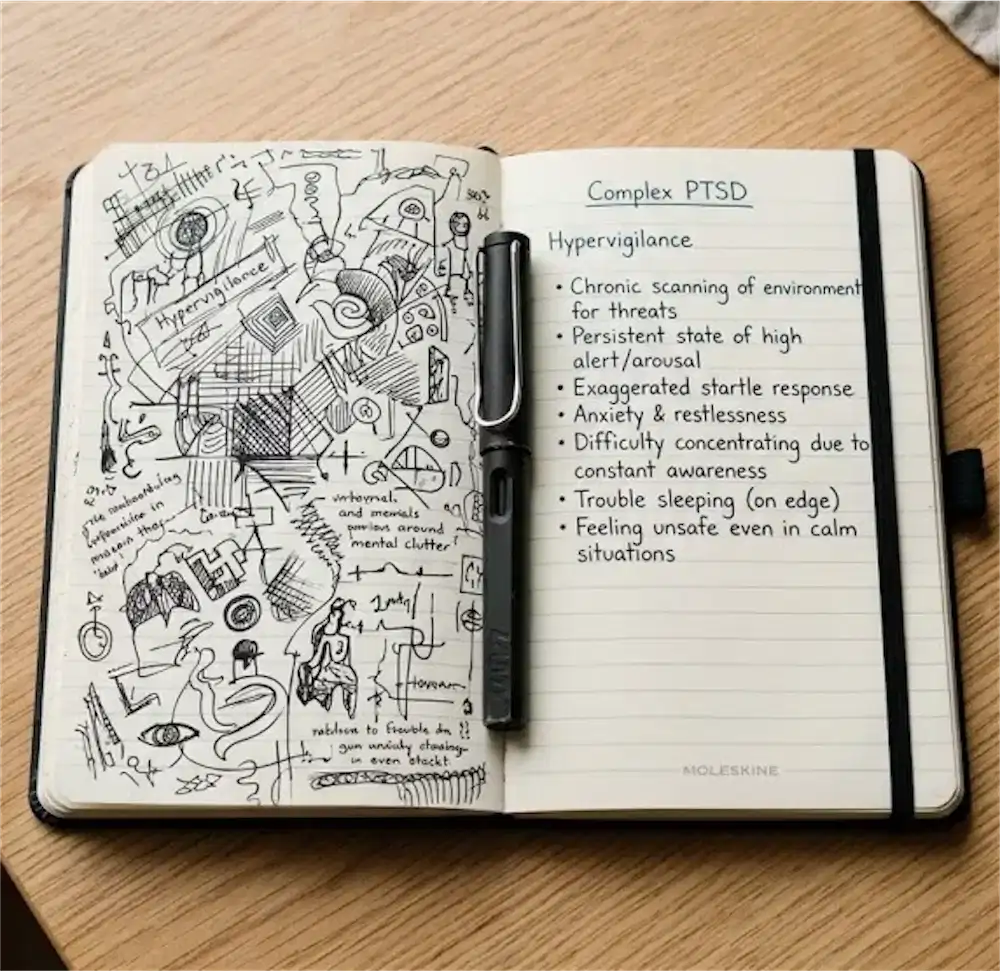
What really happens is your nervous system gets stuck in hypervigilance. Even after the relationship ends, your body and mind remain on high alert, constantly scanning for danger and replaying scenarios to be better prepared next time. This isn’t weakness. This is what happens when you survive something that required constant vigilance just to get through each day.
The Real Cost of Mental Replays
Let me tell you what rumination stole from me. It took my sleep first. I’d be exhausted but the moment my head hit the pillow, the arguments would start. Then it took my concentration. I couldn’t read a book or watch a movie without my mind drifting back to those conversations. It took my joy. Even good moments were interrupted by intrusive thoughts about what I should have said or done differently.
The physical symptoms were real too. My shoulders were constantly tight. I’d clench my jaw so hard I cracked a tooth. My stomach was a mess. Chronic stress from rumination floods your body with cortisol, keeping you in a state of fight or flight even when you’re supposedly safe. I was gaining weight, breaking out, and feeling exhausted no matter how much I slept.
But the worst part? Rumination kept me emotionally tied to someone who had hurt me deeply. Every mental replay was like pulling the wound open again. I wasn’t healing. I was rehearsing my pain. I was giving free rent in my head to someone who had already taken so much from me.
It also distorted my perception of myself. The more I replayed those arguments, the more I started believing the negative things said about me. I began to internalize the blame, the criticism, the accusations. My self-worth crumbled a little more with each mental replay.
Interrupt the Pattern Before It Takes Hold
Here’s what I learned from my therapist and through painful trial and error. You cannot stop rumination by thinking your way out of it. You have to interrupt the physical pattern. The moment you notice yourself slipping into a mental replay, you need to do something that brings you back into your body and the present moment.
I started carrying an ice cube in my pocket during the worst days. When I felt myself starting to ruminate, I’d squeeze it. The shock of cold would snap me back to reality. Some people use a rubber band on their wrist and snap it gently. Others splash cold water on their face. The method doesn’t matter as much as the interruption itself.
Grounding techniques became my lifeline. The 5-4-3-2-1 method works wonders. Name five things you can see, four you can touch, three you can hear, two you can smell, and one you can taste. It forces your brain out of the past and into the now. I did this so many times in the first months after leaving that it became automatic.
Movement is another powerful interrupter. When your body moves, especially in rhythmic patterns, it helps regulate your nervous system. I couldn’t afford a gym membership when I first left, so I’d just walk. Fast. Sometimes I’d walk for an hour, and by the time I got home, the rumination loop had loosened its grip. You don’t need fancy equipment. You just need to get your body involved in breaking the mental pattern.
If you find yourself ruminating while trying to fall asleep, don’t fight it lying down. Get up. Change your environment. Do something mundane like organizing a drawer or making tea. Breaking the physical pattern helps break the mental one. You can find more strategies for managing trauma-related insomnia here.
Write It Down and Let It Go

This sounds too simple to work, but it does. When you’re stuck in a rumination loop, your brain is trying to process something it can’t make sense of. Expressive writing gives those thoughts somewhere to go instead of circling endlessly in your mind. I filled dozens of notebooks in the first year after leaving.
But here’s the key. Don’t just write about what happened. Write the things you wish you’d said. Write your anger. Write your confusion. Write the questions you’ll never get answers to. Then, and this is crucial, close the notebook and do something physical to signal to your brain that this processing session is over. I’d wash my hands with really cold water. It became my ritual.
Some people burn the pages afterward. Others lock them in a drawer. The act of containing the thoughts physically helps your mind stop recycling them. You’ve given them form. You’ve acknowledged them. Now they don’t need to keep screaming for your attention inside your head.
I also started writing letters I’d never send. Letters telling my ex exactly what I thought. Letters explaining my side. Letters asking why. Letters saying goodbye. Writing them gave me the closure conversation I was never going to get. It didn’t matter that no one would read them. My brain didn’t know that. It just knew I’d finally said what needed to be said.
One practice that really helped was creating specific time for rumination. I know that sounds backward, but it works. Tell yourself you can think about all of this, but only during your designated 20 minutes at 3pm. When intrusive thoughts come at other times, remind yourself you have a scheduled time for them later. Your brain learns it doesn’t need to be on constant alert because there’s a safe space to process.
Understand What You’re Really Searching For
After months of therapy, I realized something that changed everything. I wasn’t actually trying to win those old arguments. I was searching for evidence that I mattered. That my feelings were valid. That I wasn’t crazy. The rumination wasn’t about the specific words exchanged. It was about trying to prove to myself that I deserved better treatment than I received.
Once I understood this, I could address the real need. Instead of replaying the argument, I started asking myself what I was really looking for. Usually it was validation, reassurance, or proof that I wasn’t the problem. Then I’d try to give that to myself directly instead of searching for it in mental replays of the past.
I’d literally speak out loud to myself. “You’re not crazy. What happened was real. Your feelings made sense.” It felt ridiculous at first, but it worked better than a thousand imaginary arguments ever did. I was the only person who could give me the closure I needed, and rumination was just a painful detour that kept me from that realization.
Sometimes rumination is also about safety. If you can figure out what you did wrong, you can avoid being hurt that way again. But here’s the truth I had to accept. There was nothing I could have said or done differently that would have fundamentally changed the outcome. The problem wasn’t my words or actions. The problem was the dynamic itself, the patterns that existed regardless of my perfect responses.
Understanding that the relationship itself was the issue, not my performance in arguments, helped me stop searching for the magic words that would have fixed everything. There were no magic words. No perfect explanation. No flawless defense. Accepting this was painful but ultimately freeing.
Get Support That Actually Understands
If you’ve tried to explain rumination to someone who hasn’t experienced narcissistic or BPD abuse, you know how isolating it feels when they say “just stop thinking about it” or “why do you keep bringing this up?” They don’t understand that this isn’t a choice. It’s a symptom of what you survived.
Finding a trauma-informed therapist was the turning point for me. Not just any therapist. One who specifically understood complex trauma, narcissistic abuse, and how these relationships rewire your brain. They didn’t tell me to just let it go. They helped me understand why my brain was doing this and gave me actual tools to interrupt the patterns.
Support groups, whether online or in person, also made a huge difference. Hearing other people describe the exact same mental loops I was experiencing helped me feel less alone and less broken. We’d share strategies that worked. We’d validate each other’s experiences. We’d remind each other that healing isn’t linear and rumination doesn’t mean you’re failing.
I also had to distance myself from people who kept asking me to explain or justify my decision to leave. Every time I had to defend my choice, I’d end up ruminating for days afterward. Setting boundaries with well-meaning but unhelpful people was essential. I learned to say “I’m not discussing this anymore” and actually mean it.
Sometimes professional help means medication, and that’s okay too. My doctor explained that my brain chemistry had been affected by years of chronic stress. An SSRI helped calm the constant mental chatter enough that I could actually practice the other techniques. It wasn’t a forever solution, but it was a bridge that got me through the worst of it.
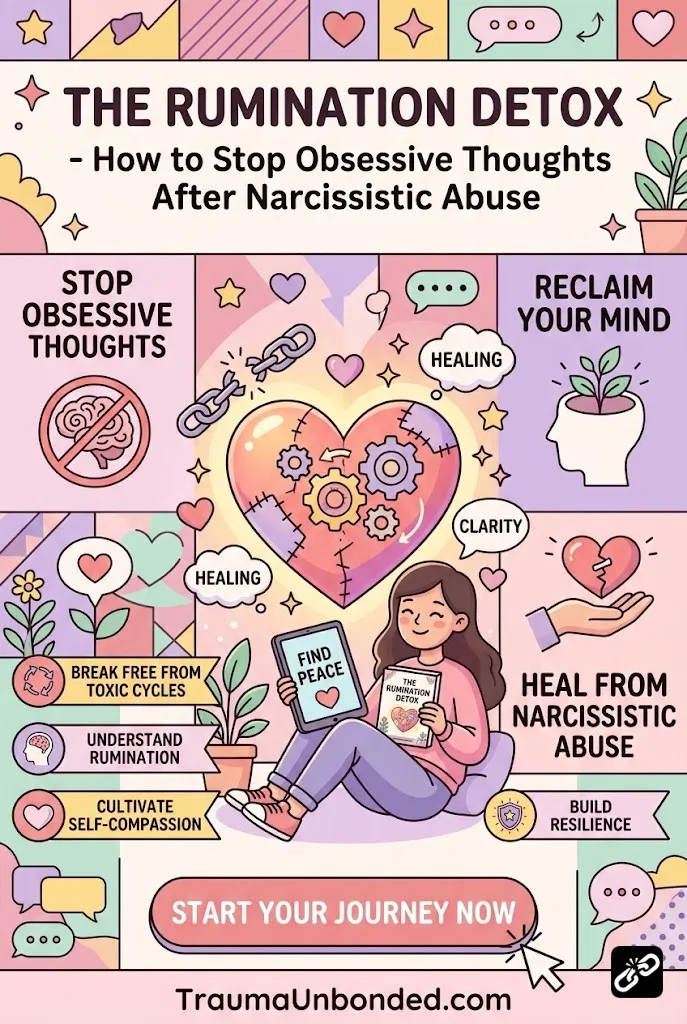
Structured Support to Break Free From Mental Loops
Breaking the cycle of rumination requires more than willpower. It needs specific, targeted strategies that address the root causes of obsessive thinking. Many survivors find that having a structured approach helps them regain control over their thoughts and start healing from the mental exhaustion that comes with constant replaying of painful interactions.
Replace the Mental Replay With Something New
Your brain has carved deep grooves for these rumination patterns. You can’t just erase them. You have to create new, stronger patterns that your mind will choose instead. This takes time and repetition, but it works. I had to train my brain like I was teaching it a new language.
When I caught myself starting to ruminate, I’d deliberately redirect to a detailed memory of something good. Not just “think positive thoughts” but actual, specific, sensory-rich memories. I’d remember the feeling of my dog’s fur under my hand, the taste of really good coffee, the sound of my friend’s laugh. The more detailed and sensory the replacement thought, the more effectively it interrupted the rumination.
I also created what I called my mental playlist. Instead of letting my brain default to argument replays, I’d mentally go through the lyrics of my favorite song, or replay a comedy special I’d memorized, or plan out a recipe step by step. These weren’t just distractions. They were deliberate neural pathway redirections.
Another strategy that helped was building what my therapist called “incompatible activities.” Things you literally cannot do while ruminating. For me, this was playing a musical instrument I was learning. I couldn’t replay arguments while trying to figure out chord progressions. The mental energy went to something that required my full attention.
Puzzle games worked this way too. Sudoku, crosswords, even video games that required problem solving. My brain couldn’t be in two places at once. The more I filled my mental space with things that demanded attention, the less room there was for rumination to take hold.
Give Yourself Credit for Small Wins
Recovery from rumination isn’t a straight line. Some days you’ll catch yourself five minutes into a mental replay. Other days you’ll spiral for hours. Both are part of the process. What matters is that you notice and you try again. I had to learn to celebrate the small victories instead of beating myself up for the setbacks.
The first time I successfully interrupted a rumination loop after only two minutes instead of two hours, I literally gave myself a high five. It sounds silly, but acknowledging progress, no matter how small, reinforces the new neural pathways you’re building. Your brain responds to reward.
I started keeping a simple tally. Every time I successfully interrupted rumination, I’d mark it down. Seeing those marks accumulate was tangible proof that I was getting better at this, even when it didn’t feel like it. Some weeks I had more marks than others. That was okay. The trend over months was what mattered.
Be patient with yourself. I spent 12 years in that relationship. My brain didn’t rewire overnight. Some experts say it takes about half the length of the relationship to fully heal. That seemed impossibly long when I first heard it, but looking back, giving myself that timeline actually helped. I stopped expecting to be “fixed” in three months and started viewing this as the long game it actually is.
There will be triggers that bring the rumination back even after you think you’re past it. A song. A place. An anniversary. When that happens, don’t see it as failure. See it as information. Your nervous system is telling you there’s still something that needs attention and care. You can learn more about managing triggers and flashbacks here.
Reclaim the Energy You’ve Been Giving Away
Every minute you spend ruminating is a minute you could be rebuilding your life. I don’t say that to make you feel guilty, but to highlight what’s at stake. That mental energy is yours. Those thoughts are taking up space that could be filled with plans, dreams, healing, connection, or even just peace and quiet.
When I finally started to break free from constant rumination, I was shocked by how much mental capacity I actually had. It was like upgrading from dial-up to high-speed internet. Suddenly I could focus on things I actually cared about. I could be present with friends. I could enjoy a meal without my mind wandering back to old arguments.
This isn’t about forgetting what happened or pretending it didn’t hurt. It’s about choosing where you direct your finite mental resources. The past will always be part of your story, but it doesn’t have to be the channel your brain is stuck on 24/7. You get to change the channel.
I started asking myself a simple question every time I caught myself ruminating: “Is this thought serving my healing or my suffering?” Usually it was serving my suffering. That realization made it easier to let go. Not immediately, not perfectly, but gradually. Small choice by small choice, I took back my mental space.
The silence that eventually replaced the constant mental noise was almost uncomfortable at first. I’d gotten so used to the chaos in my head that peace felt strange. But I learned to sit with it. To welcome it. To protect it. That quiet mind became something I valued more than almost anything else because I knew how hard I’d worked to find it.
Stopping the cycle of rumination and mental replays is one of the most important steps in reclaiming your peace after narcissistic or BPD abuse. It takes practice, patience, and often professional support, but it is absolutely possible. Your mind doesn’t have to be a prison where you’re forced to relive your worst moments on an endless loop. You deserve mental freedom, and with the right tools and commitment, you can find it. For additional comprehensive support in breaking these patterns, explore the full guide to stopping obsessive thoughts and reclaiming your mental peace.

Meet Your Guide
Helen Brooks
After surviving a 12-year NPD/BPD relationship, I dedicated over a decade to studying trauma bonding and nervous system recovery. My mission is to help you break free from the fog and reclaim your authentic self.
Ready to break the trauma bond and reclaim your life?