Toxic Family Dynamics: How to Stop Trying to Fix Them
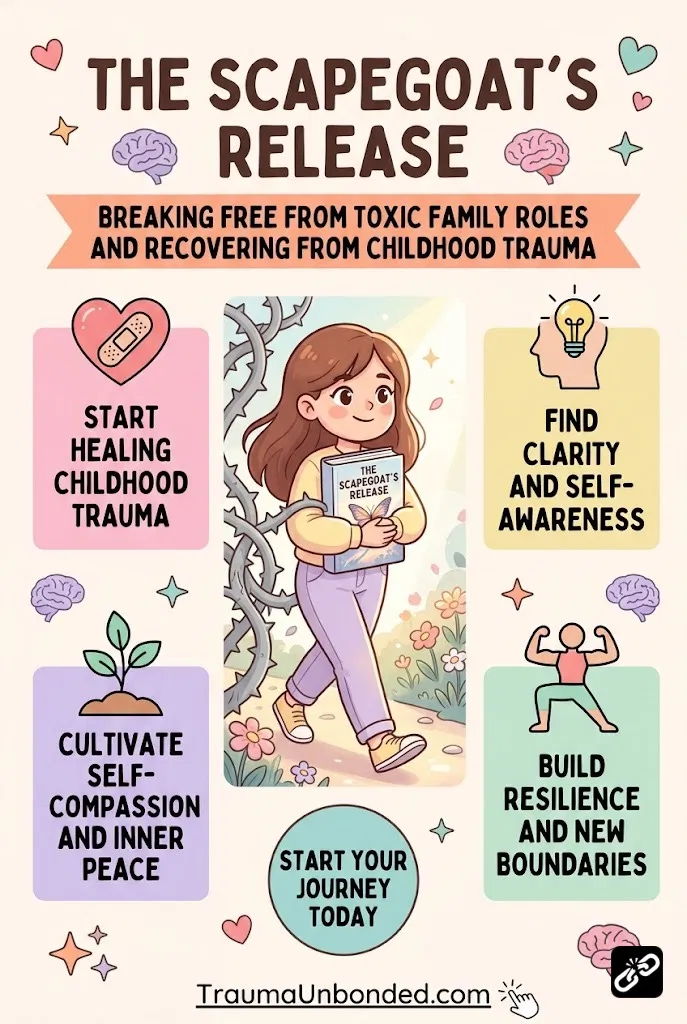
Healing from toxic family dynamics often starts with a painful realization: you cannot love someone into being a healthy person. If you grew up in a home where you had to manage everyone else’s moods, you likely carried that “fixer” role into your adult relationships. I spent twelve years in a relationship with a partner who showed both narcissistic and borderline traits, and for a long time, I thought if I just worked harder, I could repair the damage. It took losing my friends, my hobbies, and my sense of joy to realize that my obsession with fixing was a survival skill I learned as a child. If you feel trapped in this cycle, The Scapegoat’s Release can help you start the process of stepping out of those old, painful roles.
Why do we keep trying to fix people who do not want to change? In many families, the person who sees the dysfunction is the one tasked with carrying the emotional weight of the entire group. This is often called the family scapegoat or the “identified patient.” You might find yourself constantly apologizing for things you didn’t do or staying up late ruminating on arguments that never reach a resolution. Does it feel like you are speaking a different language when you try to explain your feelings to your parents or siblings? That disconnect is not a lack of communication on your part; it is a fundamental difference in how toxic people process reality.
Living through a decade of emotional abuse taught me that the urge to fix is actually a form of trauma bonding. We think that if we can just find the right words or the perfect boundary, the other person will finally have an epiphany and treat us with respect. In reality, toxic people use our desire for harmony as a weapon against us. They know we will keep coming back to try again, which gives them more opportunities to use gaslighting to make us doubt our own memories. When you stop trying to fix them, you finally have the energy to start fixing your own life.
Understanding the Fixer Role in Toxic Families

The “fixer” is usually the most empathetic person in the family. You probably learned very early how to read the room, noticing the slight shift in a parent’s tone or the way a sibling’s silence felt heavy with impending anger. This is hypervigilance, and while it kept you safe as a child, it is exhausting as an adult. You might find yourself over-explaining your boundaries or trying to “translate” for family members who are fighting. Have you ever noticed how you feel physically sick before a family gathering? That is your body telling you that the fawn response is about to take over.
In my twelve year relationship, I was the master of emotional labor. I thought that by being the “stable” one, I could balance out my partner’s volatility. I did the same thing with my family of origin, acting as the bridge between people who refused to be mature. This behavior is a cornerstone of narcissistic family roles where everyone is assigned a job to keep the toxic system functioning. The fixer’s job is to ensure the “elephant in the room” is never talked about directly, which only serves to protect the abuser while the fixer burns out.
Stopping the fixing cycle requires you to accept radical honesty about who these people actually are, not who you wish they were. You have to mourn the relationship you wanted so you can deal with the one you actually have. When you stop protecting them from the consequences of their actions, you will likely see an increase in their hostility. This is a common reaction when a toxic system loses its most reliable engine. They don’t want you to be healthy; they want you to be useful.
The Exhaustion of Unrequited Emotional Labor
Have you ever felt like you are the only person in the room who cares about the truth? In toxic family dynamics, truth is often secondary to the ego of the dominant personality. If you try to bring up a past hurt, you are met with “that never happened” or “you’re too sensitive.” This is gaslighting in its purest form. After a decade of this, I felt like a shell of a person. I had no hobbies left because my “hobby” was managing my partner’s crises and my family’s drama. I was isolated from friends because explaining my life felt too shameful and complicated.
The cost of this emotional labor is high. It manifests as chronic stress, brain fog, and a constant feeling of dread. You might struggle with low self-worth because you have tied your value to your ability to “solve” other people. But how can you solve someone who benefits from being broken? Many toxic individuals use their “problems” to gain narcissistic supply or attention. When you “fix” a problem for them, they just find a new one to keep you hooked in the cycle of intermittent reinforcement.
Breaking this pattern means you have to learn how to stop fixing toxic family members and start investing that energy into yourself. I remember the first time I stayed silent during a family argument instead of trying to mediate. It felt terrifying, like I was breaking a sacred rule. But the world didn’t end. They just found someone else to yell at, and I realized I had been a volunteer for a war I didn’t start. You are allowed to retire from a role you never applied for.
If you have spent your life trying to bridge the gap between toxic relatives and reality, you are likely carrying a heavy burden of unhealed childhood trauma. To truly reclaim your peace and stop the cycle of people-pleasing, you need a structured plan to step out of those assigned roles for good.
Recognizing You Cannot Change Them
Accepting that you cannot change your family is the hardest part of the recovery journey. We often think that if we find the perfect article, the perfect therapist, or the perfect analogy, they will finally “get it.” But toxic dynamics are not a misunderstanding. They are a power structure. In my experience, the person with NPD or BPD traits isn’t looking for a solution; they are looking for a scapegoat to carry their shame. When you stop being that scapegoat, the system has to adjust, which often looks like a smear campaign or a period of the silent treatment.
Do you find yourself rehearsing conversations in your head, hoping that this time you will finally be heard? This is a sign of trauma-based rumination. You are trying to solve a puzzle that has missing pieces on purpose. Toxic family members rely on the lack of closure to keep you engaged. If they actually listened and changed, the game would be over, and they would lose their control. Recognizing this is a “lightbulb moment” that feels both liberating and devastating. It means the relationship you wanted never truly existed.
When I finally walked away from my toxic relationship and set firm boundaries with my family, I felt like I was waking up from a dream. I had spent so many years walking on eggshells that I forgot how to walk normally. You might feel a sense of survivor’s guilt for leaving the “battlefield,” but remember that you were never the commander. You were just a soldier being sent into a fight that had no win condition. The only way to win is to stop playing the game.
Setting Boundaries vs. Cutting Ties

There is a lot of talk about no contact, but that isn’t always the first step for everyone. Sometimes, you start with low contact or the grey rock method. This means becoming as uninteresting as a pebble. You don’t share your wins, you don’t share your losses, and you certainly don’t share your opinions on their behavior. You stop being the “emotional ATM” they go to for a withdrawal. Does this feel cold? Perhaps. But in a toxic family environment, warmth is often exploited and used against you later.
Boundaries are not for the other person; they are for you. A boundary isn’t saying “You can’t talk to me like that.” A boundary is saying “If you talk to me like that, I am hanging up the phone.” It is about your actions, not their permission. During my recovery, I had to learn that guilt is a compass. If I felt guilty for saying “no,” it usually meant I was doing something healthy for myself that went against the toxic family rules. Lean into that discomfort; it is the feeling of your original self coming back to life.
If you find that boundaries are constantly ignored or mocked, you may need to consider estrangement. This is a heavy decision and one that I didn’t take lightly. But after twelve years of being gaslit and devalued, I realized that my sanity was worth more than a title like “daughter” or “partner.” You cannot heal in the same environment that made you sick. Sometimes, the most loving thing you can do for yourself is to walk away and never look back.
Reclaiming Your Identity After the Fixer Role
What do you actually like to do? This was a question I couldn’t answer for a long time. When you stop trying to fix others, you are left with a lot of empty space in your life. This space can feel lonely at first, but it is actually the fertile ground where your true self can grow. I started small. I picked up a book I liked. I went for walks without checking my phone for “crisis texts.” I slowly rebuilt my social circle with people who didn’t require me to be their therapist. You are more than a caretaker or a mediator.
Recovery from narcissistic and BPD abuse is not a straight line. You will have days where you want to reach out and “fix” things one more time. You might miss the chaos-driven dopamine hits that come with a toxic family. This is normal. Your brain is essentially detoxing from a biochemical addiction to the highs and lows. Be gentle with yourself during this time. You are unlearning decades of programming that told you your needs didn’t matter.
Today, I am back to being the cheerful, grounded person I was before the twelve year storm. I no longer feel the urge to explain myself to people who are committed to misunderstanding me. I have learned that my peace is a non-negotiable asset. You deserve a life where you aren’t constantly braced for impact. You deserve to be seen for who you are, not for what you can do for someone else. The first step to that life is putting down the tools you’ve been using to try and fix the unfixable. If you’re ready to stop carrying the weight of your family’s dysfunction, I highly recommend looking into The Scapegoat’s Release to guide you through the process of letting go and finding your voice again.

Meet Your Guide
Helen Brooks
After surviving a 12-year NPD/BPD relationship, I dedicated over a decade to studying trauma bonding and nervous system recovery. My mission is to help you break free from the fog and reclaim your authentic self.
Ready to break the trauma bond and reclaim your life?