High-Conflict Divorce: How to Document Abuse for Family Court
Navigating a high-conflict divorce requires you to meticulously document abuse for family court if you hope to protect your children and your sanity. Many survivors struggle during this transition because they do not know how to gather court-admissible evidence of emotional abuse or handle the ongoing trauma of post-separation coercive control. When you are up against a hostile ex-partner, the court does not run on feelings or private pain; it runs on hard, verifiable facts.
Having survived a grueling twelve-year relationship with a partner who exhibited severe narcissistic and borderline traits, I know exactly what it feels like to stand on the edge of this legal cliff. I remember sitting at my kitchen table, completely isolated from my friends, without any hobbies left, feeling like my life was entirely miserable. Rebuilding my life required professional therapy and learning how to present a clean, undeniable paper trail to a judge who had no previous knowledge of our family dynamics.
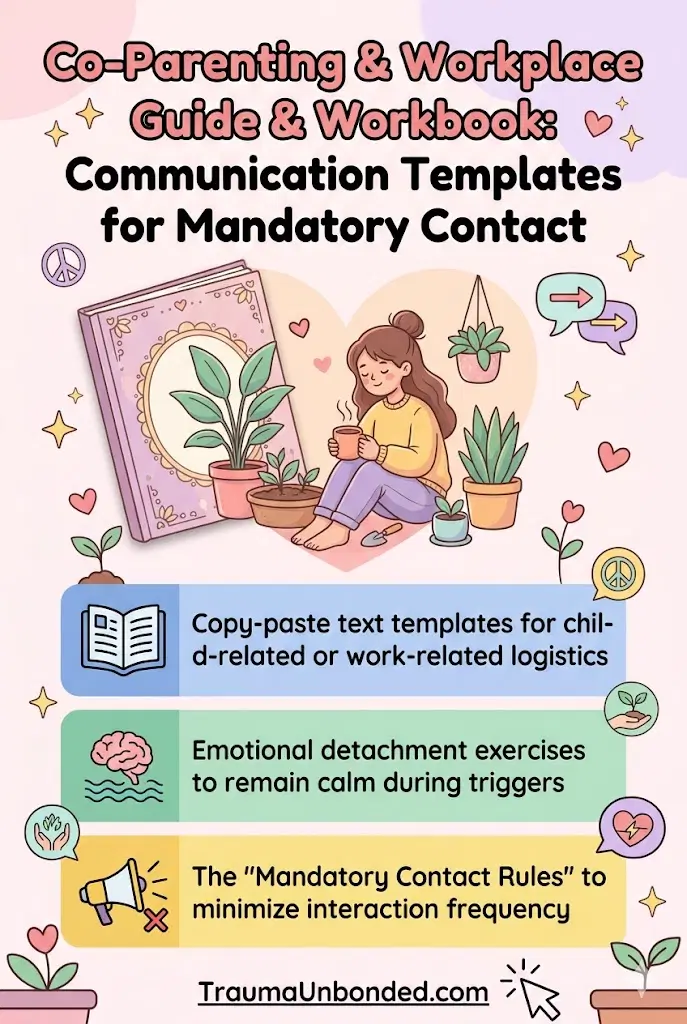
When I was in the thick of my custody battle, I realized that my communication was constantly being twisted against me in hearings. Using structured templates from resources like the Co-Parenting & Workplace Guide & Workbook was what finally helped me establish firm boundaries and stop the endless cycle of retaliatory emails. Let us look at how you can build a strong case while keeping your sanity intact.
How Do You Document Abuse for Family Court in a High-Conflict Divorce?
To document abuse for family court, compile a meticulous, chronological record of all text messages, emails, and financial statements in a secure cloud folder, accompanied by a detailed daily log. This objective paper trail shifts the courtroom focus from emotional hearsay to undeniable, verifiable facts.

In a high-conflict custody battle, your personal journal is not enough on its own. Judges need to see patterns of behavior rather than isolated incidents of marital bickering. It is easy to make critical errors when you are in survival mode, which is why learning about the common mistakes leaving a narcissist to avoid before you start filing can save you years of legal frustration.
To establish a clear pattern of emotional manipulation, you must categorize your evidence systematically. Do not dump hundreds of unorganized screenshots on your attorney, as this drives up billing hours and dilutes your message. Instead, focus on gathering these specific types of high-value evidence:
- Written communication: Export entire email threads and text conversations as PDF files, ensuring dates, times, and contact information are fully visible.
- Financial transactions: Save bank statements showing sudden withdrawals, hidden accounts, or instances where support was withheld to force compliance.
- Third-party documentation: Collect school attendance records, pediatric report cards, and police reports that offer neutral proof of your ex-partner’s conduct.
- A detailed incident log: Maintain a spreadsheet noting the date, time, brief description of the event, and the specific file name of the supporting evidence.
Why is this level of detail necessary? Because toxic personalities are masters of presenting a polished, charming facade in public. Without a rigid, objective paper trail, your hearings can quickly devolve into a mutual blame dynamic where the judge assumes both parties are equally responsible for the chaos. In my twelve-year toxic relationship, my ex-partner would switch from intense attachment to severe splitting within hours, but in court, these patterns looked like simple marital arguments until I showed their relentless frequency.
If you are struggling to communicate with a high-conflict ex-partner without triggering explosive arguments, you need clear, proven scripts. The guide below provides the exact communication templates and boundary strategies necessary to protect your peace during legal proceedings.
Surviving Courtroom Gaslighting and Staying Grounded in the Waiting Room

One of the most destabilizing aspects of a custody battle is experiencing courtroom gaslighting. An abusive ex-partner will often present themselves as calm, logical, and deeply concerned for the children, while painting you as hysterical or uncooperative. During my own hearings, I watched my ex look the judge in the eye and spin completely fabricated stories with absolute poise, making me feel like my reality was disintegrating.
According to research on post-separation legal abuse in Psychology Today, courts frequently mislabel ongoing coercive control as simple mutual conflict. This systemic oversight makes it easy to feel defeated before you even step inside the courtroom. To counter this, you must learn to detach emotionally and let your organized documentation do the talking.
When waiting in the hallway or sitting at the witness stand, your primary job is to remain centered and unreactive. Surviving a divorce with a narcissist for your peace and sanity relies on your ability to show the judge that you are the stable, grounded parent. When they throw false accusations at you, take a deep breath, count to three, and refer directly to your physical evidence instead of arguing.
Establishing Parallel Parenting and Strict Digital Boundaries
Co-parenting with a highly manipulative individual is generally impossible because they use every exchange as a battleground. Transitioning to a strict parallel parenting model is often the only way to protect your household from ongoing stress. This means minimizing direct contact, keeping schedules entirely rigid, and establishing clear boundaries around how and when communication occurs.
How do you enforce these boundaries when the other party constantly attempts to pull you back into conflict? You restrict all non-emergency dialogue to a court-approved parenting application. By using these platforms, you ensure that every message is archived, cannot be deleted, and is easily exportable for legal review.
Keep your replies brief, informative, friendly, and firm. If your ex-partner sends an angry, ten-paragraph text accusing you of being a terrible parent, do not defend your character. Simply reply with the factual coordinate of the upcoming exchange time, leaving no room for emotional escalation.
Focusing on Your Long-Term Recovery
Stepping out of the storm of a high-conflict divorce takes time, patience, and a relentless focus on reality. While you are compiling records and coordinating schedules, remember that your ultimate goal is to build a peaceful, stable environment for yourself and your children. Once the legal dust settles and you no longer have to defend your every move, you will find that your original, cheerful self is still waiting for you.
If you are currently facing hostile communication and need immediate strategies to handle high-conflict exchanges, download the Co-Parenting & Workplace Guide & Workbook today. Having the right tools makes all the difference when protecting your boundaries and securing your future peace.

Meet Your Guide
Helen Brooks
After surviving a 12-year NPD/BPD relationship, I dedicated over a decade to studying trauma bonding and nervous system recovery. My mission is to help you break free from the fog and reclaim your authentic self.
Ready to break the trauma bond and reclaim your life?