How Morning Pages Help Process Trauma and Break a Toxic Trauma Bond
For the first several months after leaving my twelve-year relationship, I couldn’t journal. I would open a blank notebook, stare at it, and feel completely frozen. Everything I tried to write came out either flat and detached, like I was describing someone else’s life, or so overwhelming that I’d slam the notebook shut and pace the room for twenty minutes.
Structured prompts helped sometimes. But on the bad days, even those felt like assignments I couldn’t complete.
Then a therapist introduced me to morning pages. Not as a creativity exercise, which is how most people know them, but as a trauma processing tool. Something to do with the noise inside my head before it had a chance to calcify into the same obsessive loops I’d been running on for months.
That practice, three handwritten pages every morning, ended up being one of the most consistently useful things I did during recovery. Not the most dramatic. Not the most therapeutic in any single session. But over time, more transformative than I expected.
This article breaks down exactly what morning pages are, what the research says about why they work for trauma specifically, and how to actually use them when your nervous system is still in survival mode.
What Morning Pages Actually Are (And What They Are Not)

Morning pages were originally introduced by Julia Cameron in her book The Artist’s Way as a tool for creative unblocking. The format is simple: three pages of longhand, stream-of-consciousness writing done first thing in the morning, before coffee ideally, definitely before checking your phone.
That’s it. Three pages. Every morning. By hand.
What makes morning pages different from regular journaling is the complete absence of structure, intention, or expectation. You are not processing a specific event. You are not answering a prompt. You are not trying to reach a conclusion. You write whatever comes out of your head, and if nothing comes out, you write “I have nothing to write” until something eventually does.
The goal is not to produce something meaningful. The goal is to externalize the internal noise before your rational mind has a chance to organize, suppress, or edit it.
What morning pages are not:
- A diary. You are not recording events.
- A gratitude journal. There is no positivity requirement.
- Therapy. They support therapy. They do not replace it.
- A creative writing exercise. Quality is completely irrelevant.
- Something you do “when you feel like it.” Consistency is the entire mechanism.
The handwriting part is not optional or nostalgic. Writing by hand activates different neural pathways than typing does. It slows the process down just enough for unconscious material to surface before the conscious, analytical brain filters it out. This distinction matters specifically for trauma work, and we’ll get into why shortly.
👉 The Artist’s Way by Julia Cameron on Amazon — the original source of morning pages, though I recommend reading it specifically as a trauma recovery tool rather than just a creativity manual.
Why a Trauma Bond Makes Normal Journaling Nearly Impossible
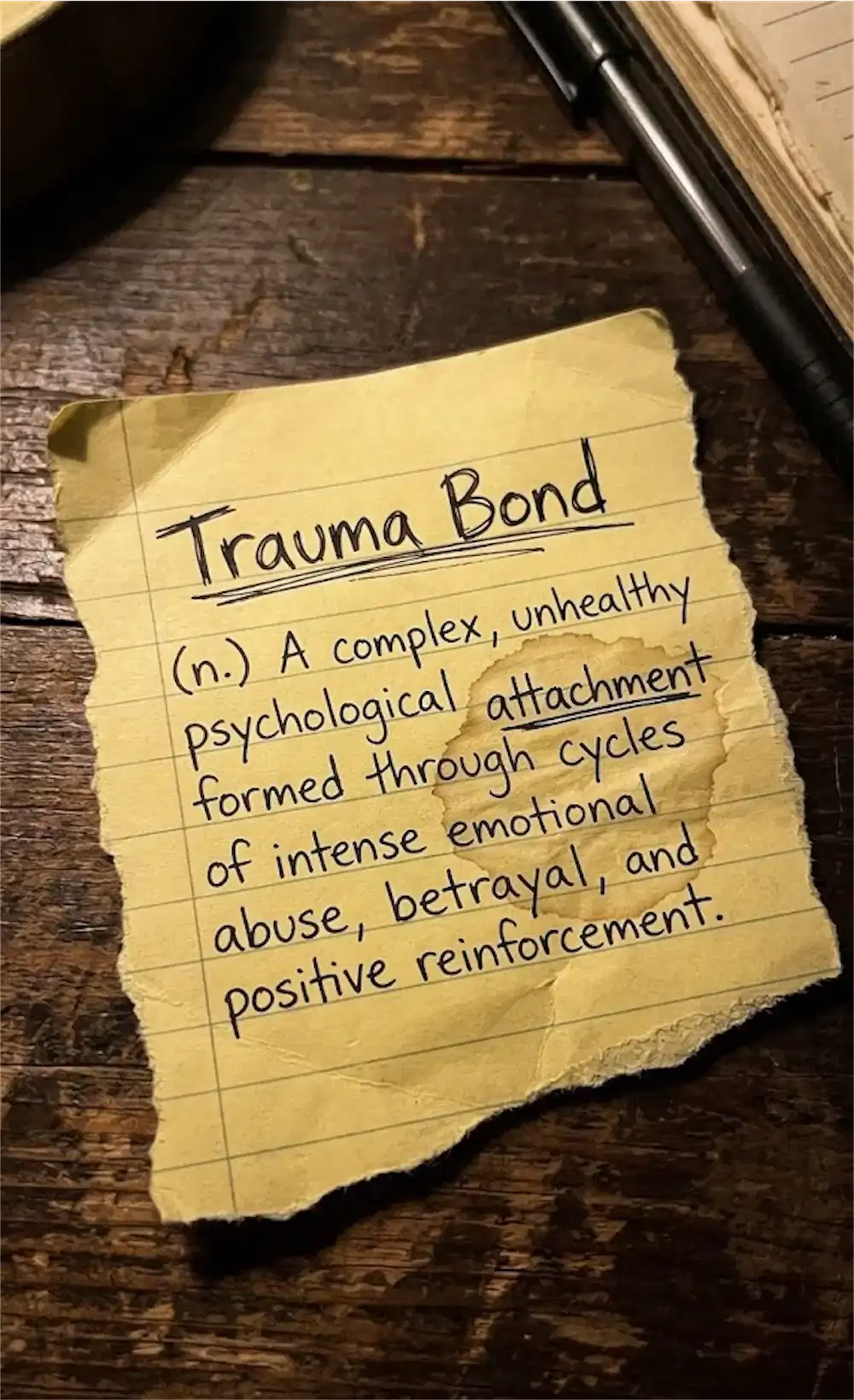
A trauma bond, in the simplest terms, is an emotional attachment that forms through cycles of abuse and intermittent positive reinforcement. The unpredictability of a BPD or NPD relationship, where affection and cruelty alternate in ways that feel completely random, conditions your nervous system into a hypervigilant state that affects everything, including your ability to access your own thoughts clearly.
Have you ever sat down to write about what happened in your relationship and immediately felt your mind go completely blank? Or found yourself writing the same circular loop over and over: “Maybe it was my fault. Maybe it wasn’t. I miss them. I hate them. I miss them”? That’s not a failure of journaling technique. That’s the trauma bond operating on your cognitive process.
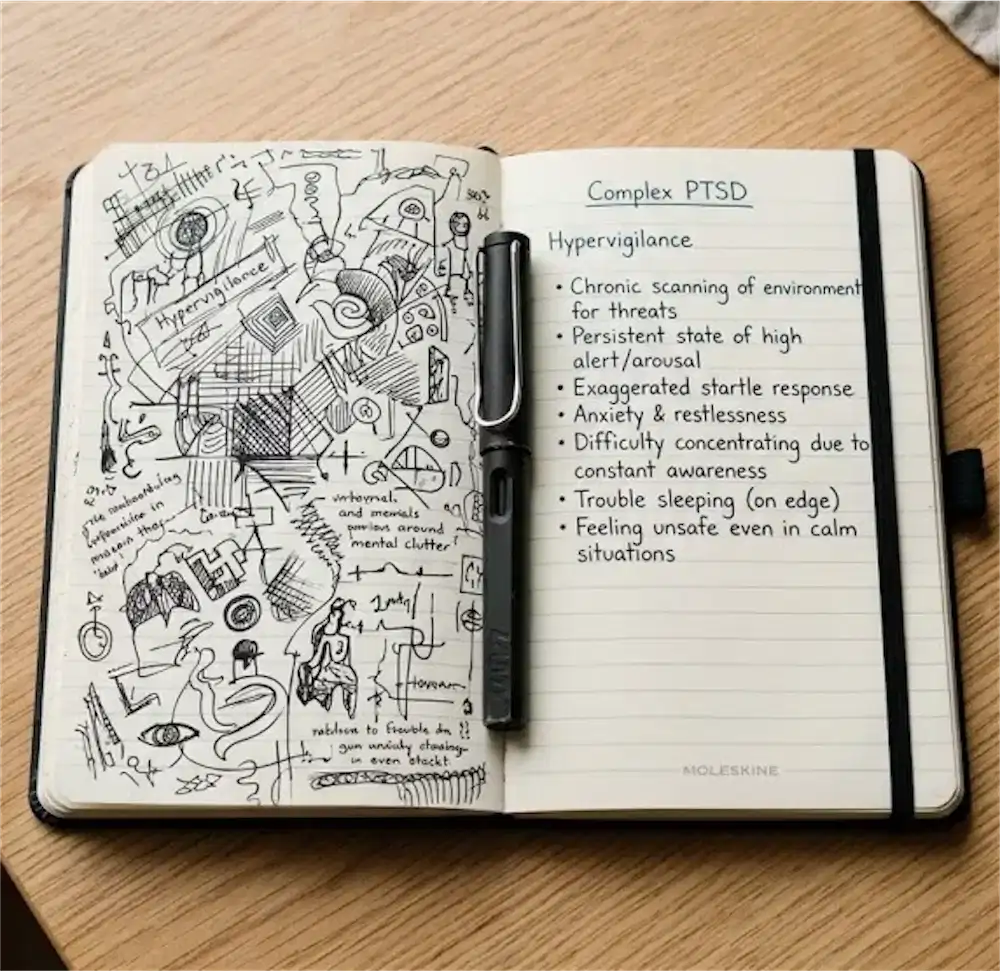
Here’s what’s happening neurologically. When you’ve spent years in a relationship defined by hypervigilance, your prefrontal cortex, the part of the brain responsible for self-reflection, narrative coherence, and emotional regulation, gets chronically suppressed by the stress response system. Your amygdala, the threat-detection center, is running the show. And you can’t think your way out of an activated amygdala using the same brain region that the amygdala is currently suppressing.
This is why structured journaling prompts can feel impossible on bad days. They require self-reflection, which requires prefrontal cortex access, which is exactly what trauma disrupts. You sit down to “process your feelings” and your brain simply cannot perform the operation you’re asking of it.
Morning pages work differently. They don’t ask you to reflect. They ask you to release. The distinction sounds subtle but in practice it changes everything about how accessible the exercise feels.
If you’ve been struggling with more structured approaches, it’s worth reading about journaling prompts specifically designed for post-narcissist breakup recovery. Those prompts are most useful once morning pages have cleared enough of the surface noise to make structured reflection possible.
The Neuroscience Behind Expressive Writing and Trauma Processing
The research behind expressive writing and trauma is not new, and it is not light. Dr. James Pennebaker, professor of psychology at the University of Texas at Austin, has spent decades studying the specific psychological and physiological effects of writing about emotionally significant experiences. His findings are among the most replicated in all of psychology.
In his foundational research, participants who wrote about their deepest thoughts and feelings regarding traumatic or difficult experiences showed measurable improvements in immune function, reduced physician visits, lower anxiety and depression scores, and improved long-term mood compared to those who wrote about neutral topics. These weren’t self-reported placebo effects. They were measurable biological changes produced by the act of putting emotional experience into written words.
Why does this happen? Pennebaker’s explanation, backed by subsequent neuroscience research, comes down to what happens when you convert raw emotional experience into language. The brain processes emotion in one region and language in another. When those two regions work together to construct a narrative around an emotional experience, it reduces the intensity of the emotional charge attached to that experience. In trauma terms, this is called narrative integration: moving a memory from raw, unprocessed sensation into a coherent story the brain can file and retrieve without triggering a full stress response.
A peer-reviewed study published in Frontiers in Psychology (2019) specifically looked at expressive writing in the context of C-PTSD and prolonged trauma exposure. The findings confirmed that regular expressive writing reduced intrusive symptoms, improved emotional regulation, and accelerated the development of a coherent trauma narrative, all of which are central challenges for people leaving long-term abusive relationships.
What makes morning pages an especially good vehicle for this kind of processing is that the absence of structure and the early-morning timing mean you are writing before your defenses fully activate. The material that surfaces in those first pages is often exactly the material you’ve been unconsciously avoiding during the more conscious parts of your day.
In my twelve years of that relationship, I had accumulated an enormous amount of unexpressed experience. Things I had talked myself out of feeling, minimized to keep the peace, or simply had no witness for at the time. Morning pages became the space where all of that started to move. Not dramatically. Not all at once. But consistently, over weeks and months, the volume of unprocessed material began to decrease.
How Morning Pages Specifically Help Break a Trauma Bond
Breaking a trauma bond isn’t primarily an intellectual project. You can understand exactly what a trauma bond is, why it forms, what neurochemicals are involved, and still feel pulled back toward the person who hurt you. Knowledge helps. But it rarely breaks the bond by itself.
What does break it is repeated, consistent contact with your own mind without the relationship organizing that contact.
Think about what the relationship did to your internal life. After years with a partner whose emotional instability demanded your constant attention, your own thoughts became background noise. Your needs, preferences, and inner experiences stopped being the thing you paid attention to. Someone else’s mood, volatility, or needs took center stage every single day.
Morning pages reverse this, slowly and without drama. Every morning you sit down and spend thirty to forty minutes in your own head, without interruption, without the relationship as the organizing frame. Over time, you begin to hear yourself again. Your own opinions start to feel louder than the internal voice that was conditioned to defer to your partner. Your own preferences start to emerge from the background.
Specific ways morning pages interrupt the trauma bond cycle:
- They externalize the obsessive loop: When the same thoughts about your ex are cycling on repeat, writing them out moves them from active mental processing to archived text. The brain registers that the loop has been “handled” in a way that pure rumination never allows.
- They build self-witnessing capacity: Long-term emotional abuse tends to collapse the observer function, the part of you that can notice what you’re thinking without being completely consumed by it. Writing rebuilds that capacity gradually.
- They create a record of your reality: After years of gaslighting, which means having your perception of reality consistently questioned or denied, having a daily written record of your own thoughts and experiences is genuinely grounding. You stop doubting your experience as easily when you have evidence of it.
- They interrupt morning hypervigilance: Many trauma survivors experience cortisol spikes on waking, those immediately-awake-and-anxious mornings where your mind is already running threat-detection before you’re fully conscious. Pages give that activated state somewhere to go.
- They slowly shift focus back to your life: As the weeks pass, the content of the pages naturally evolves. What starts as pages full of the relationship and the loss gradually includes more about your actual present-day life. This isn’t forced. It happens because you are finally paying attention to yourself again.
I noticed around week five or six that I had written two full pages about something completely unrelated to my ex before realizing it. That felt impossible in week one. That shift doesn’t happen through willpower. It happens because daily practice gradually rebuilds your inner life until your own experience becomes more interesting to your brain than the obsessive replay loop.
How to Start Morning Pages When Your Nervous System Is Still in Survival Mode

The logistics matter more than most people expect. When your nervous system is dysregulated, friction is the enemy. Any barrier between you and the practice is a barrier your depleted executive function will not always overcome. So set it up to be as frictionless as possible.
The Physical Setup
Get a dedicated notebook for morning pages and keep it somewhere visible near where you wake up. Not your laptop. Not a notes app on your phone. A physical notebook with a pen clipped inside. The choice of notebook matters less than you’d think, but something that feels pleasant to write in does help with consistency. A good-quality journal with lined or dot-grid pages is worth the small investment.
👉 Browse morning pages notebooks and journals on Amazon
The Timing
First thing in the morning means before your phone, before social media, before news, before email. The brain is still in a semi-liminal state between sleep and full wakefulness in the first thirty minutes of the day. That state is exactly when unconscious material is most accessible and when the internal critic is least active. Write in that window.
If you have a morning routine that starts with coffee or tea, that’s fine. But keep the pages early. The closer to waking, the better.
For a broader look at how to structure this into a recovery-supporting morning, the article on morning routines for NPD breakup recovery pairs well with what you’re building here.
The Rules (All Two of Them)
Rule one: three pages. Not two when you’re tired. Not one when it’s hard. Three. If you finish what you’re thinking about before you hit three pages, keep writing. Write about the room you’re sitting in, what you can hear, what you ate yesterday, what you’re dreading today. The continuity of the physical act matters as much as the content.
Rule two: don’t reread them. At least not for the first month. The benefit of morning pages comes from the act of writing, not from analysis of what you wrote. If you go back and read each entry critically, you’ll start subconsciously editing your writing toward what sounds good rather than what’s actually true. Let the pages be private, unread, and unpolished. That’s the point.
What to Do When You Hit a Wall
Some mornings, especially early in recovery, the pages will feel impossible. Your mind will be so flooded with emotion that words won’t form. Or so numb that there’s genuinely nothing there. Both of these are normal trauma responses, not signs that the practice isn’t working.
On those days, write: “I don’t know what to write. My mind is blank. I feel nothing. I feel everything. I don’t know how to start.” Keep going from there. What comes after that sentence is almost always more honest than what you’d have written if the words had come easily.
What the First 30 Days Actually Look Like
I want to be honest about the timeline because most accounts make it sound more immediately transformative than it actually is.
Week one: The pages will probably be mostly about the relationship. Grief, anger, confusion, missing them, hating yourself for missing them. This is not a problem. This is the material closest to the surface. Let it drain.
Week two: You might start to notice some repetition. The same themes surfacing again. This is actually useful: it tells you where the unprocessed material is concentrated. Don’t try to resolve the loops in the pages. Just write them again. The repetition itself is doing something.
Week three: For most people, something loosens slightly around here. It might be subtle. A morning where the pages include something mundane and real, something about your life as it actually is right now, not just the relationship you left. Notice it when it happens.
Week four onward: The practice starts to feel like a genuine container. You begin to look forward to it, or at least to rely on it. The anxiety of waking up feels slightly more manageable because you know you have thirty minutes to let the static out before you have to engage with the day.
By month two, if you’ve been consistent, the content of your pages will have changed noticeably from where they started. Not because the grief is gone, but because it has begun to share space with other things. With your life. With yourself.
Morning Pages vs. Structured Journaling: Which One You Need and When
These are not competing approaches. They do different things and they work well together when timed correctly.
Morning pages clear the surface. They drain the accumulated mental residue from the night and the recent past, giving you access to a quieter, clearer internal state by the time you finish. They are especially useful in the earlier, more acute phases of recovery when structure is impossible and the noise is loudest.
Structured journaling prompts go deeper. They work best once the surface has been somewhat cleared, because they require enough self-reflective capacity to actually respond to a question honestly. Using prompts when you’re in full activation is like trying to do a jigsaw puzzle during an earthquake. The tool is fine. The conditions aren’t right.
A practical approach: use morning pages as your consistent daily practice, and introduce structured prompts one or two evenings a week as a separate, distinct activity. The two practices will feed each other. What surfaces in the morning often illuminates what’s worth exploring more deliberately in an evening prompt session.
Evening as a recovery container has its own science. The article on evening routines for healing a trauma bond covers how to structure the later part of your day to support the nervous system regulation that makes both practices more effective.
One Thing Morning Pages Will Not Do
They will not make you feel better every day. Some mornings you will finish three pages and feel worse than when you started, because what came out was material that needed to be felt, not just written. That’s not failure. That’s the practice working correctly.
Trauma processing is not linear. There will be weeks where the pages feel like they’re helping enormously, followed by weeks where you feel like you’re regressing. You’re not. You’re working through layers. What’s surfacing in the difficult weeks is usually material that was too raw to approach in the easier ones.
The commitment is to the practice itself, not to how it makes you feel on any given morning. The transformation happens in the aggregate, over months, not in individual sessions.
I kept morning pages for almost fourteen months after my breakup. I still do them several times a week now, not out of necessity but out of genuine preference. They became a way of staying in contact with my own mind, something that felt impossible for most of a decade. That relationship with my own inner life turned out to be the thing most worth rebuilding.
Recommended Resources
These are the books and tools that deepened my understanding of writing as a healing practice. Each one is grounded in either psychological research or the direct experience of recovery from emotionally demanding relationships.
- Opening Up by Writing It Down by James W. Pennebaker and Joshua M. Smyth — This is the most research-grounded book on expressive writing and psychological healing. Pennebaker is the leading psychologist in this area, and this book translates decades of his clinical findings into practical, accessible guidance. If you want to understand why writing works at a scientific level, start here.
👉 Find it on Amazon - The Artist’s Way by Julia Cameron — The original source of morning pages, and still the most thorough guide to the practice and its effects. Cameron writes from a creative recovery perspective, but the psychological mechanisms she describes map directly onto trauma recovery. The twelve-week program structure is genuinely useful.
👉 Find it on Amazon - A quality dot-grid journal for morning pages — The physical tool matters more than people expect. Dot-grid pages give you structure without lines, which suits the freeform nature of morning pages well. A journal that feels good to write in reduces friction enough to protect your consistency on the hard days.
👉 Browse dot-grid journals on Amazon
Some links in this article are affiliate links. If you purchase through them, I may earn a small commission at no additional cost to you. I only recommend books and tools I have personally used or researched as part of my own recovery from long-term narcissistic and BPD relationship trauma.

Meet Your Guide
Helen Brooks
After surviving a 12-year NPD/BPD relationship, I dedicated over a decade to studying trauma bonding and nervous system recovery. My mission is to help you break free from the fog and reclaim your authentic self.
Ready to break the trauma bond and reclaim your life?