The Covert Narcissist Mother: Unveiling the Subtle Abuse That Shapes a Life
The toxic legacy of a covert narcissist mother is often the silent blueprint that shapes your entire adult life. Many of us spend decades wondering why we feel chronically guilty, why we constantly walk on eggshells, or why we struggle with a deep sense of inadequacy. If you are searching for the subtle signs of a covert narcissistic mother, you are likely trying to make sense of a childhood that looked normal on the outside but felt incredibly empty on the inside.
Growing up under this quiet, passive-aggressive form of control molds your personality, often priming you to accept similar dynamics later in life. My own recovery from a 12-year toxic relationship with a partner who showed severe NPD and BPD traits actually started by unpacking these exact maternal wounds. To begin breaking these painful generational patterns and understanding the root of your suffering, you can study the Narcissistic Parents Recovery Guide to map your path toward emotional freedom.
A mother is supposed to be a safe harbor, but when she uses quiet manipulation, she teaches you that love is conditional. This silent conditioning is incredibly hard to spot because it does not involve overt screaming or physical rage. Instead, it relies on guilt, playing the victim, and subtle disapproval that leaves you constantly second-guessing your own reality.
After finally leaving my toxic relationship and working through deep trauma-informed therapy, the puzzle pieces fell into place. I had normalized the emotional neglect because it was the exact language I spoke growing up.
What is a Covert Narcissist Mother?
A covert narcissist mother is a parent who uses passive-aggressive manipulation, guilt-tripping, playing the victim, and emotional neglect to control her children while maintaining a self-sacrificing, benevolent image to the outside world. Unlike overt narcissists who demand direct admiration, she gains control by making her children feel responsible for her emotional well-being.
In public, this type of mother is often seen as the ultimate caregiver. She might volunteer, speak warmly of her children to neighbors, and appear deeply devoted. But behind closed doors, her warmth vanishes, replaced by a cold, conditional presence.
Have you ever felt like you were bad simply for having your own emotional needs? This is the core of maternal narcissism.
Instead of celebrating your independence, she views your growth as a threat. The narcissistic mother guilt bond is designed to keep you tethered to her emotional demands.
When you try to set boundaries, she does not yell. Instead, she sighs, withdraws her affection, or tells you how much you have hurt her after everything she has done for you.
Recognizing the Subtle Signs of a Covert Narcissistic Mother
The damage from this dynamic is cumulative, built up over thousands of tiny, seemingly insignificant interactions. Identifying these behaviors is vital because you cannot heal from what you do not name. Here are the most common signs to watch for:
- The Martyr Complex: She constantly reminds you of her sacrifices, making you feel like a burden. If you have a problem, she instantly shifts the focus to how your struggle affects her.
- Passive-Aggressive Criticism: Instead of direct insults, she uses backhanded compliments. A comment about your appearance is designed to erode your self-worth while leaving her with plausible deniability.
- Triangulation and Family Roles: She may pit siblings against one another, whispering secrets to one child while criticizing another. If you were the one constantly blamed for family issues, you might find solace in understanding the family scapegoat healing blueprint to process that specific pain.
- Chronic Guilt-Tripping: She uses silent treatments or heavy sighs to signal her displeasure, forcing you to beg for her forgiveness without even knowing what you did wrong.
- Enmeshment: She treats you as an extension of herself rather than an individual. Your successes are hers to brag about, but your failures are a personal betrayal to her.
As noted in an analysis of daughters of narcissistic mothers on Psychology Today, a parent who cannot empathize damages her child’s healthy psychological development because she only sees her own reflection. Growing up without true maternal empathy forces you to develop defense mechanisms, often leading you to accept toxic dynamics in your adult romantic relationships.
The Maternal Trauma Bond and Its Lifelong Impact
When you grow up with a covert narcissistic mother, you learn to survive by adapting to her emotional instability. You become hyper-vigilant, constantly monitoring her mood shifts to keep yourself safe. This dynamic forms a powerful maternal trauma bond.
Because your emotional survival depended on her approval, your brain associated love with struggle, anxiety, and self-abandonment. This is exactly why so many adult children of covert narcissists find themselves in toxic romantic partnerships.
In my 12-year relationship with an NPD/BPD partner, I spent over a decade trying to fix and heal someone who was not capable of loving me back. It took years of therapy to realize I was simply repeating the childhood blueprint of trying to win my mother’s conditional love.
Healing from this deep maternal wound requires specialized support. Understanding the specific patterns of emotional control is the key to rebuilding your self-worth.
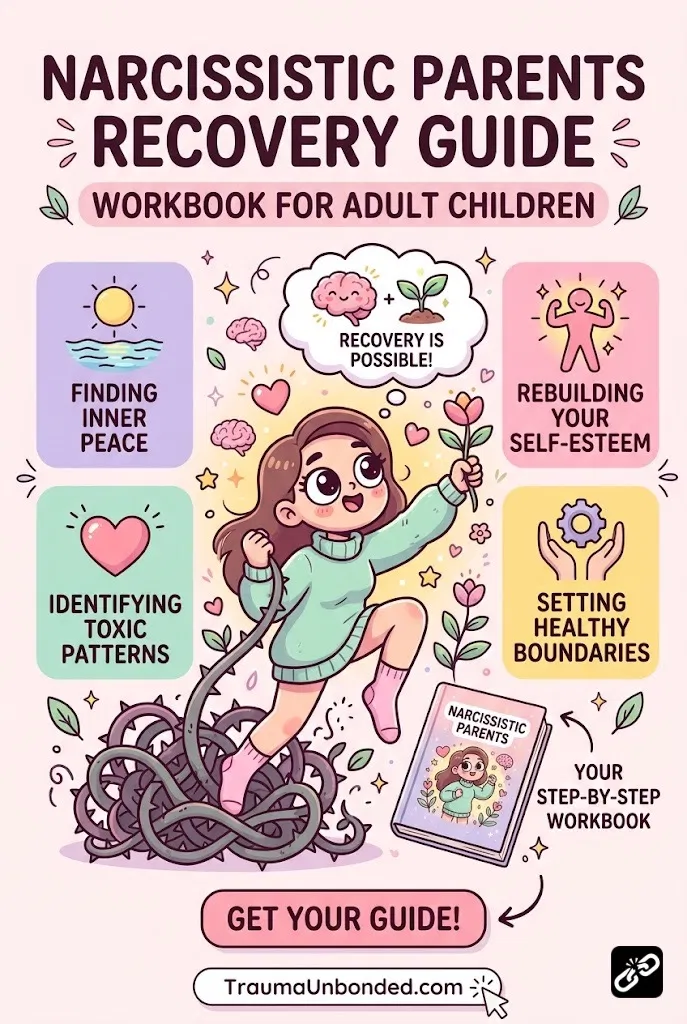
If you are ready to stop carrying the heavy weight of childhood guilt and learn how to navigate your relationship with your parent safely, this interactive guide is designed to walk you through every step of your recovery journey:
Healing the Maternal Wound and Reclaiming Your True Self

Recovery is not about changing your mother. It is about changing your response to her and reclaiming the identity you surrendered to keep the peace.
When you grow up with a covert narcissist parent, your default coping mechanism is often the fawn response. You learn to over-give, apologize for things you did not do, and ignore your own feelings to keep others happy.
You can learn to identify these traits in our fawn response traits guide to understand how this survival strategy persists in adulthood.
How do you begin to heal this childhood trauma? First, you must accept that you cannot fix your mother. She is likely locked in her victimhood and will always view her parenting as completely justified.
Second, you must practice radical acceptance. Accepting that she cannot give you the emotional validation you deserve allows you to stop seeking it from her. This shift is incredibly painful, but it is also the key to your freedom.
Finally, focus on rebuilding your self-worth. When a covert narcissistic mother has spent decades quietly chipping away at your confidence, you internalize her critical voice as your own.
In therapy, I learned to separate my mother’s passive-aggressive criticisms from my true self. It takes time, daily practice, and immense self-compassion to quiet that critical inner voice and replace it with a supportive, loving one.
Reclaiming your life after being raised by a covert narcissist mother is a slow, challenging process, but it is entirely possible. You are no longer that helpless child who had to shrink to survive. Today, you have the power to step out of her shadow, set firm boundaries, and define who you are on your own terms. To help you navigate these emotional hurdles and break free from the patterns of your past, the Narcissistic Parents Recovery Guide is here to support you in rebuilding a life rooted in peace, clarity, and self-love.

Meet Your Guide
Helen Brooks
After surviving a 12-year NPD/BPD relationship, I dedicated over a decade to studying trauma bonding and nervous system recovery. My mission is to help you break free from the fog and reclaim your authentic self.
Ready to break the trauma bond and reclaim your life?