The Parentified Child: How Taking Care of Your Parents Damaged Your Adult Relationships
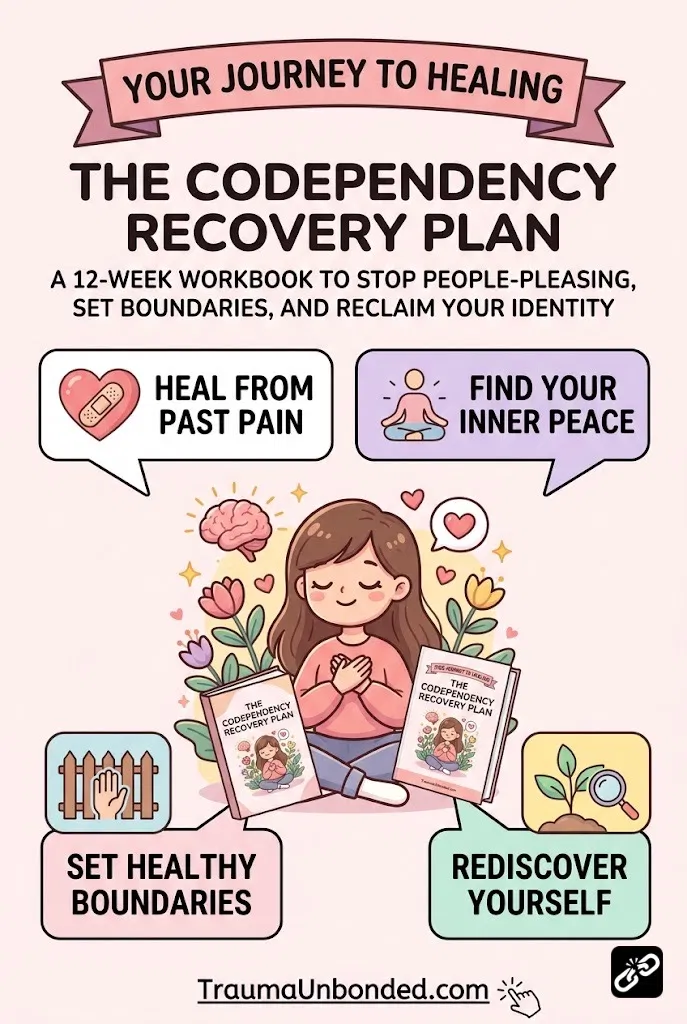
If you grew up as a parentified child, you likely learned early on that your worth was tied to what you could do for others, a pattern that explains how taking care of your parents damaged your adult relationships today. As a kid, you had to act as the therapist, mediator, or housekeeper, sacrificing your own needs to keep your family afloat. Learning how to break these exhausting patterns is the first step toward reclaiming your life, which is why working through a structured tool like The Codependency Recovery Plan can help you rebuild your identity from scratch.
I know this pain personally because my own childhood training prepared me to spend 12 years in a toxic, high-conflict relationship with a partner who showed both narcissistic and borderline personality traits. For over a decade, I normalized their emotional volatility, constantly walking on eggshells because I was already programmed to manage everyone else’s feelings. Does it feel like you are always the “responsible one” in your relationships, only to end up feeling completely invisible and drained?
When you spend your formative years acting as an emotional stabilizer for your family of origin, you enter adulthood with a skewed map of how intimacy works. You mistake anxiety for chemistry, caretaking for love, and self-abandonment for loyalty. Let us look at how this early role reversal reshapes your adult life, and how you can finally break free to build balanced, mutually supportive relationships.
What is a Parentified Child and Why Does It Happen?
A parentified child is a child who is forced to take on adult developmental and caretaking roles for their parents or siblings before they are emotionally or physically ready. This destructive role reversal teaches the child to abandon their own emotional needs, which often leads to severe codependency, chronic over-responsibility, and toxic relationship dynamics in adulthood.
This dynamic occurs when parents are emotionally immature, struggling with untreated mental illness, addiction, or severe life stressors. Instead of providing a safe container for your growth, they looked to you for emotional or physical survival. In family psychology, this is known as parental enmeshment, where the boundaries between parent and child are completely erased.
During my 12-year toxic relationship, I realized that my partner’s endless emotional crises felt intensely familiar. I was simply playing the same role I played at seven years old, trying to fix a broken adult so I could feel safe. It took professional therapy to see that this childhood survival strategy had become my adult relationship pattern.
Emotional vs. Instrumental Parentification
Psychologists divide this role reversal into two distinct types, though they often overlap. Instrumental parentification involves physical tasks, like cooking, paying bills, or caring for younger siblings. While hard, the real damage usually comes from emotional parentification, where you become your parent’s secret-keeper, emotional sounding board, or romantic surrogate.
When a parent unloads their marital problems or depression onto a child, it creates a heavy burden that is impossible for a young brain to process. According to clinical insights on Psychology Today, children who are forced to manage their parent’s emotional or physical needs often struggle with severe boundary issues and burnout in their adult romantic relationships. You learn to silence your own voice, which later makes you a prime target for manipulators.
How Childhood Parentification Ruins Adult Relationships
When you enter the dating world as a former parentified child, you do not look for an equal partner. Instead, you unconsciously look for a project, someone who needs fixing, rescuing, or constant emotional management. Let us look at the primary ways this childhood conditioning ruins your adult connections:
The Link to Codependency and Fawning: You develop a chronic fawn response, meaning you default to people-pleasing to avoid conflict. You feel responsible for your partner’s moods, believing that if they are unhappy, it is your job to fix it.
Attracting High-Conflict Partners: Narcissists and people with borderline traits are naturally drawn to parentified children. They seek out individuals who have a high tolerance for poor treatment and an endless supply of patience, creating the ultimate trap. This explains the deep childhood dynamics that attract narcissists to highly empathetic people.
An Inability to Receive Love: Because you only know how to give, receiving care feels incredibly uncomfortable, unsafe, or even suspicious. You might reject emotionally healthy partners because their stability feels boring compared to the familiar chaos of fixing someone.
Severe Burnout and Resentment: Over time, carrying the emotional weight of two people leads to deep exhaustion. You eventually build up quiet resentment toward your partner, even though you were the one who volunteered to carry the load.
Why are you so drawn to these dynamics? It is because the familiar chaos feels like home, even when it is actively destroying your physical and mental health. You end up recreating the exact same relationship with your partner that you had with your needy parent.
Breaking free from these deeply ingrained childhood survival roles requires more than just intellectual understanding. If you are ready to stop people-pleasing, establish unbreakable boundaries, and finally reclaim your authentic identity, I highly recommend using a step-by-step healing guide. Below is a structured workbook designed specifically to help you unlearn these destructive relationship habits.
Breaking the Cycle of Caretaking and People-Pleasing
To start your recovery, you must first accept that you cannot rescue everyone. Your partner is an adult who is fully responsible for their own emotions, actions, and healing. When you step in to manage their anxiety or cover up their mistakes, you are not helping them; you are keeping both of you trapped in an unhealthy cycle.
When I finally ended my 12-year relationship, my world fell apart. I felt completely lost because my entire identity had been built on being the strong caretaker who never needed help. I had to learn how to turn that intense nurturing energy inward, treating myself with the same compassion I had wasted on partners who only took advantage of me.
Establishing Boundaries and Healing the Inner Child
Healing means learning to sit with the discomfort of other people being unhappy with your choices. When you first start saying no, you will likely feel a wave of guilt, which is just the old childhood programming trying to keep you safe. Recognizing that this guilt is a sign of progress, not a sign of wrongdoing, is crucial for your growth.
Start by practicing micro-boundaries in your daily life. If a friend asks for a favor that leaves you exhausted, let them know you do not have the capacity right now. By protecting your energy, you teach your nervous system that you are safe, even when you are not actively fixing someone else’s problems.
Your childhood may have forced you to grow up far too quickly, but your future does not have to be defined by those old survival patterns. You do not have to earn love by being useful, and you certainly do not need to play the therapist to deserve a place in someone’s life. True recovery starts when you choose to save yourself instead of attempting to rescue partners who are unwilling to do the work. If you are ready to take those first practical steps to establish real boundaries and reclaim your identity, download The Codependency Recovery Plan today and start your journey back to yourself.
Meet Your Guide
Helen Brooks
After surviving a 12-year NPD/BPD relationship, I dedicated over a decade to studying trauma bonding and nervous system recovery. My mission is to help you break free from the fog and reclaim your authentic self.
Ready to break the trauma bond and reclaim your life?