Narcissistic Mother and Adult Daughter: Breaking the Guilt Bond
You know that sick feeling in your stomach every time your phone rings and it’s her? That instant wave of dread mixed with obligation? You pick up because you feel like you have to. And then the conversation leaves you drained, second-guessing yourself, and somehow apologizing for something you didn’t do. Again.
If you’re an adult daughter of a narcissistic mother, you probably know this pattern by heart. The guilt is relentless. It follows you into your relationships, your career, your quiet moments alone. It tells you that you’re selfish for wanting space, ungrateful for setting limits, and a terrible daughter for even thinking about pulling away. But here’s the thing: that guilt was installed in you. It was never yours to begin with.
I spent 12 years in a relationship with someone who had both NPD and BPD traits, and during my recovery I discovered something painful but important: much of my tolerance for that relationship was rooted in patterns I learned growing up with a controlling parent. If you’re trying to understand why you feel guilty for setting boundaries with your narcissistic mother, the Narcissistic Parents Recovery Guide is a resource I wish I’d found years sooner.
How a Narcissistic Mother Programs Guilt Into Her Daughter
A narcissistic mother doesn’t just guilt-trip you once. She builds an entire operating system around it. From childhood, you learn that her emotions are your responsibility. If she’s sad, you caused it. If she’s angry, you provoked it. If she’s happy, you better keep performing so it stays that way.
This is called parentification, and it’s when a child is forced to become the emotional caretaker of the parent. You didn’t get to be a kid. You were her therapist, her mirror, her punching bag, and sometimes her best friend, all depending on her mood that day.
Over time, the guilt becomes automatic. You don’t even question it. You just feel it. Every. Single. Time. You try to live your own life.
And the tools she uses? They’re textbook. Guilt-tripping (“After everything I’ve done for you”). Gaslighting, which is when she tells you something didn’t happen the way you remember it, or that you’re “too sensitive.” During my own toxic relationship, gaslighting felt like slowly losing my grip on reality. It’s the same with a narcissistic parent, except you never had solid ground to begin with because it started in childhood.
Why Adult Daughters Stay Trapped in the Guilt Cycle
Have you ever asked yourself, “Why can’t I just stop caring what she thinks?” You’re not weak. You’re wired this way. Literally.
When you grow up with a narcissistic mother, your nervous system learns to associate her approval with safety. Your brain creates a trauma bond with the very person who hurt you. It’s the same biochemical loop that keeps people stuck in toxic romantic relationships. The guilt bond with a narcissistic mother functions almost identically to what I experienced with my ex. Intermittent reinforcement, random moments of warmth followed by cold withdrawal, keeps you hooked because your brain is always chasing the next “good” moment.
Here’s what keeps the cycle going:
Fear of abandonment. Even though she’s the one causing pain, the thought of losing her feels unbearable. You’ve been conditioned to believe you can’t survive without her approval.
The “good daughter” identity. Your entire self-worth got tangled up in being compliant, agreeable, and available. Setting a boundary feels like you’re betraying who you are.
Flying monkeys. These are the relatives and family friends she recruits to pressure you. “She’s your mother.” “You’ll regret this when she’s gone.” “She means well.” If you’ve dealt with this, the guide on flying monkeys breaks down exactly how to handle these dynamics without losing your mind.
I remember the exact moment in my own recovery when I realized I’d been fawning my entire life, not just in my romantic relationship but with family too. The fawn response is when you automatically people-please to avoid conflict. I thought I was being kind. I was actually being terrified.
Signs You’re Carrying Your Mother’s Guilt (Not Your Own)
How do you know if the guilt you feel is legitimate or manufactured? Ask yourself these questions:
Do you feel guilty even when you’ve done nothing wrong? Do you rehearse conversations with her in your head, trying to find the “right” way to say something so she won’t explode? Do you cancel plans, abandon your own needs, or suppress your feelings just to keep her calm?
If any of that lands, the guilt isn’t yours. It’s a conditioned emotional response. Real guilt shows up when you’ve actually harmed someone. False guilt, the kind a narcissistic mother installs, shows up when you try to exist as a separate person.
Another sign? You feel guilty for being happy. This was huge for me. After leaving my 12-year relationship, I noticed that joy itself felt dangerous. Like I wasn’t allowed to have it. That feeling came from somewhere much older than my ex.
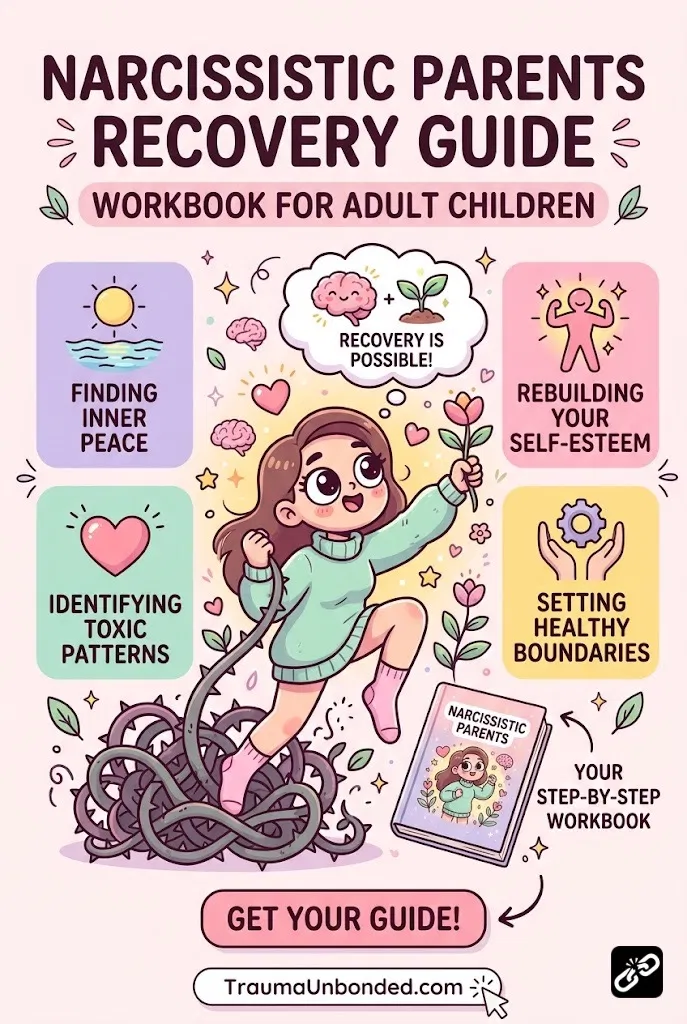
If you’re ready to go deeper into structured healing, this is the guide I recommend most for adult children still caught in these patterns:
How to Start Breaking the Guilt Bond With Your Narcissistic Mother
Breaking free doesn’t always mean cutting contact completely, although for some people that’s the healthiest option. It means untangling your identity from hers. Here’s where to start:
Name the guilt out loud. When you feel that familiar wave, pause. Say to yourself, “This is a programmed response. I haven’t done anything wrong.” It sounds simple but after decades of automatic guilt, just naming it is a radical act.
Start with small boundaries. You don’t have to go from zero to full no-contact overnight. Maybe it’s not answering the phone on the first ring. Maybe it’s ending a call when she starts yelling. Maybe it’s not sharing personal details she’ll use against you later. Each small boundary teaches your nervous system that you can survive her disapproval.
Get a therapist who understands narcissistic family dynamics. Not every therapist does. I went through two before finding one who didn’t tell me to “just try to understand her perspective.” A trauma-informed therapist will validate your experience, not gaslight you all over again in a clinical setting.
Grieve the mother you never had. This is the hardest part. It’s not just about managing her behavior. It’s about mourning the relationship you deserved but never got. I went through this with my ex too, grieving the person I thought they were versus who they actually showed themselves to be. With a mother, that grief cuts even deeper because it started before you had words for it.
Build your own support system. The family boundaries guide helped me understand that healing from a narcissistic parent isn’t about winning the argument. It’s about building a life where their opinion stops running the show.
You Are Allowed to Choose Yourself
Let me say the thing nobody in your family will say: you are allowed to put yourself first. You are allowed to screen her calls. You are allowed to skip the holiday. You are allowed to love her from a distance if that’s what keeps you sane.
The guilt will scream at you. It will tell you you’re cruel, ungrateful, and heartless. That voice is not your conscience. That voice is her voice, recorded in your nervous system before you were old enough to question it.
After my own recovery, I learned something that changed everything: the people who planted guilt in you will always call your healing “betrayal.” But your peace is not a betrayal. Your boundaries are not weapons. Your life is not an extension of hers.
If you’re just starting this journey and you feel overwhelmed, scared, or unsure of what’s real, you’re exactly where I was. And I promise it gets clearer. The Narcissistic Parents Recovery Guide walks you through structured exercises to unravel these patterns step by step. You don’t have to do this alone, and you don’t have to figure it all out today. You just have to choose yourself. Once.

Meet Your Guide
Helen Brooks
After surviving a 12-year NPD/BPD relationship, I dedicated over a decade to studying trauma bonding and nervous system recovery. My mission is to help you break free from the fog and reclaim your authentic self.
Ready to break the trauma bond and reclaim your life?