
The Broca’s Area Trauma Block: Why You Can’t Find the Words to Describe Your Abuse
Finding yourself frozen and unable to speak when trying to explain your toxic relationship is a direct result of the Broca’s area trauma block, which explains exactly why you can’t find the words to describe your abuse to others. This silent paralysis is not a personal failure or a sign of weakness, but rather a physical reaction happening deep inside your brain. If you are struggling with this frustrating silence, using a structured tool like The Brain Fog Solution can help you rebuild your cognitive clarity.
For years, you might have felt that your inability to tell your story meant you were exaggerating or losing your mind. In reality, your nervous system has simply gone into survival mode, shutting down the very regions responsible for verbal communication.
Understanding the Broca’s Area Trauma Block
The Broca’s area trauma block is a physiological shutdown of the brain’s primary speech center caused by severe emotional stress, which physically prevents survivors from articulating their traumatic experiences in words.

Broca’s area is a small region located in the left frontal lobe of your brain. It acts as the assembly line for spoken language, helping you translate thoughts, feelings, and memories into coherent sentences.
When threat levels spike during psychological abuse, your brain reroutes energy away from this language center to focus purely on keeping you safe. Have you ever tried to describe a painful argument to a friend, only to find your mind completely blank?
Your thoughts are there, swirling in your chest, but they cannot travel to your tongue. This neurological wall is why so many survivors suffer in complete isolation, unable to seek the help they desperately need.
My 12-Year Silence: How It Felt in a Toxic Relationship
I spent twelve years in a deeply toxic relationship with a partner who displayed severe narcissistic and borderline personality traits. During that time, I gradually lost my hobbies, my friends, and my sense of self, eventually feeling completely miserable.
During our worst arguments, my partner would throw intense accusations or try to twist my reality. I wanted to defend myself, to explain my side, or to stand up for the truth. Instead, my throat would tighten, and my voice would disappear entirely.
I felt like a spectator in my own body, watching myself take the blame because I could not find the words to fight back. This is how severe cognitive dissonance can trap you in a cycle of silent submission.
You know something is deeply wrong, yet your brain cannot reconcile the loving moments with the sudden, brutal attacks. When my partner attempted hoovering, sending sweet messages after a massive discard, my inability to articulate the pain made me vulnerable to falling back into the cycle over and over again.
The Science of Speechless Terror
Psychological research offers a clear explanation for this silent paralysis. When fMRI scans are performed on survivors reliving their trauma, researchers observe a dramatic drop in blood flow to Broca’s area.
In fact, a study published on Psychology Today explains how the speech center goes offline during active trauma recall, leaving the emotional brain to process the event without words.
This phenomenon is often called speechless terror. Your brain reacts to emotional and psychological abuse exactly as it would to a physical threat, forcing the logical, verbal frontal lobes to shut down to protect you.
This means your inability to talk about the abuse is not a lack of intelligence. It is a biological protective mechanism. Your brain is prioritizing survival over storytelling, even if that survival means staying quiet.
How Trauma-Induced Brain Fog Locks Your Words
Living under constant emotional distress causes your brain to stay in a state of high alert. This constant state of survival floods your body with cortisol, causing severe trauma-induced brain fog that scatters your thoughts.
You might struggle to remember simple words, forget why you walked into a room, or feel like your mind is wrapped in a thick, heavy blanket. This cognitive exhaustion makes it even harder to process what you have survived, let alone explain it to a therapist.
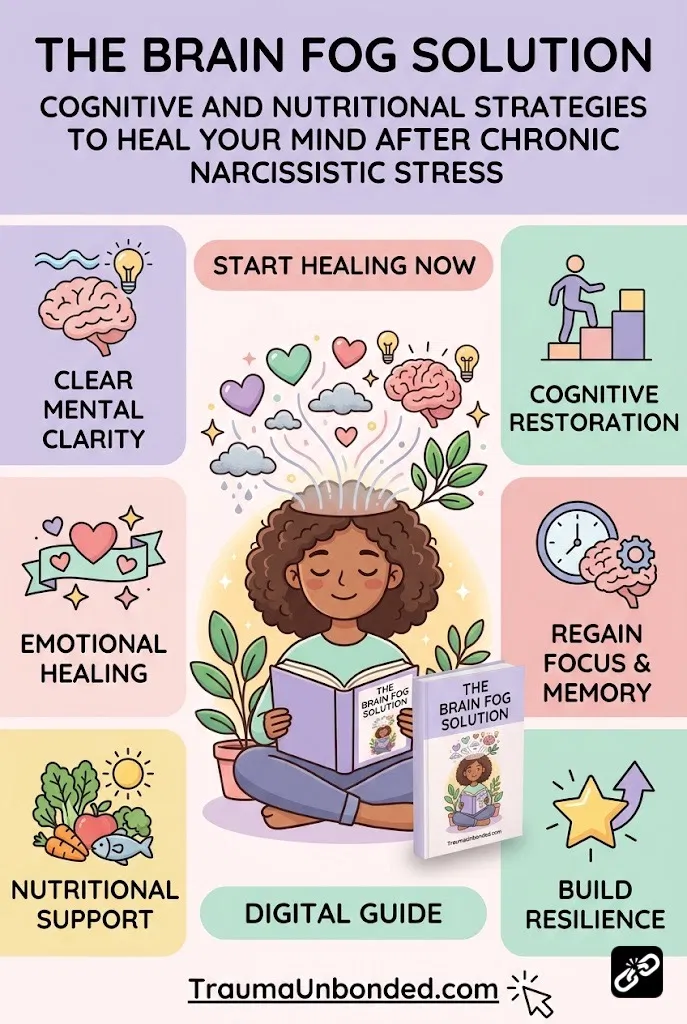
To break through this verbal freeze and clear the mental exhaustion, you need a structured approach to support your nervous system. I designed a comprehensive resource to help you rebuild your cognitive clarity, process the stress, and regain your mental focus step-by-step.
Why Memory Gaps Make Speaking Even Harder

To make matters worse, chronic narcissistic or BPD abuse often leaves you with massive gaps in your memory. You might remember the intense fear or the exhaustion, but the specific details of the arguments seem to vanish.
This is another coping mechanism where your brain blocks out painful details to protect you from overwhelming grief. When you try to describe what happened to someone else, these memory gaps make you doubt your own sanity.
You worry that if you cannot provide a perfect timeline, no one will believe you. This self-doubt keeps you silent, locked inside the isolated world your partner built for you.
But your body remembers what your mind is struggling to put into sentences. The tension in your jaw, the tight knot in your stomach, and the sudden racing of your heart are all physical expressions of the story your voice cannot yet tell.
Turning the Language Center Back Online
Healing from a twelve-year toxic relationship taught me that you cannot force your brain to speak before it feels safe. Through professional therapy and learning about codependency, I slowly learned how to unlock my voice.
One of the most critical steps is to stop forcing yourself to talk. Instead, you can use daily somatic exercises to signal to your nervous system that the danger has passed.
When your nervous system relaxes, blood flow naturally returns to your frontal lobe and Broca’s area. Here are a few simple, practical ways to start unlocking your voice today:
- Write it down first: Journaling without worrying about grammar or structure bypasses the verbal speech center, letting your thoughts flow through your hands.
- Speak to yourself out loud: Practice describing small, safe objects in your room to gently rebuild your brain’s language assembly line.
- Focus on body sensations: When words fail, focus on where you feel the tightness in your body and allow yourself to gently breathe through it.
- Give yourself permission to pause: If you get stuck mid-sentence, take a slow breath and remind yourself that your brain is just trying to protect you.
Today, I have finally returned to my original, cheerful, and optimistic self. It took time, patience, and a lot of gentle self-compassion to rebuild my life and find my voice again, but it is entirely possible for you too.
If you are ready to break through the mental exhaustion and find your words, consider exploring The Brain Fog Solution guide to support your cognitive recovery. Remember, your silence is not a sign that the abuse did not happen; it is the physical proof of how deeply you were hurt. Take a deep breath, go easy on yourself, and let your voice return at its own gentle pace.

Meet Your Guide
Helen Brooks
After surviving a 12-year NPD/BPD relationship, I dedicated over a decade to studying trauma bonding and nervous system recovery. My mission is to help you break free from the fog and reclaim your authentic self.
Ready to break the trauma bond and reclaim your life?