How to Recover Your Short-Term Memory After Chronic Emotional Abuse
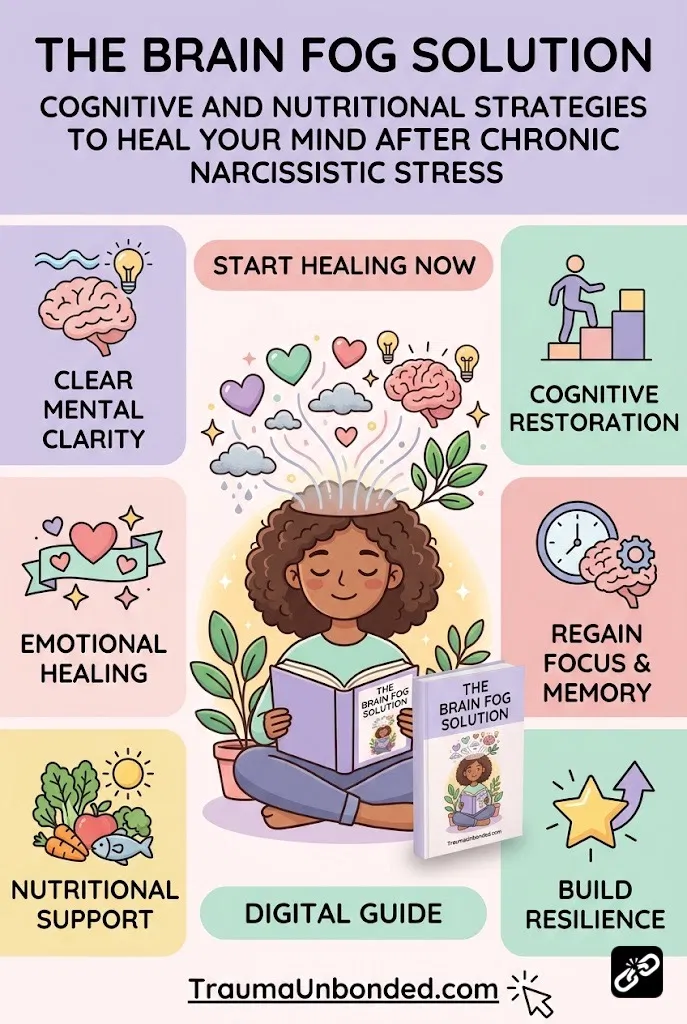
Learning how to recover your short-term memory after chronic emotional abuse is one of the most unexpected hurdles on your healing path. If you are constantly wondering, why is my memory so bad after trauma, or finding yourself struggling with chronic forgetfulness and brain fog after a toxic relationship, you are not losing your mind. During my 12-year toxic relationship with a partner who exhibited severe NPD and BPD traits, my mind felt like Swiss cheese. I would walk into a room and completely forget why I was there, or lose my car keys three times a day. If you want a complete, practical roadmap to heal your mind, check out The Brain Fog Solution – Cognitive and Nutritional Strategies to Heal Your Mind After Chronic Narcissistic Stress to begin clearing the mental haze today.
Living under constant survival pressure means your brain is in a perpetual state of high alert. When you are subjected to constant gaslighting (where your partner tells you that things you saw or heard never actually happened), your brain gets overwhelmed trying to track reality. In my decade-long relationship, I was constantly trying to record arguments or write down dates just to prove to myself that I was not imagining things. Over time, this constant cognitive overload drains your mental battery, leaving very little energy for daily memory retention.
Thankfully, the brain is incredibly adaptive, and you can reclaim your mental clarity. Recovering your original self, returning to that cheerful, optimistic, and grounded person you once were, is entirely possible. Let us look at why this happens and what practical steps you can take to rebuild your mental stamina.
Why Emotional Abuse Destroys Your Short-Term Memory
Chronic emotional abuse floods the brain with cortisol and adrenaline, which repeatedly activates the amygdala and physically shrinks the hippocampus, the brain region responsible for storing and recalling short-term memories.
When you live with a toxic partner, your nervous system is trapped in a fight-or-flight response. The constant threat of criticism, explosive rage, or sudden cold shoulders keeps your stress hormones spiked. According to research from Harvard Health Publishing, chronic stress actually changes the physical structure of the brain, causing the amygdala to grow more sensitive while robbing the hippocampus of the energy needed to process new information. In simple terms, your brain stops recording daily details because it is too busy trying to keep you safe from emotional attacks.
There is also the heavy mental toll of trying to process cognitive dissonance after narcissistic abuse. You are forced to hold two opposing realities: the charming person you fell in love with and the cruel person standing in front of you. This psychological friction is exhausting. When your brain is working overtime to make sense of emotional chaos, mundane details like grocery lists or phone numbers are simply dropped to save processing power.
How to Recover Your Short-Term Memory After Trauma

Healing your memory is not about forcing yourself to study harder or memorizing lists. It is about signaling to your nervous system that the threat is over. After leaving my toxic partner, I spent months in a daze, barely able to read a single page of a book. My therapist taught me that my mind was simply resting after twelve years of psychological warfare. If you are experiencing this, you must treat your brain like a muscle recovering from a severe injury.
To begin reclaiming your focus, you must first address the root cause of your trauma-induced brain fog. This starts with creating a daily routine that removes cognitive friction and allows your brain to rest. When you no longer have to anticipate the next sudden mood swing or hurtful comment, your nervous system can slowly move out of survival mode and back into a state of growth.
Quiet the Internal Alarm System
Why does your mind feel so cluttered? Because your brain is still scanning the environment for threats that are no longer there. Even after you establish boundaries or implement a radical no-contact strategy, your amygdala remains hyperactive. To reverse this, you must actively feed your body signals of safety. This can be as simple as practicing daily deep breathing, stepping into nature, or taking a warm bath without any digital distractions.
If you are struggling to manage daily tasks because your focus is completely shattered, you do not have to navigate this cognitive rebuild alone. I put together a practical, step-by-step workbook specifically designed to help survivors clear the mental haze, nourish their nervous system, and reclaim their memory after years of high-stress relationships. This resource contains targeted nutritional and cognitive strategies to fast-track your healing journey.
Managing Executive Dysfunction and Post-Abuse Brain Fog

When you are recovering from chronic emotional abuse, your executive function is often severely impaired. This means that organizing tasks, planning your day, and focusing on a laptop screen can feel like climbing a mountain. During my recovery, I felt so much shame because I could not keep up with my simple work deadlines. How could someone who used to be so organized suddenly struggle with basic emails? The truth is, your brain’s prefrontal cortex has been temporarily offline due to trauma, and you have to rebuild those pathways slowly.
Here are several practical, low-effort strategies to bypass your damaged short-term memory while it heals:
- Externalize your brain: Write absolutely everything down immediately. Do not trust your short-term memory to hold onto a task for even five minutes. Carry a small notepad or use a simple voice recorder on your phone.
- Minimize sensory overload: High-stress relationships prime your brain to be hyper-reactive to noise, light, and clutter. Work in quiet, dimly lit spaces and use noise-canceling headphones to give your brain a rest.
- Do one thing at a time: Multitasking is the enemy of trauma recovery. Focus on a single task for fifteen minutes, then take a complete break to let your nervous system catch its breath.
- Establish cognitive anchors: Keep your essential items (keys, wallet, phone) in the exact same designated spots every single day to eliminate the panic of losing them.
Reclaiming Your Perception and Reality
When you have spent years with an abuser who constantly rewrote reality, you stop trusting your own senses. This lack of trust makes your memory issues even worse because you constantly second-guess what you remember. To heal from gaslighting, you have to practice grounding exercises that anchor you in the present moment. Affirming what you see, feel, and hear in real time helps rebuild the neural pathways that connect memory and trust.
Be Gentle With Your Healing Mind
Your short-term memory did not disappear overnight, and it will not return in a day. It took me months of quiet, deliberate self-care and professional therapy to stop feeling like I was living in a perpetual fog. But as I distanced myself from the constant chaos and focused on regulating my nervous system, my mind began to clear. I started remembering conversations, finding my keys without panic, and finally feeling like my old, cheerful self again.
If you find yourself struggling today, take a deep breath and forgive your mind for being tired. Your brain did a magnificent job of keeping you alive during a period of immense psychological strain. Now, it is time to give it the quiet space, nutrition, and safety it deserves to rebuild. For a structured, trauma-informed system to clear the haze and restore your cognitive sharpness, explore The Brain Fog Solution – Cognitive and Nutritional Strategies to Heal Your Mind After Chronic Narcissistic Stress and take your first step toward clarity.

Meet Your Guide
Helen Brooks
After surviving a 12-year NPD/BPD relationship, I dedicated over a decade to studying trauma bonding and nervous system recovery. My mission is to help you break free from the fog and reclaim your authentic self.
Ready to break the trauma bond and reclaim your life?