Confabulation vs. Lying: Why Narcissists Actually Believe Their Own Rewritten History
Understanding narcissistic confabulation vs lying is often the first step to reclaiming your mind after surviving a toxic relationship. During my own 12-year struggle with a partner who displayed severe narcissistic and borderline traits, I constantly felt like I was losing my grip on reality because of how easily they rewrote history. If you are currently feeling isolated, miserable, and wondering how someone could look you in the eye and rewrite a conversation that happened five minutes ago, you might find clarity in this healing from gaslighting recovery guide.
Did you ever find yourself recording conversations just to prove you weren’t going crazy? For over a decade, I believed my partner was simply a malicious liar who enjoyed watching me twist in agony. Through professional therapy and studying the mechanics of trauma bonds, I realized the truth was far more unsettling: they actually believed their own lies. They were not always intentionally deceptive; instead, their minds actively altered their memories to protect their incredibly fragile egos from any shred of guilt.
This psychological phenomenon is known as confabulation, and it feels entirely different from standard lying once you recognize the patterns. While a normal liar knows they are telling a falsehood, a narcissist’s brain automatically swaps facts for feelings to maintain their false self-image. When they accuse you of things you never did, they are not always plotting a calculated mind game; they are living in a completely fabricated reality where they are always the victim.
What is the Difference Between Narcissistic Confabulation and Lying?
Confabulation is the unconscious creation of false memories to fill memory gaps, which the person fully believes to be true, while lying is a conscious, deliberate attempt to deceive others. Narcissists use confabulation as a defense mechanism to escape shame, rewriting the past to align with their current emotional state.

When someone tells a lie, they are fully aware of the truth and actively choose to hide it. They might stutter, avoid eye contact, or show signs of stress because their brain is working hard to keep the fabrication straight. If you corner a standard liar with hard evidence, they will eventually look uncomfortable or admit their mistake.
With narcissistic history rewriting, there is no discomfort because their brain has already deleted the actual event. According to clinical studies on memory distortion published by Psychology Today, our brains naturally reconstruct memories, but highly defensive personalities do this to an extreme degree to ward off psychological collapse. To a narcissist, feelings equal facts; if they feel angry at you right now, their memory of the past instantly changes to justify that anger.
Have you ever watched someone argue a completely false point with absolute, unshakeable conviction? That is the hallmark of confabulation. They do not experience the physiological anxiety of telling a lie because, in their minds, they are telling the absolute truth.
Why Narcissists Rewrite History and Believe Their Own Version
To understand this behavior, we have to look at how a narcissist handles the feeling of shame. For normal individuals, making a mistake triggers guilt, which encourages us to apologize and make things right. For a person with narcissistic personality disorder, shame is a mortal threat that must be avoided at all costs.
If they were to admit they hurt you, their fragile false self would shatter, forcing them to face their deep-seated feelings of worthlessness. To prevent this, their subconscious mind immediately deploys defense mechanisms like projection and denial. The brain rapidly constructs a new narrative where you were the instigator and they were the innocent party who had to defend themselves.
Over time, this constant twisting of events creates intense cognitive dissonance in narcissistic abuse survivors. You know what you saw, but their absolute certainty makes you doubt your own senses. You begin to ask yourself if you are remembering things wrong, which is exactly how the cycle of self-doubt keeps you trapped in the relationship.
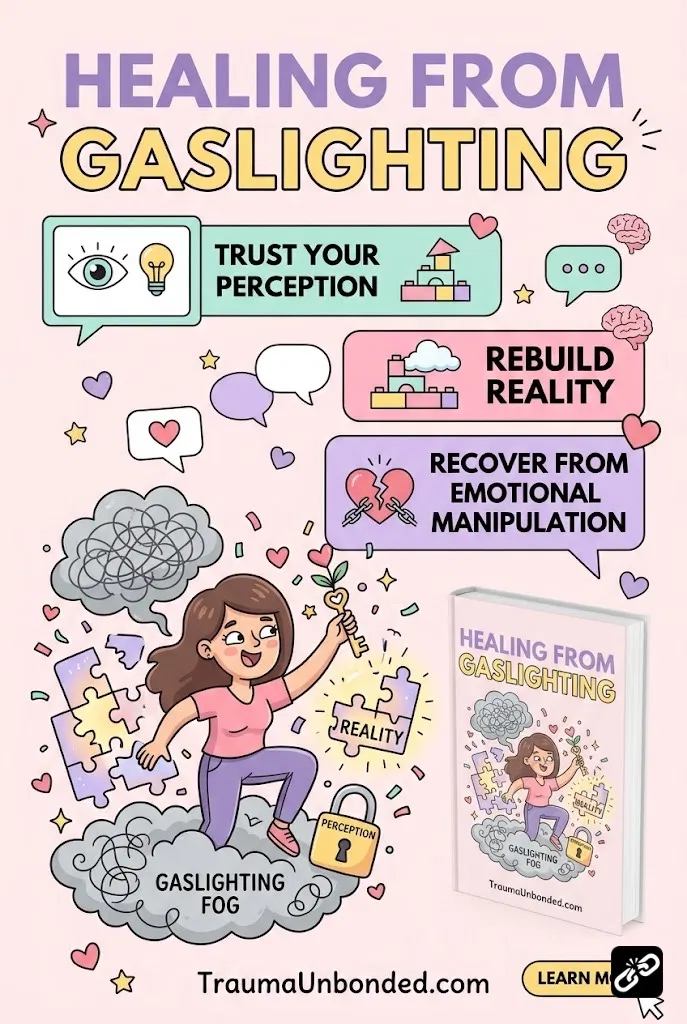
If you find yourself constantly doubting your memory and struggling to break free from the mental fog of their fabricated reality, you need a structured roadmap to rebuild your trust in yourself. The step-by-step workbook below is designed specifically to help you unmask these manipulation tactics, restore your confidence, and find your footing on solid ground again.
How Confabulation Fuels Gaslighting and Brain Fog
When a narcissist rewrites history, they are not just protecting themselves; they are forcing you to accept their reality. This creates a severe form of gaslighting that leaves survivors feeling completely disoriented. In my experience, the constant arguments over basic facts left me with severe memory issues and physical exhaustion.
Why does this happen? The human brain is not built to constantly defend its basic perception of reality. When you are forced to debate whether a conversation happened, whether you paid a bill, or whether they threw a glass across the room, your nervous system stays in a permanent state of high alert. You cannot process information normally when your daily life is a battleground over facts.
This state of chronic stress leads to what survivors call trauma-induced brain fog. It is a biological response to emotional warfare, where your mind shuts down certain cognitive functions because it is overwhelmed by the constant defense mechanisms of your partner. To begin healing, you must learn to heal gaslighting and trust your reality once again without needing their validation.
How to Spot the Difference in Real-Time Conversations
Recognizing whether a person is actively lying or confabulating can help you decide how to respond. While both behaviors are toxic and destructive, knowing the underlying mechanism can save you hours of useless arguing. Here are a few key indicators to look for during a difficult conversation:
- Emotional Intensity: A liar is usually careful and defensive, trying not to get caught. A confabulator will show genuine, intense outrage that you would dare to question their memory, often escalating into narcissistic rage because they truly believe they are being falsely accused.
- Consistency of the Narrative: Lies often change details over time as the person forgets what they said. Confabulated memories remain remarkably consistent in the speaker’s mind because their brain has permanently overwritten the old files with the new, convenient story.
- Lack of Real Evidence: A confabulator will often claim they have proof or that other people agree with them, but they can never actually produce it. If you show them physical proof that contradicts their story, they will either claim the proof is fake or shift the goalposts entirely.
Understanding these signs helps you realize that trying to prove your point is a dead end. You cannot reason someone out of a belief that their brain created to protect their sanity. The moment you stop trying to win the argument is the moment you reclaim your power.
How to Rebuild Your Sanity and Trust Your Own Reality

The journey back to your original self requires you to stop looking to the toxic person for closure or agreement. They will never agree on what happened because doing so would require them to face the shame they have spent a lifetime running from. After my relationship ended, I spent months in therapy learning how to manage the intense self-doubt after abuse recovery phase.
One of the most powerful steps you can take is to start documenting things solely for yourself. Keep a private journal, write down dates and times of key events, and read them when you feel the familiar wave of confusion washing over you. Do not share this journal with the narcissist; they will only use it as fuel for further arguments. Keep it as a private anchor for your own sanity.
Surround yourself with people who validate your reality and do not play mind games. When I finally reconnected with friends and built a support system, I was shocked at how easy it was to have normal, honest conversations. You deserve to live in a world where the truth is not a moving target and where your memories are respected.
If you are ready to stop arguing with a rewritten past and want to rebuild a life anchored in truth, consider working through our detailed healing from gaslighting recovery guide. You do not have to live in their fog anymore, and you can trust your own mind again.

Meet Your Guide
Helen Brooks
After surviving a 12-year NPD/BPD relationship, I dedicated over a decade to studying trauma bonding and nervous system recovery. My mission is to help you break free from the fog and reclaim your authentic self.
Ready to break the trauma bond and reclaim your life?