Trauma Bond Biochemical Addiction: The Toxic Dopamine Cycle
I remember the exact moment I realized I wasn’t grieving a person. I was grieving a chemical. After 12 years with someone who had both NPD and BPD traits, leaving felt less like a breakup and more like going cold turkey off a drug I hadn’t even known I was taking. The shaking, the obsessive thoughts, the desperate urge to call. That was not love. That was a trauma bond biochemical addiction, and understanding what was happening inside my brain is what finally started to set me free.
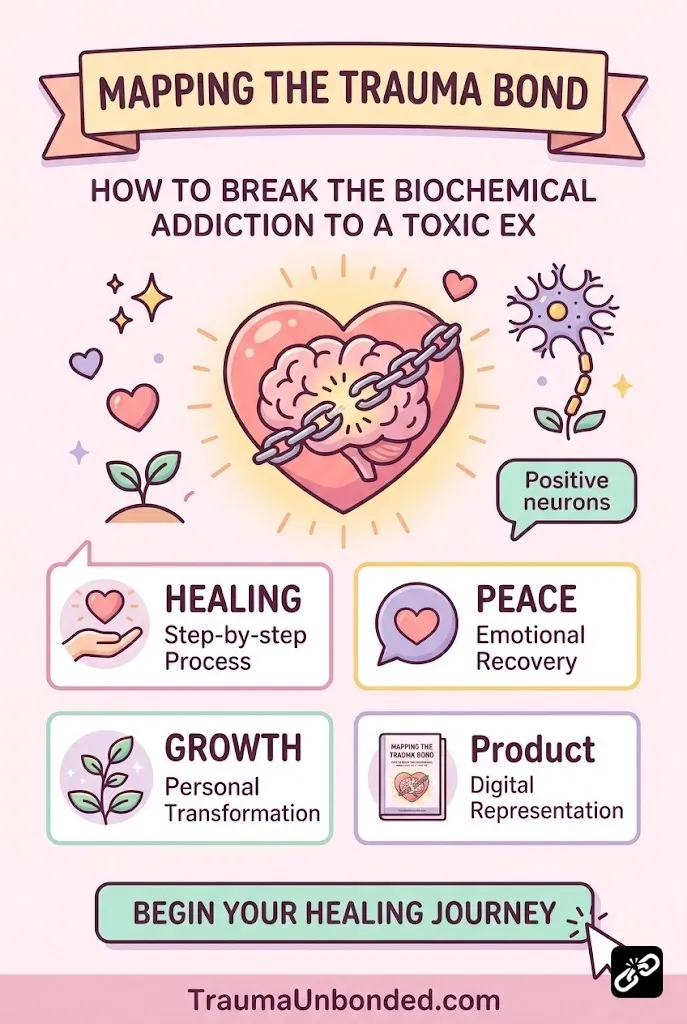
If you’re here because you can’t stop thinking about someone who hurt you, or because you’ve left a toxic relationship but feel worse than ever, you are not weak. You are chemically hooked. And that distinction matters more than you know. I highly recommend taking a look at Mapping the Trauma Bond early in your journey because it helped me understand exactly what I was up against.
Let’s get into what’s actually happening in your body and brain, because once you see it clearly, you can finally start fighting it.
What Is a Trauma Bond, Really?

A trauma bond is not just a very intense attachment. It’s a psychological and neurochemical chain that forms when love and fear get mixed together repeatedly over time. Think of it like this: your nervous system stops being able to tell the difference between danger and desire.
In my relationship, the chaos was constant. There were explosive rages followed by tearful apologies. Disappearances followed by love bombing, which is basically being flooded with affection and attention so intense it feels unreal, because it is. My brain learned to associate the relief after the storm with safety and love. That pattern is what creates the bond.
The technical underpinning of this is intermittent reinforcement. This is the same psychological mechanism used in slot machines. You don’t get rewarded every time you pull the lever. You get rewarded randomly, which makes you pull it more. In a toxic relationship, the “reward” is affection, calm, or connection. And the unpredictability of it is exactly what makes it so addictive.
The Toxic Dopamine Cycle Explained
Here is where the science gets uncomfortably relatable. Dopamine is commonly called the “pleasure chemical,” but that’s only half the story. Dopamine is actually a chemical of anticipation. It spikes hardest when you’re waiting for something uncertain. And what is more uncertain than a partner who might blow up at you, or might hold you like you’re everything?
Every time my partner was sweet after a period of cruelty, my dopamine surged. Every time I received a text after hours of silence, my brain lit up like a reward circuit. I wasn’t addicted to them. I was addicted to that spike. My brain was literally chasing the next hit of relief.
This is also why you might find yourself obsessively checking your ex’s social media, replaying old arguments in your head, or feeling an almost magnetic pull to reach out even when you know it’s a terrible idea. That’s not weakness. That’s your dopamine system working exactly as it was conditioned to work inside that relationship.
But dopamine is not the only player here.
Cortisol, Adrenaline, and the Stress Loop
When your partner was unpredictable, your body released cortisol and adrenaline, the classic stress hormones. Over time, your nervous system began to normalize that state of low-grade alarm. You might have stopped noticing how tense you were all the time. That became your baseline.
Here’s the cruel part: when you leave, that adrenaline has nowhere to go. The chaos is gone, but your body keeps waiting for it. Calm starts to feel wrong, even dangerous. This is why so many people describe the post-breakup period as more unbearable than the relationship itself. Your system is in withdrawal from its own stress chemicals.
I spent months after my breakup feeling a constant buzzing anxiety I couldn’t name. Now I understand that was cortisol dysregulation after years of chronic relational stress. Your body was running a trauma program on a loop, and breaking that loop takes real, intentional work.
Oxytocin: The Bonding Chemical That Keeps You Stuck
Oxytocin is released during physical touch, intimacy, eye contact, and emotional vulnerability. It is literally designed to bond you to another person. Toxic relationships still produce oxytocin. Physical closeness still triggers it, even when the person is hurting you. Even a fight followed by a reconciliation can flood your brain with it.
This is why walking away from an abusive relationship is not just a matter of deciding it’s bad for you. Your own chemistry is working against your logic. Every time you tried to leave and went back, that wasn’t failure. That was biology.
Understanding the trauma bond withdrawal symptoms you go through after leaving helps you stop blaming yourself for how hard this is.
Why You Miss Someone Who Hurt You

This is the question that haunted me most. How could I miss someone who made me feel so awful, so often? The answer is that you are not missing who they were. You are missing the dopamine hit. You are missing the relief after the storm. You are missing the version of them that appeared just long enough to keep you hooked.
In psychology, this is sometimes called idealization after devaluation. Your brain holds onto the good moments and unconsciously minimizes the painful ones, especially in the early weeks of separation when you’re in withdrawal. The neurochemical craving literally distorts your memory.
Does that sound familiar? You replay the vacation, not the screaming match before it. You remember the good morning texts, not the weeks of silent treatment. That selective memory is not you being naive. It is a well-documented feature of the trauma bond biochemical process.
How to Start Breaking the Cycle
If you’ve made it this far and you recognize yourself in everything above, the next thing you need is not more information. You need a structured, step-by-step path forward. That’s exactly why I want to share a resource that did more for me than any single therapy session in terms of understanding my own addiction to the chaos.
This guide walks you through the exact biochemical pattern you’re stuck in and gives you real tools to begin rewiring your brain’s response. If you’re ready to stop being a passenger in your own recovery, this is where to start.
No Contact Is Detox, Not Punishment
The single most important step is cutting off access to the source of the chemical hit. No contact is not about being cold or playing games. It is literal neurological detox. Every time you check their Instagram, send a late-night text, or respond to a hoover, which is when they reach out just enough to reel you back in, you restart the dopamine cycle from zero.
I know how brutal the first days are. I sat on my bathroom floor more than once, phone in hand, talking myself out of a text I would have regretted. But each day without contact is a day your brain gets a tiny bit of its baseline back.
Replace the Chemical With Something Real
Your brain still needs dopamine. The goal is not to starve it. The goal is to redirect it. Exercise was the first thing that started working for me. Even a 20-minute walk produced enough of a natural dopamine and endorphin response to take the edge off the craving for a few hours.
Other things that genuinely helped: journaling consistently, reconnecting with one friend I had slowly lost during the relationship, and getting back into a creative hobby I had quietly abandoned around year three of the relationship. These are not small things. They are chemical recalibration in disguise.
Work With a Therapist Who Gets Trauma Bonds
Not every therapist understands what a trauma bond actually is. Look for someone trained in trauma-informed care, somatic therapy, or who has specific experience with narcissistic and BPD relationship abuse. The work I did in therapy was not just talking. It was rewiring. Learning to tolerate calm without interpreting it as abandonment. Learning to trust my own perception again after years of gaslighting, which is when someone consistently makes you question your own memory and reality until you stop trusting yourself entirely.
That kind of deep work does not happen overnight. But it does happen.
You Are Not Broken. You Are Wired for Survival.
Everything your brain did inside that relationship, it did to keep you safe and connected. The bonding, the minimizing of pain, the constant hypervigilance, the desperate hope for one more good day. That was your nervous system doing its job under impossible conditions. The trauma bond biochemical addiction you are experiencing right now is the price of having a brain that adapted to survive.
The work is to slowly teach that brain that it is safe now. That it does not need to scan for danger anymore. That calm is not a trick. That is not a quick process, but I am living proof that it is a real one.
I went from barely functioning after 12 years in a trauma bond to genuinely feeling like myself again. Not a damaged version of myself. My actual self. Curious, hopeful, present. That is available to you too. Start by understanding what you are dealing with, and if you want a structured path to break the biochemical grip for good, this guide on mapping the trauma bond is the most practical place I know to begin.

Meet Your Guide
Helen Brooks
After surviving a 12-year NPD/BPD relationship, I dedicated over a decade to studying trauma bonding and nervous system recovery. My mission is to help you break free from the fog and reclaim your authentic self.
Ready to break the trauma bond and reclaim your life?