Narcissistic Family Scapegoat: The Ultimate Healing Blueprint
If you grew up in a narcissistic family, you probably already know the feeling. That low-grade hum of shame that followed you everywhere. The sense that no matter what you did, it was never quite right. You were the one blamed when things went wrong, the one whose emotions were treated as inconvenient, the one who somehow always ended up carrying the weight of the family’s dysfunction. That’s not a coincidence. That’s the scapegoat role, and it’s one of the most damaging positions a child can be placed in. If you’re ready to start untangling what happened to you, The Scapegoat’s Release guide was built for exactly this.
I didn’t grow up in a narcissistic family system, but after 12 years with a partner who had both NPD and BPD traits, I ended up living inside one. The same dynamics played out on a smaller scale: one person held up as perfect, one person blamed for everything, and a whole system designed to protect the narcissist’s image at all costs. Healing from that taught me how deeply these patterns run, and how much intentional work it takes to get free.
This article is a practical healing blueprint for adult survivors of narcissistic family scapegoating. Not just theory. Real steps, real context, and the kind of honest information that actually moves the needle.
What the Scapegoat Role Actually Does to You

The scapegoat in a narcissistic family system is the designated problem child. They absorb the family’s projected shame, anger, and dysfunction so the narcissistic parent and the rest of the family unit can maintain an illusion of normalcy. It sounds almost clinical when you write it out like that, but the lived experience is brutal.
You were told, in a hundred different ways, that you were too much. Too sensitive, too difficult, too angry. You probably believed it for a long time. That belief doesn’t just disappear when you grow up and leave. It gets embedded in the nervous system, in the way you relate to people, in how quickly you apologize, and how often you shrink yourself to avoid conflict.
The long-term damage of being the family scapegoat often includes chronic self-doubt, difficulty trusting your own perceptions, people-pleasing behaviors, and a deep-seated fear of being abandoned or rejected. Many survivors also develop C-PTSD, which shows up as hypervigilance, emotional flashbacks, and an inability to feel safe even in healthy relationships. Understanding how narcissistic family roles are assigned and maintained can help you see the full picture of what you survived.
The Golden Child Comparison
Almost always, the scapegoat exists in contrast to a golden child. One sibling is idealized. The other is blamed. This isn’t random. It’s a deliberate, if unconscious, system that keeps the narcissistic parent at the center and keeps both children competing for approval that’s never equally distributed.
Growing up watching a sibling receive what felt like unconditional love while you were criticized for breathing wrong creates wounds that are genuinely hard to name. Grief, rage, confusion, and loyalty guilt all get tangled together. Healing means separating those threads one by one.
Why Scapegoats Often End Up in Toxic Relationships
This part is hard to hear, but it matters. Children who were scapegoated often grow into adults who unconsciously recreate familiar dynamics. Not because they’re broken, but because the nervous system seeks out what it recognizes as “normal,” even when normal was painful.
If you were raised to believe your needs were excessive and your feelings were a burden, you’re likely to tolerate partners who treat you that way. You might be drawn to people who are emotionally unavailable, critical, or volatile, because somewhere deep down, earning their approval feels like finally winning the love you never got at home.
This is also why fawn response is so common in scapegoat survivors. Fawning means automatically appeasing, over-explaining, and over-giving to avoid conflict or rejection. It was a survival strategy in childhood. In adult relationships, it becomes a pattern that attracts exactly the wrong people. Understanding your fawn response traits is one of the most important steps in breaking that cycle.
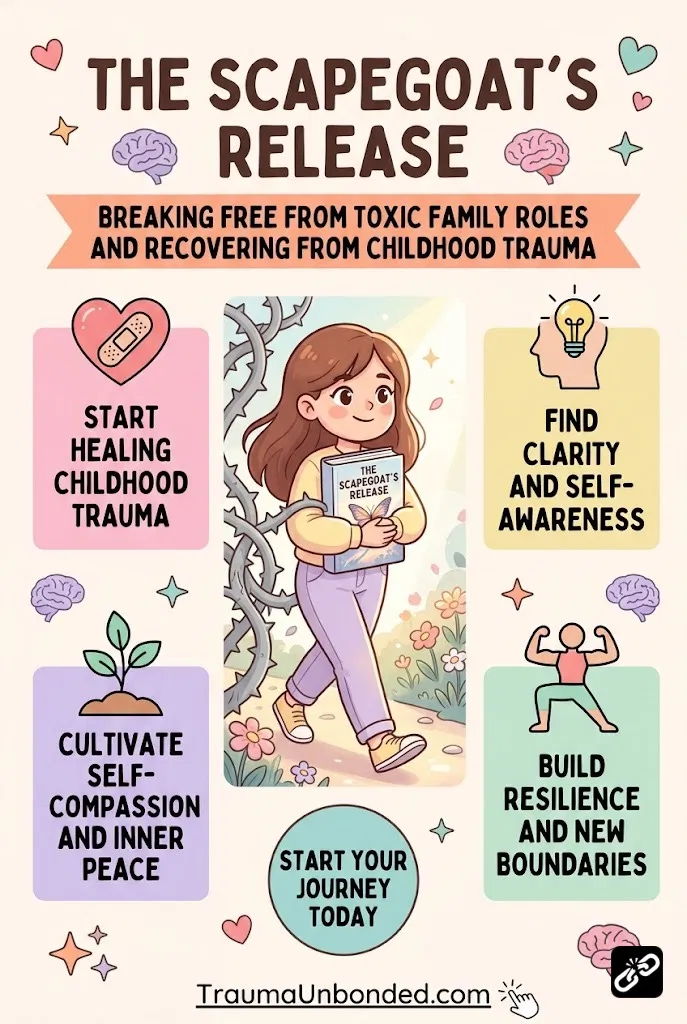
If you recognize yourself in any of this, there is a structured, step-by-step resource that goes much deeper than a single article can. It was designed specifically for scapegoat survivors who are ready to break free from toxic family roles and finally stop carrying everyone else’s weight.
The Healing Blueprint: Where to Actually Start

Healing from narcissistic family scapegoating is not linear, and it’s not fast. But there is a direction. There are real, concrete things you can do that shift the internal landscape over time. Here’s where to begin.
Step 1: Name What Happened
The first and most foundational step is simply naming the abuse for what it was. Not “my family was difficult.” Not “my mom had a hard life.” The scapegoat role involves real, repeated emotional abuse, and calling it that matters.
This is harder than it sounds. Most scapegoats have been gaslit for decades, which means they’ve been made to doubt their own experience over and over. Gaslit children become adults who automatically minimize their own pain and make excuses for people who hurt them. Breaking that habit starts with honest language.
Step 2: Grieve the Family You Deserved
One of the most overlooked parts of scapegoat recovery is grief. Not grief for the family you had, but grief for the family you should have had. The parents who should have seen you. The childhood that should have felt safe. That grief is real, and it needs space.
Many survivors skip this step because they feel guilty grieving something they never had. But your nervous system knows what it missed. Until you honor that loss, it keeps driving the bus, pulling you back toward familiar pain trying to finally get the ending it always wanted.
Step 3: Rebuild Your Internal Authority
Scapegoats are trained to outsource their sense of reality. They learn early that their perceptions can’t be trusted because the family kept telling them they were wrong. Rebuilding internal authority means learning to trust yourself again, your feelings, your memory, your gut instincts.
Journaling is one of the most practical tools for this. Writing down what happened, what you felt, and what you observed starts to build an internal record that is yours. Nobody can gaslight a private journal. Over time, that record becomes a foundation for self-trust.
Step 4: Set Real Boundaries with the Family System
This is the step most people dread, and for good reason. When a scapegoat starts setting boundaries, the family system pushes back hard. Flying monkeys get deployed. These are other family members, sometimes well-meaning, sometimes not, who pressure you to “keep the peace” or “think about the family.”
Keeping the peace always means one thing in a narcissistic system: going back to being the scapegoat. Boundaries are not optional if you want to actually heal. They might mean low contact, no contact, or simply refusing to engage in certain conversations. Whatever form they take, they are not cruelty. They are self-preservation.
Step 5: Get Professional Support
Therapy is not a luxury for scapegoat survivors. It is close to essential. Specifically, a therapist who understands childhood emotional abuse, narcissistic family dynamics, and trauma is what you’re looking for. Not all therapists have this background, so it’s worth asking directly before you commit.
In my own recovery from a 12-year toxic relationship, therapy was the single thing that moved me from surviving to actually living again. The work you do in that room, untangling the old beliefs, learning to feel safe in your own body, is irreplaceable. No article or book fully substitutes for it, including this one.
The Identity You Get to Reclaim
Here’s something worth holding onto. The scapegoat role was never the truth of who you are. It was a function assigned to you by a system that needed someone to absorb its pain. Your sensitivity, your self-awareness, your ability to name dysfunction clearly, those are yours. They were always yours. The family just tried to make them liabilities.
Many scapegoat survivors, once they do the healing work, discover that those exact traits are their greatest strengths. The same depth of feeling that made you a target in a narcissistic family makes you an extraordinary friend, partner, and human being in safe relationships.
The path forward is real. It takes time, support, and a willingness to face some uncomfortable truths. But the version of you that exists on the other side of this work is not broken. That version is whole. Start with the steps in this article, lean into the grief, protect your boundaries fiercely, and if you’re ready for a deeper, more structured approach, The Scapegoat’s Release can walk you through the full process, step by step, in your own time.

Meet Your Guide
Helen Brooks
After surviving a 12-year NPD/BPD relationship, I dedicated over a decade to studying trauma bonding and nervous system recovery. My mission is to help you break free from the fog and reclaim your authentic self.
Ready to break the trauma bond and reclaim your life?