The Power of Silence After Narcissistic Abuse: 7 Things That Happen
There’s a moment, right after you stop responding to a narcissist, when the silence feels unbearable. It feels like you’re holding your breath underwater. Your body is screaming at you to reach out, to explain yourself one more time, to fix something that was never yours to fix. I know that feeling. I lived inside it for 12 years.
But here’s what nobody told me back then: silence is not emptiness. Silence is power. And when you finally learn to wield it, everything changes. Not overnight. Not painlessly. But permanently. If you’ve been searching for answers about what happens when you go silent on a narcissist, you’re in the right place. I want to walk you through the seven things that actually happen, from someone who lived it.
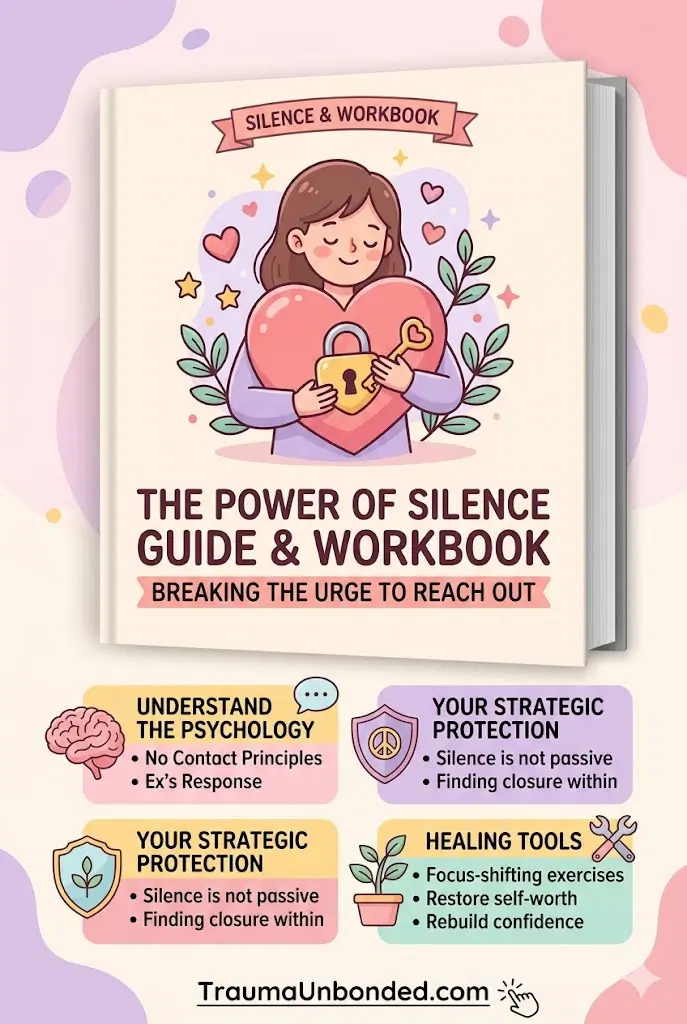
If you’re struggling with the urge to break your silence right now, The Power of Silence Guide & Workbook was built for exactly this moment. It gives you the structure your nervous system is craving when willpower alone isn’t enough.
1. The Narcissist Loses Their Primary Source of Supply

Here’s something that took me years to truly understand: narcissistic supply isn’t just about praise or admiration. Your emotional reactions, your tears, your desperate text messages at 2 AM, your anger, even your confusion… all of it is fuel. Every single response you give, positive or negative, feeds their sense of control.
When you go silent, you cut off that fuel line. And they feel it immediately. During my relationship, I noticed that my ex would escalate arguments specifically to get a reaction out of me. It didn’t matter if I was agreeing or fighting back. What mattered was that I was engaged. The moment you stop reacting to a narcissist, you become unpredictable to them. And unpredictable is the one thing they cannot tolerate.
2. You Start Hearing Your Own Thoughts Again
This one caught me off guard. After years of constant conflict, gaslighting (being told your memory is wrong, that you’re “too sensitive,” that things you clearly witnessed never happened), and walking on eggshells, I had forgotten what my own inner voice sounded like.
The first few weeks of silence felt disorienting. Almost like a ringing in my ears had suddenly stopped and the quiet was too loud. But slowly, my own thoughts started to surface. My own preferences. My own opinions. Have you ever realized you don’t even know what kind of music you actually like because you spent years listening to theirs? That’s what I mean.
Silence gives you back the mental space that was occupied by obsessive thoughts about your narcissistic ex. If you find yourself stuck in loops of replaying arguments, learning to stop ruminating is one of the most important skills you can build right now.
3. The Hoovering Begins (And It Tests Everything)
Let me be honest about this part. When you go silent after narcissistic abuse, hoovering almost always follows. Hoovering is when your ex tries to suck you back in, like a vacuum cleaner, with sweet messages, fake emergencies, apologies that sound perfect, or even showing up where they know you’ll be.
After I went no contact, my ex cycled through every tactic in the book. The “I’ve changed” texts. The “I just need closure” calls. The mutual friend who casually mentioned how heartbroken they were. Each one hit like a wave of adrenaline. My hands would shake. My chest would tighten. Trauma bond withdrawal is real, and hoovering is designed to exploit it.
But here’s the thing: your silence during hoovering is the most powerful statement you will ever make. It says, “I am no longer available for this.” If you need a tactical plan for handling narcissist hoovering tactics, please read that before they reach out again.
4. Your Nervous System Begins to Regulate

For over a decade, my body was stuck in fight-or-flight mode. I didn’t even realize it until a therapist pointed out that my cortisol levels were through the roof, my sleep was fractured, and I was clenching my jaw so hard I cracked a molar. Living with someone who has NPD and BPD traits keeps your nervous system in a constant state of alert. You’re always scanning for danger. Always bracing for the next mood shift.
When you maintain silence and no contact after narcissistic abuse, your body slowly starts to come down from that hypervigilant state. It doesn’t happen in a week. For me, it took months. But one morning I woke up and realized my shoulders weren’t up by my ears. I took a full breath without feeling like something terrible was about to happen. That small moment was everything.
5. They May Try to Punish You
Not every narcissist responds to your silence with hoovering. Some respond with rage. Narcissistic injury, the deep wound they feel when they lose control over you, can trigger smear campaigns, flying monkeys (people they recruit to do their bidding), or outright threats.
I experienced this firsthand. When the sweet tactics didn’t work, my ex began telling mutual friends distorted versions of our story. Painting me as the unstable one. The cruel one. It hurt in ways I can barely describe. But even through that pain, I held my silence. Not because I didn’t want to defend myself. God, I wanted to scream the truth from the rooftops. But because I knew that engaging would only feed the cycle.
Your silence in the face of a smear campaign is not weakness. It is the hardest kind of strength. The people who matter will eventually see through the distortion. The ones who don’t were never truly in your corner.
If you’ve been looking for a structured way to stay committed to your healing and stop breaking no contact, this guide was designed specifically for survivors in the thick of it:
6. You Rediscover Who You Were Before the Abuse
This is the part of the healing journey that people don’t talk about enough. After the withdrawal fades, after the hoovering attempts stop working, after your body begins to calm down, something unexpected starts to happen. You start remembering who you were before all of this.
I remember the exact moment. I was driving with the windows down, a song came on that I used to love in college, and I laughed out loud for no reason. Just pure, uncomplicated joy. It had been so long since I’d felt that. I had spent 12 years molding myself around someone else’s moods, someone else’s rules, someone else’s version of reality. Silence after narcissistic abuse gave me the room to find myself again.
You might feel like that person is gone forever. They’re not. They’re just buried under years of codependency, survival strategies, and trauma responses. The silence is what gives them air to breathe again. If you’re wondering why you feel addicted to the chaos, understanding the biochemical addiction behind trauma bonds can be a real turning point.
7. You Realize Silence Was Never About Them
Here’s the biggest shift that happens, and it usually comes last. You realize that going silent was never really about punishing the narcissist. It was never about winning or getting revenge. It was about choosing yourself, maybe for the first time in years.
For the longest time, I thought no contact was a strategy to make my ex regret losing me. And honestly? In the beginning, part of me hoped it would. But as the weeks turned into months, I stopped thinking about their reaction entirely. The silence became mine. It was my space. My peace. My decision.
The power of silence after narcissistic abuse isn’t about what it does to them. It’s about what it does for you. It rewires the patterns. It breaks the cycle of intermittent reinforcement, that addictive push-pull dynamic where they alternate between cruelty and affection to keep you hooked. It teaches your brain that safety doesn’t require their approval.
What If You Break Your Silence?
Let me say this clearly: if you’ve broken no contact, you are not a failure. I broke it multiple times before it finally stuck. Recovery from narcissistic abuse is not a straight line. It’s messy and human and full of setbacks. What matters is that you keep choosing silence again. Each time you do, the muscle gets stronger.
Don’t beat yourself up. Learn from the slip. Notice what triggered it. Was it loneliness? A trauma anniversary? A hoovering attempt you weren’t prepared for? Name it, write it down, and build a plan for next time.
The silence you’re building right now is the foundation of your entire recovery. It’s the thing every other healing step rests on. If you want a day-by-day framework to hold you through the hardest moments, The Power of Silence Guide & Workbook will walk you through breaking the urge to reach out and turning your silence into lasting freedom.

Meet Your Guide
Helen Brooks
After surviving a 12-year NPD/BPD relationship, I dedicated over a decade to studying trauma bonding and nervous system recovery. My mission is to help you break free from the fog and reclaim your authentic self.
Ready to break the trauma bond and reclaim your life?