Scapegoat No Contact: What Happens When You Leave the Family
Scapegoat no contact is often the final, desperate step for someone who has spent their entire life being the family punching bag. When you finally decide to walk away from a toxic family system, you aren’t just leaving a group of people; you are resigning from a role you never asked for. For twelve years, I stayed in a relationship with a partner who had both NPD and BPD traits, and I realized that my role in that relationship was exactly like the one I held in my family: the one who carried all the blame. If you are struggling with the guilt of leaving, The Scapegoat’s Release can help you process these heavy emotions and start your recovery.
What happens when the family scapegoat goes missing? The system depends on you to be the “bad one” so they don’t have to look at their own shadows. When you remove yourself, the balance is thrown into total chaos. Are they going to apologize? Probably not. Instead, they will likely try to pull you back in using every trick in the book. I remember feeling like the world was ending when I first cut ties, but that was just the trauma bond talking, not reality.
Choosing no contact with toxic parents or siblings is a survival move. It is about protecting your nervous system from constant gaslighting and emotional attacks. You might feel like a “bad” daughter or son, but you are actually just a person who finally chose to stop being a target. How many times can you be blamed for things you didn’t do before you finally decide you’ve had enough?
The Immediate Fallout of Scapegoat No Contact
The moment you go no contact, the family often starts a smear campaign. They need to explain your absence in a way that keeps them looking like the victims. They will tell aunts, uncles, and family friends that you are “unstable,” “difficult,” or “ungrateful.” During my decade-long toxic relationship, I saw this happen every time I tried to set a boundary. My ex would tell our mutual friends that I was the one causing the drama, making me feel isolated and crazy.
You will likely encounter “flying monkeys.” These are family members or friends who act as messengers for the narcissistic parent. They will call you to say things like, “Your mother is so worried, why are you doing this?” or “Family is everything, you should just move on.” It feels like a coordinated attack because, in a way, it is. They want you back in your role so the family can go back to its “normal” level of dysfunction. Dealing with narcissist flying monkeys requires a steel spine and a commitment to your own truth.
The silence that follows can be deafening. You might expect a realization or an apology, but usually, there is only more blame-shifting. In a narcissistic family dynamic, there is no room for accountability. If they admit they treated you poorly, their whole reality falls apart. So, they double down on the idea that you are the problem. Have you noticed how they never seem to talk about what they did to push you away?
The Internal Battle of Breaking the Trauma Bond
Leaving the family is a physical departure, but the mental battle is much harder. You are likely dealing with cognitive dissonance, which is that painful feeling of having two opposite thoughts at once. You love them because they are family, but you hate how they treat you. This conflict kept me stuck for twelve years. I kept waiting for my partner to be the person they were during the “good times,” but those times were just a mask. In a family setting, this is called intermittent reinforcement, where the occasional crumb of kindness keeps you hooked.
Guilt is the primary tool they use to keep the scapegoat in line. You have been conditioned since childhood to feel responsible for everyone else’s emotions. When you go no contact, that guilt can feel like a physical weight in your chest. You might find yourself checking your phone constantly, waiting for a nasty text or a fake “I miss you” that only leads to more pain. It is a literal addiction to the chaos that you have to break, one day at a time.
The first few months are the hardest. You will probably ruminate on every argument you ever had, trying to figure out if you really were the “crazy” one. This is the trauma bond screaming for its fix. I spent years in therapy learning that my “original self” was buried under layers of survival tactics. I wasn’t actually a miserable person; I was just a person in a miserable situation. Are you starting to see that your “difficult” personality was actually just a reaction to being mistreated?
If you feel like you are losing your mind trying to navigate the guilt and the confusing messages from your family, you need a structured plan to stay firm in your decision. Reclaiming your identity starts with refusing to accept the labels they placed on you.
Rebuilding Your Identity After the Family Smear Campaign
When you leave, you finally have the space to figure out who you actually are. For the longest time, I didn’t have any hobbies or interests. My entire existence was dedicated to managing my partner’s moods. When I went no contact, I realized I didn’t even know what kind of music I liked or what I wanted to do on a Saturday morning. This is the scapegoat’s greatest challenge: filling the void left by the drama with things that actually bring you joy.
You might find yourself struggling with C-PTSD symptoms like hypervigilance. This is your brain staying on high alert, waiting for the next “hit” from your family. Even when you are no contact, you might jump when the phone rings or feel a wave of anxiety when you see a car that looks like theirs. This is a normal part of trauma recovery. Your body is still trying to protect you from a threat that is no longer there. Following a scapegoat no contact guide can help you navigate these physiological responses.
As the months pass, you will notice a strange thing happening: you feel lighter. The “brain fog” starts to lift. You stop apologizing for things that aren’t your fault. You might even start to feel cheerful and optimistic again. I remember the day I realized I hadn’t thought about my ex’s opinion on my choices for a full twenty-four hours. That was the moment I knew I was returning to my “original self.” It wasn’t about “fixing” myself, but about removing the people who were breaking me.
The New Family Dynamic Without a Scapegoat
What happens to the family once the scapegoat is gone? Since the system needs someone to blame to stay “stable,” they will usually turn on each other. Often, a new scapegoat is chosen. This might be a “golden child” who is suddenly no longer perfect, or a spouse who was previously on the sidelines. The toxic family roles must be filled. Watching this from a distance can be painful, but it also validates everything you felt. It proves that the problem was never you; it was the system itself.
Don’t be surprised if they try to “hoover” you back in when the internal fighting gets too bad. They might use a health crisis, a holiday, or a fake apology to test your boundaries. They don’t miss you; they miss the service you provided by being the target for their frustration. Staying strong during these times is crucial. If you go back, the abuse will likely be worse than before because they want to punish you for leaving in the first place.
Your life now is about radical acceptance. You have to accept that they may never change, and that is okay because you have changed. You are no longer willing to trade your peace for their comfort. I found that my true “family” was made of the friends I reconnected with and the new, healthy people I met once I stopped vibrating at the frequency of trauma. You deserve a life where you are celebrated, not just tolerated. Isn’t it time you gave yourself the permission to be happy?
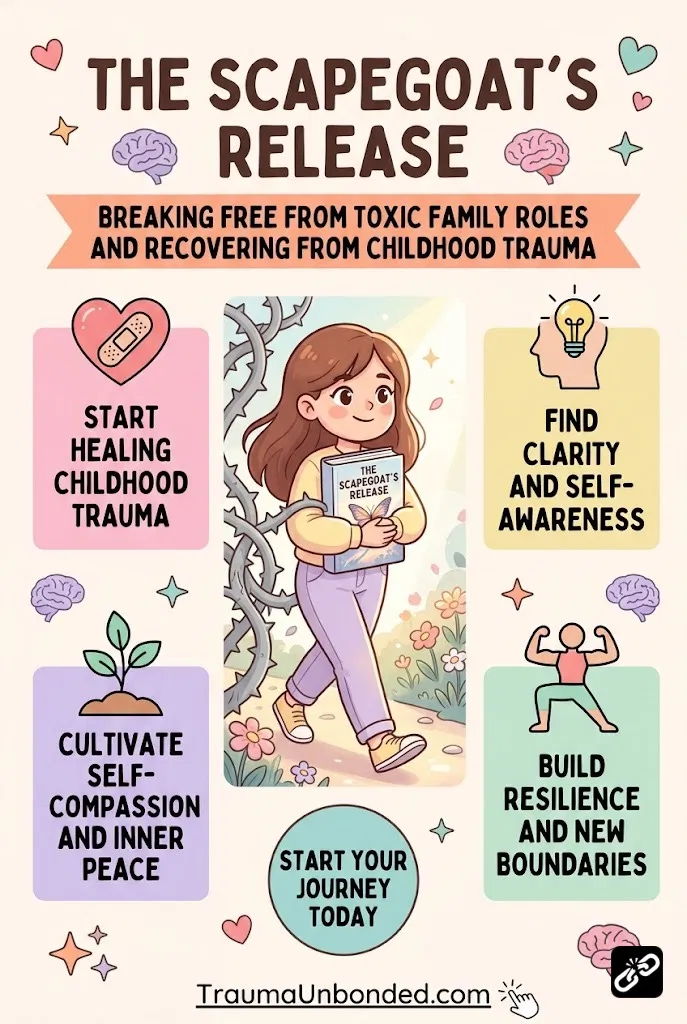
Leaving a toxic family is the hardest thing you will ever do, but it is also the most rewarding. By choosing scapegoat no contact, you are breaking a cycle of generational trauma that might have gone back decades. You are the one who had the courage to say “no more.” As you continue your journey, remember that your worth is not defined by their inability to see it. For more support on this path, I highly recommend looking into The Scapegoat’s Release to help you anchor your new identity in truth and peace.

Meet Your Guide
Helen Brooks
After surviving a 12-year NPD/BPD relationship, I dedicated over a decade to studying trauma bonding and nervous system recovery. My mission is to help you break free from the fog and reclaim your authentic self.
Ready to break the trauma bond and reclaim your life?