Learn to Trust Yourself Again After a Narcissistic Breakdown
Trusting yourself again after a narcissistic breakdown feels like trying to rebuild a house while the ground is still shaking. If you are currently wondering why you can’t even pick a brand of cereal without second-guessing your choice, please know you are not losing your mind. I spent twelve years in a relationship with a partner who displayed heavy NPD and BPD traits, and by the end, I was a shell of a person. I had no hobbies left, my friends were long gone, and my internal compass was spinning in circles. For years, I believed I was the problem because I was told so every single day.
The journey to trust after a narcissistic breakdown is not a straight line, but it is possible to find your way back. During my recovery, I had to accept that my inability to trust myself was a survival mechanism, not a character flaw. When you live with someone who constantly moves the goalposts, your brain stops trusting its own perceptions just to keep the peace. You might find yourself checking out the Healing from Gaslighting guide to understand how your reality was systematically dismantled.
Why does it feel so impossible to make a simple decision today? It is because your self-trust was the first thing they had to break to keep you under control. After a decade of hearing that my memories were “wrong” or my feelings were “crazy,” I simply stopped having them. Rebuilding that inner voice takes time, patience, and a lot of grace for the person you became while you were just trying to survive the storm.
Understanding the Shattered Identity After a Toxic Collapse
A narcissistic breakdown usually happens when the cognitive dissonance finally snaps. You reach a point where you cannot reconcile the person you love with the person who is hurting you. In my case, it felt like a total system failure. I woke up one day and realized I didn’t know what I liked to eat, what music I enjoyed, or what I wanted for my future. Everything had been centered around managing my partner’s volatile moods and avoiding the next explosion.
This collapse is terrifying, but it is also the beginning of your freedom. When the “false self” you created to appease the abuser falls away, it leaves a vacuum. Have you noticed how quiet your house feels now, yet your head is still incredibly loud? That loudness is the leftover programming of their voice telling you that you are incapable. Healing from emotional abuse means learning to turn down the volume of their criticism and turning up the volume of your own needs.
In those early months after the split, I felt like a child learning to walk. I had to learn how to rebuild self-worth after discard because I truly felt worthless. I was isolated and miserable, but therapy helped me see that my “miserable” state was actually a very normal reaction to an abnormal situation. You aren’t broken; you are just recovering from a long-term psychological war.
Reclaiming Your Reality From the Fog of Gaslighting
Gaslighting is a slow poison that makes you doubt your own eyes. In a 12-year relationship, it becomes the air you breathe. My ex would say something cruel, and then ten minutes later, swear they never said it. Eventually, I started recording conversations just to prove to myself that I wasn’t imagining things. Does that sound familiar? If you’ve ever felt the need to keep a “evidence log” just to stay sane, you’ve experienced deep psychological manipulation.
To trust your intuition again, you have to start with very small, undeniable truths. Start by acknowledging physical sensations. If you feel cold, you are cold. If you feel tired, you are tired. These tiny anchors of reality help reattach your mind to your body. After years of being told your feelings are “wrong,” simply admitting that you feel sad or angry is a massive win. You don’t need anyone to validate these feelings anymore. They are yours, and they are real.
I found that trauma-informed healing was the only way out of the fog. I had to understand how the trauma bond worked, which is essentially a biochemical addiction to the highs and lows of the relationship. When you stop the cycle, your brain goes through actual withdrawal. It is during this withdrawal that the self-doubt is at its strongest. You might feel the urge to go back just to stop the pain, but remember: the person who caused the wound cannot be the one to heal it.
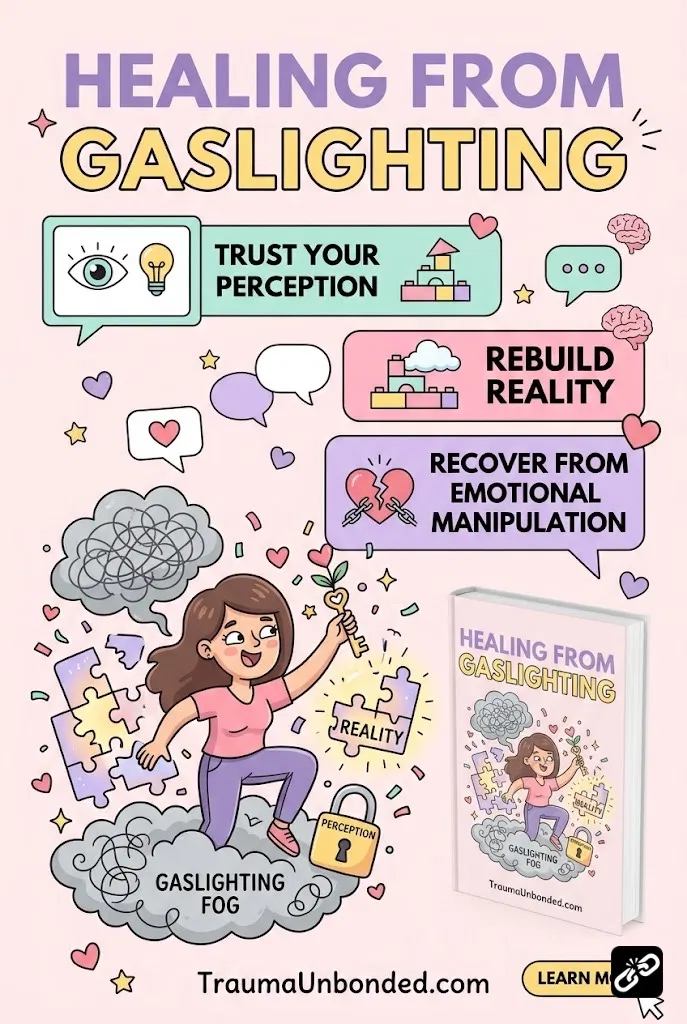
If you are struggling to make sense of the lies and the distorted reality you lived in for years, you need a structured way to get your feet back on solid ground. This guide was the turning point for me in understanding how to trust my own eyes again.
Practicing Micro-Decisions to Build Confidence
One of the hardest parts of my recovery was the “decision paralysis.” I was so used to being criticized for making the “wrong” choice that I stopped making choices altogether. To fix this, I started practicing micro-decisions. This means making small, low-stakes choices and forcing myself to stick with them. What color socks do I want to wear? What path should I take for my walk? Do I want tea or coffee? It sounds silly, but these are the building blocks of self-trust.
Every time you make a choice and the world doesn’t end, your brain learns that it is safe to have an opinion. In a narcissistic relationship, your opinions were threats to their control. Now, your opinions are the tools of your independence. When you feel that old familiar panic rising up—that “What if I’m wrong?” feeling—stop and breathe. Remind yourself that even if a small choice is “wrong,” you have the right to make mistakes. You are no longer under a microscope.
I also had to deal with the fawn response, which is the habit of people-pleasing to stay safe. I would find myself agreeing with people I just met because I was terrified of conflict. If you find yourself doing this, try to heal gaslighting trust issues by pausing before you speak. Ask yourself: “Do I actually agree with this, or am I just trying to be safe?” It takes effort to separate your true voice from your survival voice.
The Return of Your Original Self
People often ask me if they will ever feel “normal” again. I can tell you from the other side of a 12-year nightmare that you won’t just feel normal; you will feel better. My “original self” was someone who loved to laugh and see the best in people. That person didn’t die; they just went into hiding. Once I cleared out the toxic influence and worked through my codependency issues, that cheerful, optimistic person came back out.
How do you know you are getting there? You start to feel grounded. You stop looking over your shoulder. You start to enjoy your own company again. I remember the first time I spent a whole Saturday alone and didn’t feel a sense of impending doom. I actually enjoyed my coffee, read a book, and felt peaceful. That peace is the ultimate indicator that your nervous system is finally regulating itself.
Recovery isn’t about forgetting what happened. It is about integrating the experience so it no longer controls your future. You are now equipped with a “BS detector” that is incredibly sharp. While it feels like a burden now, this heightened intuition will protect you for the rest of your life. You have been through the fire, and the person you are becoming is much stronger than the person you were before the relationship started.
The road back to your own mind is long, but every step away from the abuse is a step toward your true self. If you need more help navigating the confusion and reclaiming your perception of the world, I highly recommend checking out the Healing from Gaslighting guide. You deserve to trust your own heart again.

Meet Your Guide
Helen Brooks
After surviving a 12-year NPD/BPD relationship, I dedicated over a decade to studying trauma bonding and nervous system recovery. My mission is to help you break free from the fog and reclaim your authentic self.
Ready to break the trauma bond and reclaim your life?