Navigating Friendships When Your Mutual Friends Can’t See the Narcissist’s Real Self
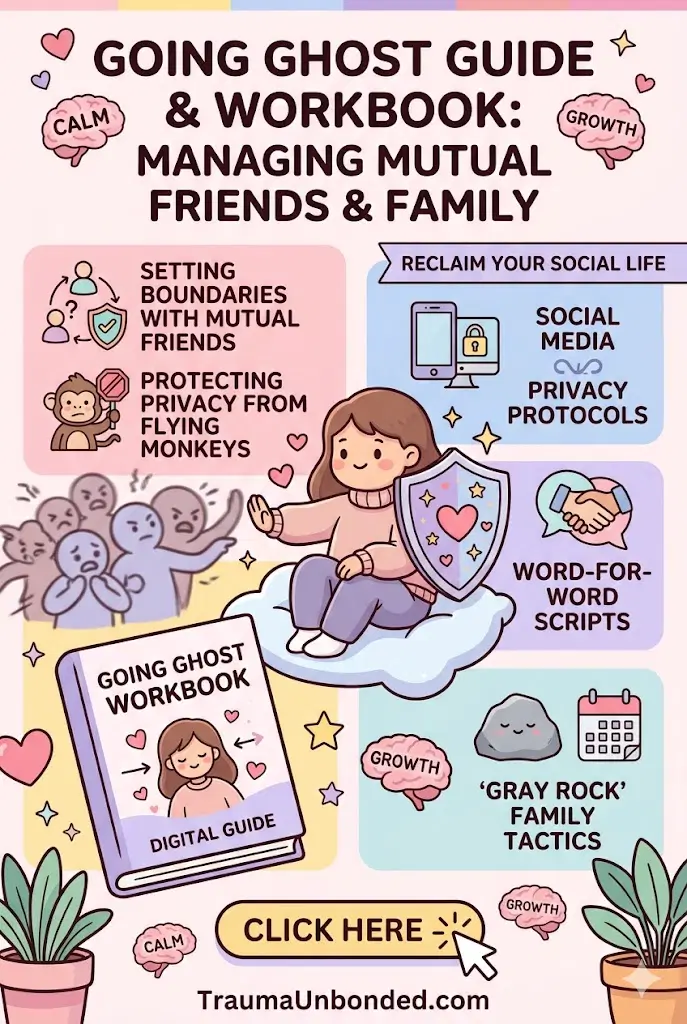
If you are trying to pick up the pieces of your life, dealing with mutual friends after narcissistic abuse can feel like a secondary betrayal. You escaped a toxic relationship only to find that the people you used to laugh with are still laughing with your narcissistic ex. It is incredibly isolating when your social circle remains charmed by the very person who shattered your mental health. To protect your sanity and learn how to manage these delicate social dynamics, downloading the Going Ghost Guide & Workbook: Managing Mutual Friends and Family Pressure can give you the exact steps to handle this pressure.
I know this pain deeply because I spent twelve years in a toxic partnership with someone who exhibited both narcissistic and borderline personality traits. When the relationship finally collapsed, I was completely devastated, cut off from my old friends, and left without a single hobby or outlet. My life felt utterly miserable while my ex continued to play the perfect, charming friend to everyone we knew.
Through years of professional therapy, I finally began to understand the mechanics of codependency and trauma bonds. I learned that my ex’s public persona was entirely separate from the emotional destruction that happened behind closed doors. If you are struggling with friends who still defend your abuser, you are not crazy, and you do not have to fight for their validation.
Why Mutual Friends Fail to See the Narcissist’s True Persona
Mutual friends often fail to see a narcissist’s true behavior because toxic individuals maintain a highly calculated, charming public mask to secure social validation, keeping their abusive actions strictly hidden behind closed doors.

During my twelve-year relationship, my ex was always the life of the party, buying drinks and offering favors to everyone in our circle. Nobody saw the icy silence, the gaslighting, or the sudden rages that waited for me the moment we got in the car to go home. Why would our friends believe my pain when all they ever saw was a generous, charismatic soul?
Narcissists spend years grooming their social environments to build a solid wall of positive reputation. They use this public approval as a shield. When you finally speak up, the contrast is so sharp that your friends naturally experience deep cognitive dissonance. They often prefer to believe you are overreacting rather than accept that their fun friend is capable of emotional cruelty.
Setting Firm Boundaries with Friends Who Stay in Contact
It is a brutal realization that some people will choose to remain neutral. They might tell you they do not want to get involved, or that your ex has always been nice to them. While this feels like a punch in the gut, you must realize their neutrality is actually a choice to ignore your pain.
You cannot force anyone to see the truth of what you went through. Trying to convince them only makes you look unstable and obsessed, which plays right into the narcissist’s hands. Learning how to handle mutual friends after a toxic breakup is not about winning an argument, but about preserving your limited healing energy.
If you decide to keep these friendships, you must set clear, non-negotiable boundaries. Let them know that you will not discuss your ex, and that you do not want to hear any updates about them. If they cannot respect this simple request, they do not deserve a place in your healing space.
Taking back control of your social life requires a practical strategy. When mutual friends pressure you to play nice or share information, you need a structured plan to stay grounded. The guide below provides the tools and boundary templates you need to handle these exact high-pressure situations without losing your peace.
Protecting Your Peace and Rebuilding Your Social Circle

When you are recovering, your primary job is to lower your nervous system’s stress levels. You cannot heal while constantly monitoring what a mutual acquaintance might feed back to your ex. In many cases, people who refuse to see the truth end up acting as flying monkeys, who often participate in abuse by proxy by spreading false narratives and gathering intelligence.
This is why a toxic breakup survival guide is so vital; it helps you realize that losing certain friends is actually a form of protection. I remember the terror of attending social events where I knew my ex’s allies would be watching. I felt like a ghost in my own life.
But as I leaned into therapy and understood how my trauma bond kept me hooked, I slowly rebuilt my hobbies. I reconnected with genuine people who saw me for who I really was. Step by step, I found my way back to being cheerful, optimistic, and grounded.
Implementing a Strict Information Diet
If you choose to keep some mutual friends close, you must put them on an information diet immediately. This keeps your private recovery safe and starves the narcissist of the reaction they crave. Here is how you can practically manage what you share with mutual connections:
- Keep conversations superficial: Talk about movies, recipes, or sports. Avoid discussing your emotional healing, your career steps, or your dating life.
- Do not ask about your ex: Even a casual inquiry sends a signal that you are still hooked. Maintain total silence regarding their current life.
- Shut down gossip immediately: If a friend starts a sentence with “Did you know your ex…”, gently but firmly cut them off. Say, “I have closed that chapter, let us talk about something else.”
By controlling the flow of information, you stop the toxic cycle from leaking into your new life. It teaches your brain that your safety is no longer dependent on what your ex is doing or saying. You gain the freedom to simply exist without constantly looking over your shoulder.
Accepting the Loss of Charmed Friends
Sometimes, the hardest truth to accept is that some friendships are casualties of the abuse. People who are easily manipulated by a charming mask cannot provide the deep, authentic connection you need during recovery. If they prefer the shiny lie over the painful truth, you must let them go.
Do not waste your precious healing energy trying to make them see the light. Focus instead on those who loved you before the darkness, or new friends who only know you as the resilient person you are today. Your true friends are the ones who stand by you when the mask slips, not the ones who applaud the performance.
Rebuilding your life after a twelve-year toxic fog taught me that peace is much quieter than a crowded room of superficial friends. You deserve to be surrounded by people who believe you, validate you, and do not make you feel like you are walking on eggshells. If you are struggling to manage the social fallout and need a clear roadmap, consider downloading the Going Ghost Guide & Workbook: Managing Mutual Friends and Family Pressure to help you navigate these difficult waters and reclaim your life.

Meet Your Guide
Helen Brooks
After surviving a 12-year NPD/BPD relationship, I dedicated over a decade to studying trauma bonding and nervous system recovery. My mission is to help you break free from the fog and reclaim your authentic self.
Ready to break the trauma bond and reclaim your life?