Quiet BPD Relationship: Spotting the Signs Before the Toxicity
Spotting quiet BPD relationship signs is often much harder than identifying the more explosive versions of Borderline Personality Disorder. If you feel like you are losing your mind because your partner is never “loud” but you are constantly exhausted, you might be dealing with the inward-facing version of this condition. For twelve years, I lived in a house where the tension was so thick I could barely breathe, yet there were no plates smashed on the floor.
Understanding these toxic relationship red flags early on is the only way to protect your sanity before the emotional drain becomes permanent. It took me a decade to realize that the crushing silence and the “victim” narrative were actually forms of manipulation. If you are struggling to make sense of the emotional roller coaster, you should look into The BPD Relationship Detox to start clearing the fog from your head.
Many survivors describe their quiet BPD partner as someone who is incredibly kind one moment and then completely cold the next. Have you ever felt like you did something wrong but you have no idea what it was? That is the hallmark of this dynamic. It is a slow erosion of your self-worth that leaves you feeling small, isolated, and totally confused about your own reality.
The Subtle Red Flags of a Quiet BPD Relationship
In a typical BPD dynamic, the rage is external. In a quiet BPD relationship, the partner turns that rage inward. Instead of yelling at you, they might disappear into a bedroom for three days. Instead of blaming you directly, they make sure you see how much they are “suffering” because of something you allegedly did. It is a form of emotional manipulation that uses guilt as a primary weapon.
During my twelve-year marriage, I became an expert at reading micro-expressions. I could tell by the way my partner set a coffee mug down that I was in for a week of the cold shoulder. This constant state of hypervigilance is what eventually breaks you down. You stop having your own hobbies. You stop seeing your friends because you are too tired to explain why your partner is “sad” again. Does this sound like your daily life?
One of the most common quiet BPD relationship signs is the “waif” persona. They appear fragile and helpless, making you feel like you are the only person who can save them. This creates a powerful trauma bond that is incredibly hard to break. You aren’t staying because things are great; you are staying because you feel responsible for their survival. You can learn more about these patterns by reading our guide on quiet BPD relationship signs.
The Silent Treatment as a Control Tactic
We often think of the silent treatment as a childish sulk. In a toxic BPD relationship, it is much more sinister. It is a way to punish you without leaving a mark. When my partner would stop speaking to me, I would spend hours ruminating over every word I had said that day. I was desperate to fix a problem I didn’t even create. This is how they maintain control: by keeping you in a state of constant apology.
This behavior is often called splitting. One day you are their hero, the next you are the villain who has “abandoned” them just by going to work or wanting a nap. Because they don’t scream, you might think they aren’t abusive. But the psychological weight of being erased for days at a time is a heavy burden to carry. It leaves you feeling like a ghost in your own home.
Walking on Eggshells and the Loss of Self
Living with someone with quiet BPD means you are always waiting for the other shoe to drop. You learn to scan the room the moment you walk in. Are they breathing heavily? Is their posture stiff? This constant nervous system dysregulation is why so many survivors end up with chronic fatigue or mystery illnesses. I remember being so focused on my partner’s moods that I forgot I actually liked hiking and painting. I became a shell of a person.
The toxicity in these relationships isn’t always found in what is said, but in what is unsaid. The heavy sighs, the slammed doors, and the “I’m fine” that clearly means they are not fine. This is passive-aggressive behavior taken to an extreme. Over time, you stop bringing up your own needs because it isn’t worth the three-day fallout. You simply disappear to keep the peace.
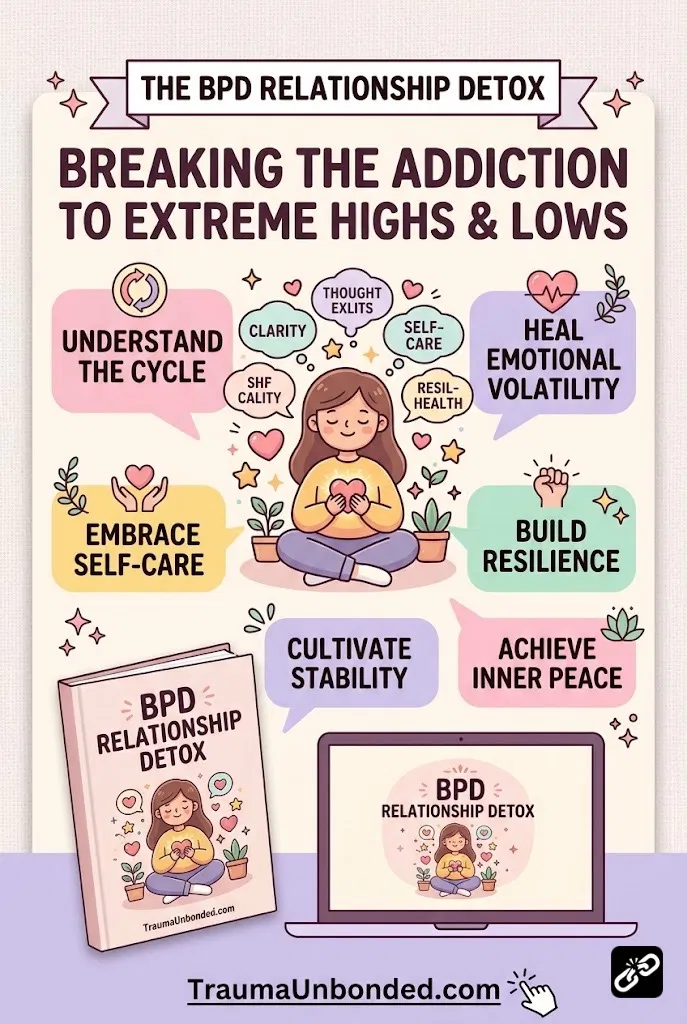
If you are currently feeling trapped and like you have lost your identity, it is time to start looking at the exit. The first step is realizing that you cannot “love” them into wellness. You need a clear plan to reclaim your mind. If you are struggling with the extreme highs and lows that keep you hooked, I highly recommend checking out the resource below to help you untangle the mess.
To finally stop the cycle of emotional exhaustion and regain your sense of reality, you need a structured path toward clarity. This guide was a turning point for many who felt they were losing their minds in the quiet chaos of a BPD partner.
Recovering from BPD Relationship Trauma

Breaking free from a quiet BPD relationship is a unique kind of pain. Because there was no physical abuse or screaming matches, you might feel guilty for leaving. Your friends might not understand because they only saw the “sweet” side of your partner. But you know the truth: you were being slowly erased. Recovering from BPD relationship trauma requires you to stop looking at their pain and start looking at your own.
When I finally left after twelve years, I didn’t know who I was. I had no friends left because I had spent a decade managing my partner’s crises. I felt like a failure. But through therapy and learning about codependency, I realized I was just a person who had been trained to be a full-time caretaker. Healing started when I stopped trying to understand why they did it and started asking why I accepted it for so long.
If you are in the middle of a discard or thinking about leaving, check out our BPD breakup recovery guide. It will help you navigate the intense feelings of abandonment that often come with these splits. Remember, their inability to regulate their emotions is not your fault. You are allowed to be happy without feeling like you are “hurting” someone else just by existing.
Finding Your Original Self Again
People often ask me how I became so optimistic again after such a long time in the dark. It wasn’t an overnight change. It was a million tiny choices to put myself first. I started with small things: eating food I liked, listening to music they hated, and sleeping in the middle of the bed. These small acts of self-care eventually lead to bigger breakthroughs.
You can return to the person you were before the trauma bond took over. That cheerful, grounded version of you is still in there. They are just buried under layers of someone else’s shame. Do you remember what you used to love before the relationship became your full-time job? Go find that thing again. Whether it is a sport, a book, or just sitting in silence without waiting for a sigh, do it for you.
The road to healing is not linear. You will have days where you miss them, and that is okay. That is just the biochemical addiction talking. Stay the course. The peace on the other side is worth every difficult step of the journey. You deserve a life where you aren’t managing someone else’s internal weather. You deserve to be seen, heard, and truly loved without the hidden price tag of quiet BPD.
If you need more help navigating the complexity of these emotions, don’t hesitate to use The BPD Relationship Detox to find your way back to clarity. You have already done the hardest part by surviving. Now, it is time to start living.

Meet Your Guide
Helen Brooks
After surviving a 12-year NPD/BPD relationship, I dedicated over a decade to studying trauma bonding and nervous system recovery. My mission is to help you break free from the fog and reclaim your authentic self.
Ready to break the trauma bond and reclaim your life?