
How to Stop Over-Explaining Yourself to People Who Do Not Respect Your Boundaries
Learning how to stop over-explaining yourself to people who do not respect your boundaries is a massive turning point in your healing journey. For 12 painful years, I lived with a partner who struggled with intense NPD and BPD traits, and I spent almost every single day explaining my basic choices. I thought that if I could only find the perfect combination of words, they would finally understand my heart and respect my wishes.
Instead, that exhausting loop left me completely devastated, isolated from my closest friends, and without any of the creative hobbies that used to bring me joy. I felt absolutely miserable, operating under the false belief that my lack of clarity was the reason our relationship was so chaotic. When you are trapped in that kind of toxic cycle, you slowly lose touch with who you are and become a stranger to yourself.
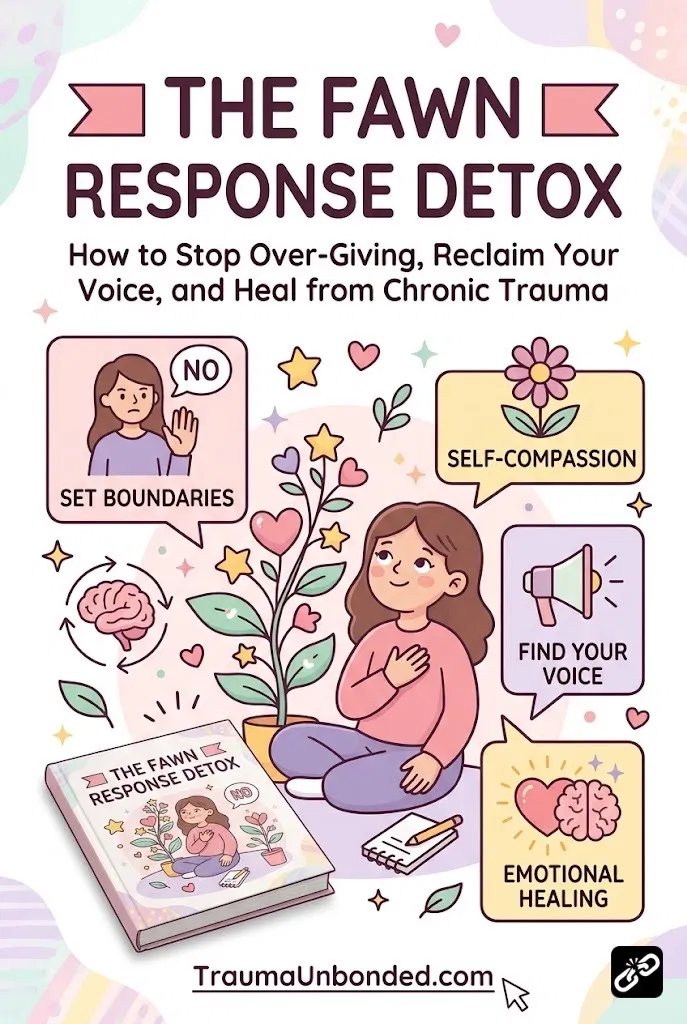
Reclaiming my cheerful, optimistic original self did not happen overnight; it required professional therapy to dismantle my deep codependency. Today, as someone who made it to the other side, I want to show you how to quiet that urgent need to justify your existence. If you are tired of giving away your energy, exploring resources like The Fawn Response Detox can help you rebuild your sense of personal agency.
Why We Over-Explain Ourselves After Narcissistic Abuse
To stop over-explaining yourself to people who do not respect your boundaries, you must realize that your explanations are being used as opportunities for negotiation. State your decision clearly and once, then refuse to justify, argue, or defend your choices.
When you spend over a decade walking on eggshells, your nervous system learns that explaining your actions is a survival strategy. This behavior, known as fawning, is an automatic attempt to appease a threat and keep yourself safe from sudden outbursts. In my past relationship, I would explain every detail of my day, trying to preemptively clear myself of any imagined wrongdoing.
You do not over-explain because you are weak or because you lack intelligence. You do it because your body still remembers the pain of being unjustly accused or punished. According to clinical studies on stress responses published by Psychology Today, fawning is a survival strategy where you seek safety by accommodating the needs of an abusive partner at the expense of your own limits. If you want to break this habit, you must learn to recognize your personal fawn response traits as survival tools that you have simply outgrown.
Why do we keep talking to people who clearly do not care about our peace? When a toxic partner demands to know why you are changing your plans, they are not looking for a mutual understanding. They are looking for a crack in your armor, a piece of information they can twist to make you feel guilty or wrong.
The High Cost of Trying to Rationalize with Someone Who Lacks Respect
When you deal with people who do not respect your boundaries, every explanation you provide is viewed as a point of negotiation. If you say you cannot attend an event because you are exhausted, they will argue that you are lazy or that you do not care about them. They use your vulnerability as raw material to construct a narrative where you are always the villain.
In the psychological recovery community, we refer to this exhausting loop as the trap of J.A.D.E., which stands for Justifying, Arguing, Defending, and Explaining. During my 12-year relationship, I constantly felt forced to defend my basic human needs, such as sleeping or visiting my family. I did not realize that by defending my choices, I was silently giving my partner the authority to approve or disapprove of my life.
To heal, you must learn to separate your inner truth from the noisy criticisms of others. A crucial part of this recovery is learning to distinguish your voice from the narcissist’s inner monologue that might still run inside your mind. Once you realize their voice is not your own, you can begin to trust your own instincts again.
If you find yourself constantly exhausting your energy trying to make difficult people understand your worth, it is time to actively retrain your mind. You do not have to live in a state of constant defensiveness or let others drain your peace of mind. To help you quiet the urge to please others, step out of the fawning trap, and reclaim your personal power, I highly recommend checking out this practical recovery resource.
Practical Steps to Stop Over-Explaining and Protect Your Sanity
Breaking a deeply ingrained survival habit takes time, patience, and a willingness to sit with the temporary anxiety of someone else’s anger. When I first started setting limits, my heart would race and my hands would shake just from saying no. Here are a few practical strategies that helped me rebuild my boundaries and protect my mental space:
- Embrace the power of brief statements: You do not need to attach an apology or a story to your choices. A simple, polite “I am not able to do that” is a complete sentence that requires no further explanation.
- Utilize a low-contact strategy: If you cannot cut ties completely due to family or work obligations, keeping your interactions structured and minimal is vital. Using a low-contact strategy will help you protect your emotional budget.
- Implement the 24-hour rule: When you receive a hostile or demanding text, do not reply immediately. Give your nervous system a chance to calm down before sending a brief, neutral response.
What happens when we stop feeding the fire with our explanations? At first, the other person might escalate their behavior, trying harder to get a reaction out of you. But as you remain consistent, they will slowly realize that their usual emotional hooks are no longer working on you.
Recognize When You Are Being Hooked Back In
Manipulative individuals are incredibly skilled at using bait to make you defend your choices. They might ask seemingly innocent questions like, “Why are you being so cold?” or “What did I do to deserve this?” They want you to explain yourself so they can find a way to make you feel responsible for their feelings.
When you refuse to explain, you reclaim your personal authority. Your decisions do not need their approval to be valid, and your boundaries do not need to be agreed upon to be respected. You are allowed to walk away from conversations that are designed to make you doubt your own sanity.
Do you remember who you were before you felt the need to apologize for your basic preferences? Rebuilding that cheerful, grounded version of yourself starts with holding your ground without feeling the need to convince everyone of your right to do so.
Your energy is your most precious currency, and you do not owe explanations to people who only use them to build a case against you. Walking away from the need to be understood by everyone was the hardest thing I ever did, but it was also the only way I reclaimed my life. If you are ready to stop exhausting your mental energy to keep toxic people comfortable, take a moment to look at The Fawn Response Detox and begin taking back your peace of mind today.

Meet Your Guide
Helen Brooks
After surviving a 12-year NPD/BPD relationship, I dedicated over a decade to studying trauma bonding and nervous system recovery. My mission is to help you break free from the fog and reclaim your authentic self.
Ready to break the trauma bond and reclaim your life?