5 Critical Lessons from “Psychopath Free” for Healing After Narcissistic Abuse
I picked up Psychopath Free by Jackson MacKenzie about eight months after leaving a 12-year relationship with someone who had both narcissistic and borderline traits. I was a mess. Not the poetic, cinematic kind of mess. The real kind. Dishes in the sink for a week, no plans on the weekend, sitting in a parking lot crying because a song came on the radio.
A friend texted me a link to the book. I almost didn’t read it. I thought, “Another self-help thing that will tell me to meditate and journal.” But this one was different. What MacKenzie wrote felt like someone had been watching my relationship from the inside. It named things I had no language for. And it started something in me that therapy later built on.
This is not a book review. This is a breakdown of the five lessons from Psychopath Free that genuinely moved the needle in my recovery, with context about why they work, what science says, and how you can apply them starting today.

Lesson 1: You Were Targeted, Not Broken
One of the first things Psychopath Free gets right is something most people spend years trying to figure out on their own: you did not end up in this relationship because something is fundamentally wrong with you.
MacKenzie talks about how narcissists, sociopaths, and psychopaths are skilled at identifying people who are empathetic, loyal, and forgiving. Those are not character flaws. Those are qualities that were weaponized against you. Psychopaths are “cunning charmers and master manipulators, to the point where you start to accept the most extreme behaviors as normal.” That sentence hit me like a wall the first time I read it.
For years, I blamed myself. I thought I was too needy, too sensitive, too much. My ex would tell me exactly that during arguments. And I believed him. What I did not understand then is that the targeting is intentional. Using false praise and flattery to get what they want, they lure an unsuspecting target into a relationship. Once hooked, their charming promises spin into mind games and psychological torture.
This lesson does not give you a free pass to skip self-reflection. But it gives you the right starting point. You were not broken. You were chosen specifically because of your strengths, then slowly convinced those strengths were weaknesses.
What to do with this: Write down three qualities your abuser used to praise in the beginning, then later criticized. Those are likely your most genuine strengths. Start there when rebuilding your self-image.
For deeper reading on why certain people attract narcissists, check out this piece on childhood dynamics and narcissistic attraction patterns.
Lesson 2: The Idealize-Devalue-Discard Cycle Is Predictable, and That Predictability Is Your Power
When I was still in the relationship, every good phase felt like proof I had imagined the bad ones. Every terrible stretch felt like my fault for not being “enough.” I had no framework for what was happening. Once I got one, everything changed.
Psychopath Free lays out the three-stage cycle that researchers and clinicians now widely recognize: idealize, devalue, discard. Despite some differences between each disorder, “their relationship cycles can be predicted like clockwork: Idealize, Devalue, Discard.”
Understanding this cycle is not just intellectually interesting. It is deeply therapeutic. When you name a pattern, you stop internalizing it. You stop asking “what did I do wrong this time?” and start recognizing “this is the cycle doing what cycles do.”
A 2025 peer-reviewed paper published in the Indian Journal of Psychological Medicine confirmed that in-depth interviews of 20 survivors revealed that all were on treatment for depression, anxiety, post-traumatic stress disorder, and other conditions, directly linked to experiencing this abuse cycle. The damage is real. And it follows a pattern.
MacKenzie’s breakdown of the love bombing phase, in particular, was a revelation for me. I remembered the early months of my relationship: the constant texting, the declarations of soulmate-level connection, the feeling that I had finally found someone who truly understood me. This covers the three stages of the narcissist’s playbook, from the love bombing to questioning how things went wrong so fast.
- Idealize phase: Intense affection, mirroring, “you are perfect for me” energy. Feels like falling in love at warp speed.
- Devalue phase: Subtle criticism begins. You start walking on eggshells. Confusion becomes your baseline.
- Discard phase: Can be sudden or drawn out. You are left devastated, often with no explanation.
The power move here is recognizing which phase you are currently in or were in when the relationship ended. That recognition alone can cut through months of self-blame.
Lesson 3: Trauma Bonds Are Not Love, They Are a Neurobiological Survival Response
This was the hardest lesson for me to absorb. Because it felt like love. It felt like the most intense connection I had ever experienced. How could that not be real?
Here is what Psychopath Free explains, and what psychology backs up: what you felt was not love in the traditional sense. A trauma bond is an unhealthy emotional attachment or connection to someone who causes emotional or physical harm. In other words, we can form trauma bonds in abusive dynamics.
The mechanism behind this is called intermittent reinforcement. Your abuser was not consistently cruel or consistently kind. They cycled between warmth and coldness in a way that actually hijacked your brain’s reward system. Research argues that trauma bonding is not a failure of emotion or cognition, but a neurobiological survival imperative that bypasses logic and emotional processing altogether.
Think of a slot machine. You do not keep pulling the lever because it always pays out. You keep pulling it because sometimes it does. That unpredictability is more psychologically compelling than consistency ever could be. That is what was happening in your nervous system every time your partner was kind after a period of cruelty.
Over time, victims of narcissistic abuse internalize the abuser’s distorted narratives, self-blaming attributions, and pathological relational expectations. This internalization results in progressive weakening of emotional, behavioural, cognitive, and relational boundaries.
I spent years after the breakup grieving something that had harmed me every single day. My therapist finally helped me understand: I was not grieving the person. I was grieving the person I believed he was during the idealization phase. That person never fully existed. Naming that distinction was one of the biggest turning points in my healing.
If you want to go deeper on the neuroscience and the emotional mechanics of why leaving feels impossible, the The Body Keeps the Score by Bessel van der Kolk is essential reading alongside Psychopath Free. It explains what trauma does at the level of the nervous system, not just the mind.
Also worth reading: why books alone won’t heal a trauma bond, and what you need alongside the reading.
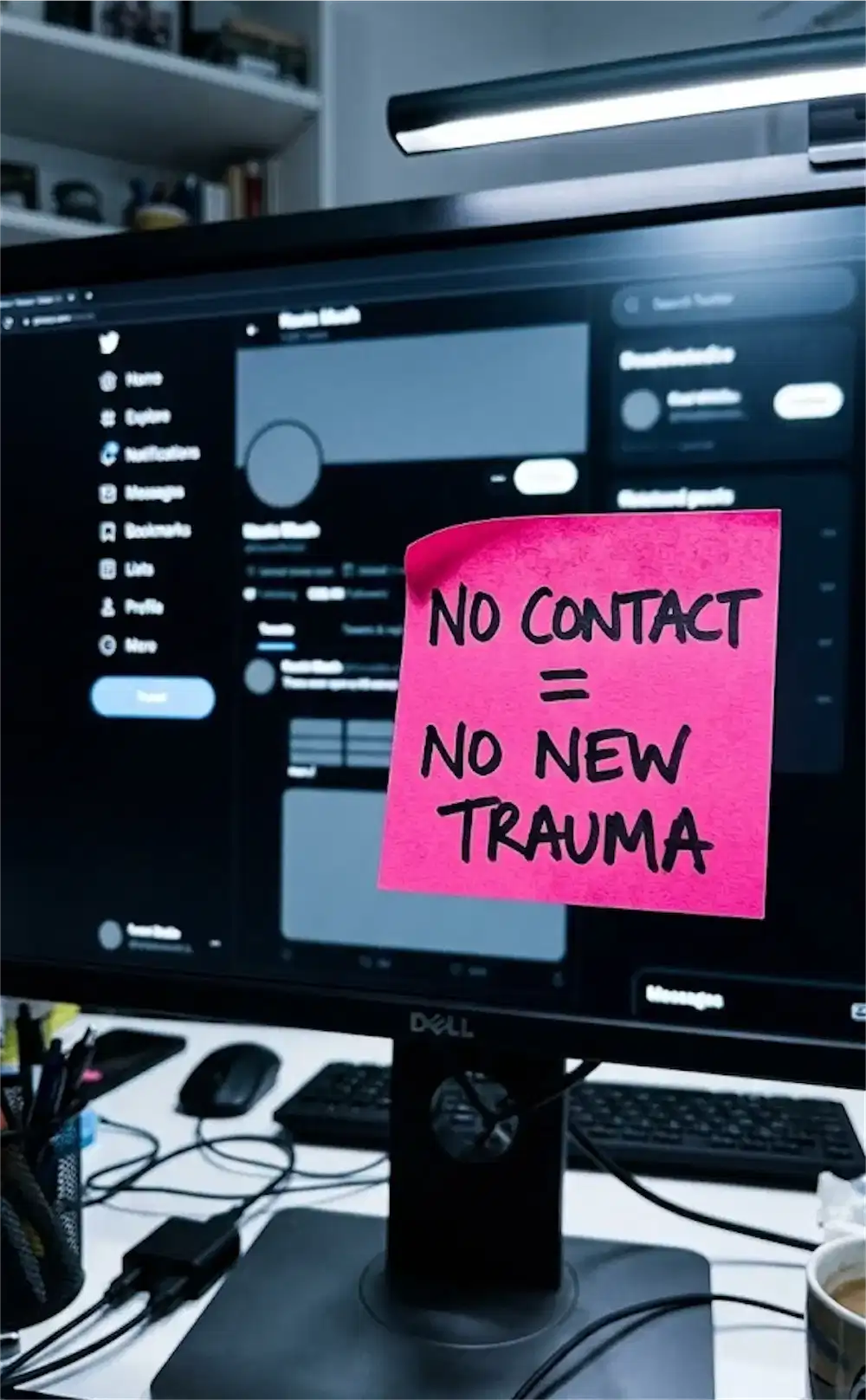
Lesson 4: No Contact Is Not About Punishing Them, It Is About Protecting You
When I first went no contact, I felt guilty. Like I was being petty or dramatic. My ex would reach out, and every unanswered message felt like I was doing something wrong. It took a long time to understand that no contact is not a game. It is a boundary you set for yourself, not a punishment you deliver to them.
Psychopath Free is very direct on this point. Maintaining no contact helps in focusing on self-respect and happiness. Full stop. Not “it might help.” Not “consider reducing contact.” No contact, maintained consistently, is the foundation of recovery after narcissistic abuse.
Here is the thing nobody tells you about no contact: it is not just about not texting them. It is about not checking their social media. Not asking mutual friends for updates. Not googling their name at 2am to see if they have moved on. Every one of those behaviors re-activates the trauma bond and resets your nervous system back to square one.
MacKenzie writes about this at length, and the community on PsychopathFree.com, which reaches millions of abuse survivors each month, was built on the foundation that survivors need a safe place to validate their experiences and support each other through exactly this struggle.
Why does no contact work? Because your brain needs time without the stimulus to start rewiring. Trauma bonding can be difficult to spot if you are currently caught in the cycle of abuse, because the love bombing stage of a trauma bond involves periods of affection and dependency forging. Without distance, those neural pathways stay active.
- Block them on every platform, not just one or two.
- If you share children or property, use a mediator or structured communication tool only.
- Tell trusted friends you are going no contact so they can support you and not pass along updates.
- When the urge to check hits, write instead. Journal the feeling without acting on it.
For a deeper breakdown of the psychology behind why this approach works so well, read why no contact works after narcissistic abuse.
Lesson 5: You Have to Rebuild Your Identity, Not Just Recover from the Relationship
This is the lesson most people skip or underestimate, and it is probably the most important one in the entire book.
After 12 years, I did not know who I was without him. My preferences, my habits, my social circle, even my sense of humor had all been shaped or suppressed by the relationship. When it ended, I was not just heartbroken. I was hollow. There was no “me” to return to because I had slowly stopped being a person outside of the dynamic.
Psychopath Free addresses this as identity erosion. The second section of the book breaks down the subject of the manufactured soulmate, covering personalized grooming, identity erosion, and the horrible grand finale. The manufactured soulmate concept is key here: narcissists mirror you so intensely in the beginning that you feel profoundly understood. Then, gradually, they replace your identity with one that serves them.
Research supports this. Identity enmeshment is a conflicted identification with an abuser. Self-identity becomes fused with an abuse identity. That fusion is why leaving feels like losing yourself, because in a very real way, you did.
Recovery, then, is not just “getting over” someone. It is actively rebuilding a self. That means:
- Reconnecting with interests you abandoned during the relationship.
- Noticing your own preferences without filtering them through “would they approve of this?”
- Spending time alone, not to isolate, but to learn what you actually enjoy.
- Letting grief be part of the process without letting it be the whole process.
Recovery from a psychopathic relationship, though lengthy, leads to increased self-awareness and the ability to form healthier relationships, providing survivors with wisdom and strength. That is not a platitude. That is what actually happens when you do the work.
MacKenzie followed Psychopath Free with Whole Again: Healing Your Heart and Rediscovering Your True Self After Toxic Relationships, which goes even deeper into this stage. If Psychopath Free is the “naming the abuse” book, Whole Again is the “rebuilding yourself” book. I read both, multiple times.
Also worth reading as you work through this phase: the lessons that came from living 12 years inside a narcissistic relationship.

One Important Caveat About “Psychopath Free”
I want to be honest with you, because that matters more to me than selling you on a book.
Psychopath Free is not a clinical textbook. Jackson MacKenzie is not a licensed psychologist. It is the first guide for survivors written by a survivor, offering hope for healing and thriving after psychopathic abuse. That is both its greatest strength and its primary limitation.
Some of the language in the book is broad. It applies the term “psychopath” loosely across Cluster B personality disorders, which does not always match the clinical distinctions between NPD, BPD, antisocial personality disorder, and others. My ex had both narcissistic and borderline traits, and some sections of the book fit perfectly while others felt like they were describing someone else entirely.
Use the book as a validation tool and a starting map. Let a trauma-informed therapist be your guide on the more complex terrain. The two work very well together.
A 2025 peer-reviewed study in the Indian Journal of Psychological Medicine noted that acknowledging and validating survivor experiences can help change negative perceptions of themselves and their situation, and help them understand that their psychological challenges stem from the abuse and not their intrinsic flaws. That validation, which Psychopath Free delivers on a deep level, is clinically meaningful even when it comes from a non-clinical source.
Additionally, a 2026 study published in the World Journal of Advanced Research and Reviews confirmed that survivors often struggle to differentiate personal needs from perceived external demands, leading to excessive compliance, self-monitoring, and hypervigilance within interpersonal contexts, with narcissistic relational dynamics fostering boundary diffusion, trauma bonding, and compulsive appeasement patterns. What MacKenzie describes experientially is being validated more and more in formal research.
The Takeaway
Psychopath Free will not heal you by itself. No book will. But it can do something therapy sometimes struggles to do in the early stages: it makes you feel less alone, less crazy, and less responsible for what happened to you. That is where recovery begins.
The five lessons above, that you were targeted not broken, that the cycle is predictable, that trauma bonds are neurobiological not romantic, that no contact is self-protection not punishment, and that you must rebuild your identity not just recover from the loss, these are not just ideas in a book. They are the actual framework I used to get my life back after 12 years of losing it.
You are not starting over. You are starting from a point of knowledge that most people never get. That is worth something.
Recommended Resources
These are books and tools that supported my recovery alongside Psychopath Free. All links are affiliate links, which help keep this blog going at no extra cost to you.
- Psychopath Free (Expanded Edition) by Jackson MacKenzie – The book this article is based on. Start here if you have not read it yet.
- Whole Again by Jackson MacKenzie – MacKenzie’s follow-up, focused entirely on rebuilding your identity and learning to trust again. I consider it the more important of the two for long-term healing.
- The Body Keeps the Score by Bessel van der Kolk – The clinical backbone behind what Psychopath Free describes experientially. Explains the neuroscience of trauma and why healing has to involve the body, not just the mind.
- Complex PTSD: From Surviving to Thriving by Pete Walker – If you experienced prolonged narcissistic abuse, C-PTSD symptoms are common. Pete Walker’s book is one of the most practical and compassionate guides available for this specific kind of trauma.
- Trauma Recovery Journal – Structured journaling was a major part of my own recovery. A dedicated journal with prompts keeps the process focused rather than spiraling.

Meet Your Guide
Helen Brooks
After surviving a 12-year NPD/BPD relationship, I dedicated over a decade to studying trauma bonding and nervous system recovery. My mission is to help you break free from the fog and reclaim your authentic self.
Ready to break the trauma bond and reclaim your life?