How to Explain a Parent’s Absence to Your Child Without Speaking Badly of the Ex
Finding a way to explain a parent’s absence to your child without speaking badly of the ex is one of the most painful tasks you will meet on your healing path. After a high-conflict divorce, trying to protect your children while sorting through your own raw feelings is incredibly heavy.
During my own recovery from a twelve-year relationship with a partner who struggled with intense **narcissistic and borderline traits**, I was utterly lost. My social circle was gone, my interests were buried, and my daily reality felt dark. Yet, the true test of my healing was not rebuilding my life, but looking at my child and speaking with calm grace when their other parent simply stopped showing up.
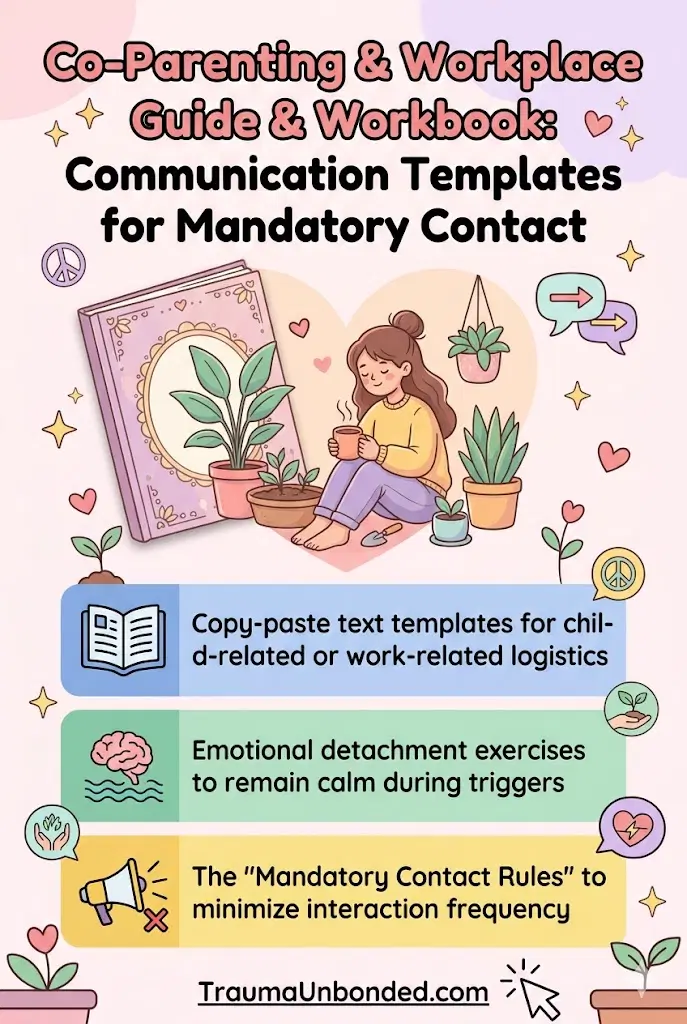
When you are handling this delicate balance, you need practical boundaries that keep adult conflict far away from small ears. If you need actionable communication tools to protect your household, our Co-Parenting & Workplace Guide & Workbook provides templates designed to manage high-conflict dynamics cleanly.
How to Explain a Parent’s Absence Without Badmouthing
To explain a parent’s absence to a child without speaking badly of your ex, keep your explanation brief, factual, and age-appropriate, emphasizing that the absence is never the child’s fault. Focus on reassuring them of your constant love and security rather than analyzing the other parent’s toxic behavior or personal shortfalls.

Children have a unique way of processing separation. They do not think like adults, nor should they have to. If we explain their other parent’s absence with details of betrayal, manipulation, or emotional instability, we burden them with weight they cannot carry.
What do kids actually hear when we speak poorly of an ex? Because children see themselves as fifty percent of each parent, they internalize criticism of an ex as a criticism of themselves. When you call your ex selfish or lazy, your child wonders if those same traits are hiding inside of them.
To break this cycle, we must learn to separate our personal heartbreak from our child’s need for security. You can speak the truth without telling the entire, messy story. Your child needs to know that they are safe, that they are loved, and that the absence of their other parent is completely outside of their control.
The Psychological Safety of Factual Explanations
Keeping your explanations rooted in simple, unvarnished facts prevents confusion. When we use vague excuses like “Daddy is just too busy with work” or “Mommy is on a long trip,” we inadvertently teach children that work or travel is more valuable than they are.
Instead, focus on simple realities. Studies published by Psychology Today show that children naturally try to make sense of parental absence by looking inward, often assuming they did something wrong to cause the separation. By using clear, age-appropriate honesty, you remove the heavy burden of guilt from their shoulders.
How can you frame this so it feels natural? You state what is happening right now, reassure them of your safety, and leave the adult reasons out of the picture. This keeps their focus on their own growth and childhood rather than on trying to solve adult problems.
To keep these stressful moments from overwhelming you, having a clear plan is vital. Having structural scripts and boundary templates can help you stay grounded when difficult questions catch you off guard.
Practical Scripts by Age Group
Answering these questions requires you to adjust your language as your child grows. A toddler needs simple physical reassurance, while a teenager might need a bit more context to help them process their thoughts.
Here are some straightforward approaches you can use depending on your child’s developmental stage:
- For toddlers and young children (Ages 3 to 6): Keep it centered on their immediate world. You might say: “Your dad is living in a different place right now and cannot visit. I know that feels sad, but you are very safe here with me, and we are going to have a wonderful dinner together.”
- For school-aged children (Ages 7 to 11): Validate their sadness while keeping boundaries firm. Try saying: “I know you miss your mom. She is dealing with some personal adult struggles right now that keep her from being here. It is not because of anything you did, and it is not your job to fix it.”
- For teenagers (Ages 12 and up): Teens often see through vague answers, but they still do not need the burden of adult relationship details. You can say: “Your parent is not in a place where they can show up consistently right now. I know it is painful. If you want to talk about how you feel, I am always here to listen, or we can find a professional counselor to talk to.”
If you are practicing a complete break from a highly toxic co-parent, you may need a deeper strategy on what to say to kids when a strict boundary is necessary for your family’s safety.
Processing Your Own Grief to Protect Your Child

When you spend twelve years walking on eggshells around a partner with intense personality traits, your nervous system remains stuck in a defensive loop. It is incredibly difficult to speak calmly about someone who dismantled your self-worth and left you to pick up the pieces alone.
This is why your own healing is a non-negotiable part of parenting. When we carry unresolved anger, it naturally leaks out through our tone, our sighs, or our facial expressions when our kids ask about their other parent. By taking the time to address your own trauma bonds, you can drastically reduce the self-doubt after abuse that makes these conversations so triggering.
Learning to separate your adult grief from your child’s experience is a quiet act of courage. It allows you to become the steady anchor they need when their other parent’s world is in chaos.
Establishing Boundaries and Consistency
Children do not just need the right words; they need a predictable environment. When one parent is absent, the remaining parent’s consistency becomes their entire foundation for safety.
How do you build that consistency? You do it through small, daily routines and firm behavioral boundaries. If your ex attempts to drift back into your lives unpredictably, you can utilize grey rock coparenting strategies to manage the contact without letting the emotional storm infect your household.
By keeping your interactions business-like and predictable, you protect your child from the painful cycle of hope and disappointment that comes with high-conflict parental absence.
Your goal is not to raise a child who has never experienced pain, but to raise a child who knows they are completely secure in your love. By refusing to speak badly of your ex, you preserve your child’s peace and allow them to draw their own healthy conclusions as they grow. If you want to protect your home from ongoing drama and establish clear boundaries, explore our Co-Parenting & Workplace Guide & Workbook to find structural templates that support your journey toward a quiet, stable life.

Meet Your Guide
Helen Brooks
After surviving a 12-year NPD/BPD relationship, I dedicated over a decade to studying trauma bonding and nervous system recovery. My mission is to help you break free from the fog and reclaim your authentic self.
Ready to break the trauma bond and reclaim your life?