10 Realistic Ways to Reclaim Your Power After a Narcissistic Relationship
Let me be upfront with you: when I finally left my 12-year relationship, I didn’t feel powerful. I felt hollow. Like someone had taken a spoon and scooped out everything that used to be me — my confidence, my opinions, my friendships, my sense of humor. All of it, gone. Or at least buried somewhere so deep I couldn’t find it anymore.
So when people talk about “reclaiming your power” after narcissistic abuse, I want that to land realistically — not as a motivational poster phrase, but as something you can actually do. One small, unglamorous step at a time.
This isn’t a list of things to feel inspired by and then forget. These are ten things that actually worked — for me, and for many survivors I’ve spoken with since. Some of them are uncomfortable. Some take longer than you’d like. But all of them are real.
What “Reclaiming Your Power” Actually Means After Narcissistic Abuse
First, let’s be clear about what we’re talking about here. Reclaiming your power after a narcissistic relationship doesn’t mean becoming invulnerable or never hurting again. It doesn’t mean never thinking about your ex or having zero emotional responses when something reminds you of them.
It means something quieter and more durable than that.
It means rebuilding the ability to trust your own perceptions. To make decisions without second-guessing yourself into paralysis. To feel your emotions without being controlled by them. To be alone without feeling like you’re disappearing.
After years of gaslighting — which is when someone consistently makes you question your own reality and memory — many survivors develop what psychologists describe as a fractured sense of self. You start to genuinely not know who you are, what you want, or what you’re even feeling at any given moment. That’s the real damage. And that’s what needs to be rebuilt.
According to Dr. Judith Herman, author of Trauma and Recovery and one of the most respected psychiatrists in the field of complex trauma, the core experiences of psychological trauma are disempowerment and disconnection from others. Recovery, she writes, is built on restoring a sense of power and connection. That framing changed how I understood my own healing entirely.

You can read more about what that long-term damage really looks like in this piece on the long-term effects of narcissistic abuse — because understanding the full scope of what happened to you is part of undoing it.
1. Accept That the Relationship Was Real, But the Version of You They Sold You Wasn’t
This one took me a long time. Years, actually.
One of the most disorienting parts of leaving a narcissistic relationship is this: the relationship itself was real. The feelings were real. The years were real. But the version of yourself that your partner reflected back at you? That was mostly a distortion.
Narcissists — especially those with NPD and BPD traits combined — project a version of you onto you. Early on, that projection was idealized and flattering. Later, it became critical, contemptuous, and small. And over time, you started to believe both versions, because you were hearing them from someone you loved and trusted.
The first act of reclaiming power is understanding that neither version was accurate. You were never as perfect as they made you feel at the start. And you were never as worthless or broken as they made you feel later. You were simply a person — with ordinary strengths and flaws — who got caught in a distorted mirror for too long.
Start noticing when thoughts about yourself sound like things your ex used to say. That’s not your inner voice. That’s their voice, wearing your face.
2. Stop Waiting for the Apology That Will Never Come
This is a hard one to hear, so I’ll say it with as much care as I can: you are not going to get the apology you deserve. Not a real one. Not one that matches the weight of what you went through.
A genuine narcissist cannot offer that kind of accountability without dismantling the psychological defenses their entire identity is built on. The fake apologies — “I’m sorry you felt that way” or “I’m sorry things got messy” — are not what you’re waiting for. You’re waiting for someone to truly see what they did and take full responsibility. That version of your ex doesn’t exist.
Waiting for it keeps you tethered. Every time you replay the relationship looking for the apology, you stay in the loop. You stay theirs.
The shift happens when you stop needing their acknowledgment to validate your pain. Your pain is valid regardless. You don’t need their signature on it. This is directly connected to the guilt many survivors carry — if you’re working through that specifically, this piece on processing guilt after leaving a narcissist covers it honestly and practically.
3. Understand What a Trauma Bond Actually Is (And Why It Makes Recovery Harder)
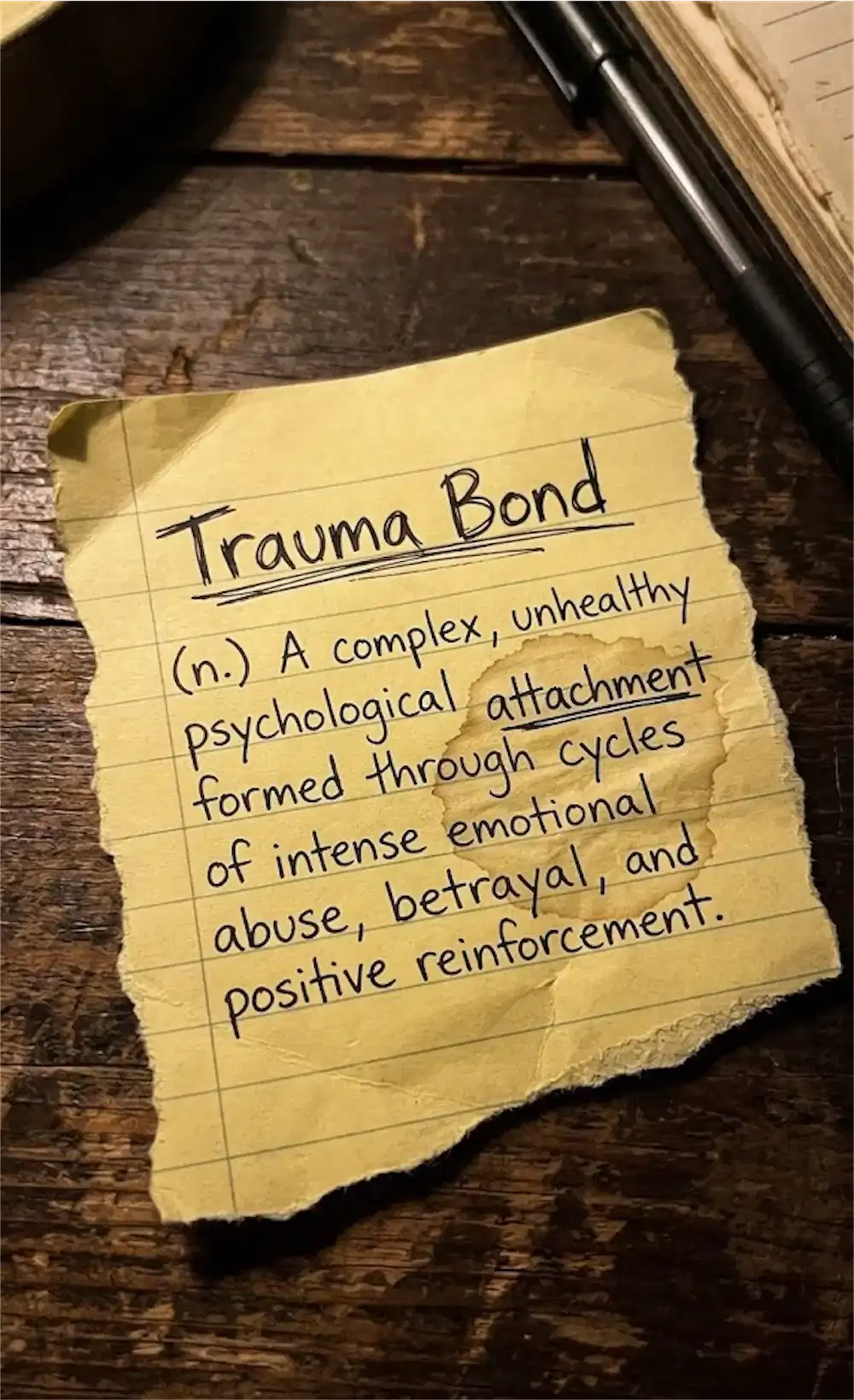
A trauma bond is not just “being really attached to someone.” It’s a biochemical and psychological attachment that forms specifically in cycles of abuse and reward. In plain terms: when someone hurts you and then shows affection, your nervous system gets flooded with relief — and that relief feels like love.
Repeat that cycle over months and years, and the attachment becomes almost indistinguishable from addiction. The brain literally craves the person who causes the pain, because they’re also the source of the relief.
Dr. Patrick Carnes, who has written extensively on trauma bonding, describes this as “betrayal bonding” — the stronger the fear and the more intermittent the reward, the more powerful the attachment becomes. This isn’t a character flaw. It’s neuroscience.
Understanding this doesn’t make the craving go away, but it does change how you relate to it. Instead of asking “why can’t I just get over this?”, you start asking “what does my nervous system need to feel safe without this person?” Those are very different questions with very different answers.
If you’re early in this process, The Body Keeps the Score by Dr. Bessel van der Kolk is one of the most important books you can read right now. It explains, with actual neuroscience and clinical case studies, why trauma lives in the body — and what that means for how you heal.
For a deeper look at the trauma bond specifically, the piece on trauma recovery after BPD relationships goes into the specific dynamics that make BPD/NPD combinations particularly bonding.
4. Rebuild Your Identity Through Small, Consistent Actions
One of the least-talked-about parts of narcissistic abuse is identity erosion. Over time, in a relationship with someone who constantly centers themselves, your preferences, interests, and opinions start to fade. Not because you consciously gave them up, but because they were never reinforced — and often punished.
By the time I left, I genuinely didn’t know what kind of music I liked anymore. What movies I wanted to watch. What I wanted for dinner when no one else was weighing in. It sounds minor. It wasn’t.
Rebuilding identity doesn’t start with a grand reinvention. It starts with tiny, repeated choices that say: I exist. I have preferences. I matter to myself.
- Cook something you always wanted to try but they dismissed.
- Watch a show based entirely on your own interest.
- Buy something small — a plant, a candle, a journal — just because you want it.
- Spend time alone without immediately filling the silence with distraction.
- Pick up something you used to enjoy before the relationship took over.
None of these are dramatic. That’s the point. Identity is rebuilt through repetition, not revelations. Each small act of self-direction is a vote for who you’re becoming again.
5. Put Your Body Back on Your Side
Chronic relationship stress — the kind that comes from years of walking on eggshells, hypervigilance, and emotional dysregulation — does real physical damage. Elevated cortisol levels, disrupted sleep, inflammation, digestive issues, immune suppression. The physical health symptoms of a toxic relationship are more serious and more common than most people realize.
One of the fastest ways to start shifting your nervous system back toward baseline is physical movement. Not because “exercise fixes everything” — it doesn’t — but because the body stores trauma, and movement is one of the ways it processes and releases it.
Research published in the Journal of Psychiatric Research found that aerobic exercise produces effects on depression and anxiety comparable to medication for many people. In the context of trauma recovery, it also restores a sense of agency — your body doing something because you chose it, not because you were reacting to someone else’s chaos.
You don’t need a gym membership or a training plan. A 30-minute walk most days is genuinely enough to start. If you want to understand the deeper connection between movement and breaking a trauma bond, the article on using exercise to break a trauma bond covers exactly that.
If sleep and cortisol regulation are where you’re struggling most right now, magnesium glycinate supplements are widely used to support nervous system calming and sleep quality. Many therapists and integrative doctors recommend them for people going through high-stress transitions — just check with your own doctor before adding anything new.
6. Grieve the Relationship Without Idealizing It
You are allowed to grieve. Full stop. The relationship was real, the years were real, and the loss is real. You don’t have to perform strength or pretend you’re already over it.
What doesn’t help is grieving a version of the relationship that didn’t exist. The idealized version. The relationship you thought you were in at the start, or the one they kept promising you were about to have.
There’s a difference between grieving what was real and mourning what was never actually there. Both feel like grief — but they lead to different places. Grieving the real relationship moves through you. Grieving the fantasy keeps you stuck, because what you’re mourning never existed to begin with and can never be gotten back.
A good way to test which one you’re doing: when you miss them, what specifically do you miss? If the answer is mostly things they promised or moments of love bombing intensity — that’s the fantasy. Try to get honest about what the daily reality actually felt like. Not the highs. The ordinary days.
7. Confront Your Codependency Patterns (Without Shame)
Codependency is one of those words that gets used loosely, so let’s be specific. In the context of narcissistic relationships, codependency refers to a pattern of organizing your emotional life around managing someone else’s moods, needs, and crises — at the expense of your own.
It doesn’t mean you’re weak. It usually means you learned, very early, that your safety or worthiness depended on how well you could take care of someone else. That’s a survival pattern, not a personality defect.
But it does need to be seen and worked with — because codependency is part of what made the relationship so hard to leave, and it’s part of what will draw you toward similar dynamics again if it goes unaddressed.
Melody Beattie’s Codependent No More is still one of the most grounded and readable books on this topic — and it doesn’t make you feel pathologized for having these patterns. It explains where they come from and how to start untangling them. I read it during my first three months out of the relationship and it helped me see myself more clearly than almost anything else at that stage.
For a practical breakdown of how to actively work through codependency, this guide to overcoming codependency is worth bookmarking.
8. Work With a Therapist Who Understands Complex Trauma, Not Just Relationships
Not all therapists are equipped for narcissistic abuse recovery. A couples counselor or general talk therapist may not be familiar with the specific dynamics of NPD, trauma bonding, or C-PTSD — and in some cases, seeing someone without that training can make things worse rather than better.
What you’re looking for is a therapist who has experience with complex trauma, ideally someone trained in approaches like EMDR, somatic therapy, or schema therapy. These modalities work at the level where narcissistic abuse actually lives: not in your rational mind, which already knows the relationship was bad, but in your nervous system, which hasn’t gotten the message yet.
Pete Walker, a therapist and author who has written extensively on Complex PTSD recovery, describes the goal of therapy in this context as learning to “reparent” yourself — to provide the emotional consistency and safety that was never modeled or offered in the relationships that shaped you. That framework helped me understand what I was actually working toward in my own therapy.
His book Complex PTSD: From Surviving to Thriving is one of the most genuinely useful things I read during recovery — practical, human, and written by someone who has also lived through this kind of relational trauma.
If you’re unsure how to evaluate a therapist for this work, the article on therapy insights into the toxic attraction cycle is a helpful starting point.
9. Use Journaling to Rebuild Contact With Yourself

After years of being gaslit, your relationship with your own inner voice gets seriously compromised. You start to distrust your instincts, second-guess your memories, and doubt your feelings before they’re even fully formed. Journaling is one of the most direct ways to start repairing that.
Not because writing magically heals trauma, but because it creates a record. A log of your actual thoughts and feelings that can’t be revised by someone else later. When your ex told you “that never happened” or “you’re overreacting,” having a written account of what you actually experienced is quietly powerful.
It doesn’t need to be formal or literary. Morning pages — just three pages of stream-of-consciousness writing first thing in the morning — is one of the most simple and effective ways to rebuild that inner voice. The article on how morning pages help heal a trauma bond explains the practice and why it works specifically for survivors.
If structured prompts are more helpful than free writing, a dedicated trauma-recovery journal can make this easier to start. Guided trauma recovery journals are widely available and give you a starting point on days when your mind feels too tangled to write freely.
10. Rebuild Your Support System, Even When Social Life Feels Foreign
Narcissists frequently isolate their partners — not always overtly, but through gradual erosion. Making it uncomfortable to see friends. Creating conflict before or after social events. Monopolizing your time and emotional energy until other relationships quietly wither.
When you finally leave, you often look up and realize the social world you used to have is either gone or badly damaged. And then you’re expected to rebuild it while also processing the biggest loss of your adult life. It’s a lot.
Start small. One person. One coffee. One honest conversation. You don’t need to tell the whole story — you just need to be present with another human being who isn’t your ex.
Some friendships won’t come back. Some people won’t understand what you went through. That’s okay. You’re not looking to rebuild the exact social life you had before — you’re building something new, with people who are actually good for you. That takes time and it’s allowed to be awkward at first.
Online communities for narcissistic abuse survivors can also be a bridge when in-person connection feels too overwhelming. Just be mindful of communities that keep you in a perpetual victim loop rather than supporting actual forward movement.
A Note on Timeline: This Takes Longer Than You Think It Should
Here’s something I wish someone had told me plainly: recovery from a long-term narcissistic relationship takes years, not months. Not because you’re doing it wrong, but because what was damaged took years to damage, and the nervous system doesn’t reset on a schedule.
There will be weeks where you feel genuinely like yourself again. Followed by a week where you’re back in the fog, crying for reasons you can’t explain, or feeling the pull to reach out to your ex. That’s not failure. That’s how nonlinear healing actually looks.
The question to ask yourself isn’t “am I healed yet?” but “am I trending in the right direction over the last three months?” That’s a more honest and useful frame. If the answer is yes, keep going. If it’s no, look at what support or change might be missing.
For a realistic picture of what that first stretch of recovery looks like, this piece on insights from the first three months after leaving a narcissist is as honest as I know how to be about it. And if you’re curious about the full picture from someone who lived it for twelve years before getting out, these lessons from 12 years with a narcissist might put a lot into perspective.
The Real Takeaway
Reclaiming your power after a narcissistic relationship is not a dramatic moment. It’s not one decision or one breakthrough or one morning you wake up and finally feel free. It’s a slow, stubborn accumulation of small choices that point you back toward yourself.
It’s choosing not to respond to a hoover text. It’s writing three pages in a journal when you’d rather scroll. It’s going to therapy even when you leave sessions feeling worse before you feel better. It’s telling a friend the truth about what your relationship was really like.
None of it is glamorous. All of it counts.
You were not broken by that relationship. You were shaped by it, in ways that aren’t permanent. And the version of you that existed before — curious, alive, capable of genuine joy — that person is still in there. Tired, maybe. Cautious. But there. The work is just finding your way back to them.
Recommended Resources
These are books, tools, and products that were genuinely useful during my own recovery and that I continue to recommend to anyone navigating this process.
- Running on Empty by Dr. Jonice Webb — A deeply practical book on emotional neglect and why so many narcissistic abuse survivors struggle to identify and trust their own feelings. If you grew up in a household that primed you for these relationships, this book connects a lot of dots.
- Healing the Shame That Binds You by John Bradshaw — One of the most honest explorations of toxic shame and how it operates in abusive relationship dynamics. Heavy, but worth every page if shame is part of what you’re working through.
- The Five Minute Journal — A simple, structured daily journal designed around gratitude and intention-setting. On days when writing feels too heavy, having a short, guided format makes all the difference. A surprisingly effective daily anchor during recovery.

Meet Your Guide
Helen Brooks
After surviving a 12-year NPD/BPD relationship, I dedicated over a decade to studying trauma bonding and nervous system recovery. My mission is to help you break free from the fog and reclaim your authentic self.
Ready to break the trauma bond and reclaim your life?