BPD Breakup Recovery: Surviving the Splitting Cycle Safely
If you’ve ever loved someone with Borderline Personality Disorder, you already know that a BPD breakup doesn’t feel like a normal breakup. It feels like whiplash. One day they adored you. The next, you were the villain in a story you didn’t even know you were in. I lived that reality for 12 years, and the confusion it left behind was unlike anything I had words for at the time. If you’re in that fog right now, this BPD Breakup Recovery Guide was written specifically for what you’re going through.
The splitting cycle is real. The trauma it leaves is real. And your recovery is absolutely possible, even when it doesn’t feel that way yet.
What makes a BPD breakup so uniquely painful is that it doesn’t end cleanly. There are layers of confusion, guilt, grief, and sometimes a desperate longing to go back, even when you know the relationship was destroying you. Understanding what actually happened to you is the first step toward healing. Let’s break it down.
What Is BPD Splitting and Why Does It Hurt So Much?
Splitting is a psychological term for what happens when someone with BPD sees people as either completely good or completely bad, with no middle ground. Think of it like a switch that flips. One moment you are their soulmate, their person, the one who finally understands them. The next moment, without much warning, you are the source of all their pain.
In my 12-year relationship, I experienced this as this constant, exhausting emotional rollercoaster. My partner could go from warm and loving on a Sunday afternoon to cold, rageful, and threatening to leave by Sunday evening. No argument necessary. Sometimes just a look was enough to trigger a complete reversal.
What makes this so psychologically damaging is that your nervous system never gets to fully relax. You are constantly scanning for danger. That hypervigilance doesn’t just go away when the relationship ends. It follows you. That’s why so many survivors of BPD relationships struggle with anxiety, hypervigilance, and even physical symptoms long after the breakup.
The Idealization and Devaluation Trap
BPD relationships often begin with an intense period where you feel truly seen and cherished. This is sometimes called idealization, and it’s intoxicating. But idealization always has a ceiling. When reality inevitably sets in, the person with BPD often moves into devaluation, where the same qualities they once adored about you become sources of contempt.
This cycle runs on intermittent reinforcement, meaning the unpredictable mix of love and pain creates a biochemical attachment that’s incredibly hard to break. Your brain gets hooked on the good moments the same way it gets hooked on any unpredictable reward. That’s not weakness. That’s neuroscience.
Why a BPD Breakup Feels Like Withdrawal
When I finally left, I expected to feel relief. Instead, I felt like I was dying. I couldn’t eat, couldn’t sleep, and spent hours replaying every version of the relationship in my head. It took me a long time to understand that what I was experiencing wasn’t just grief. It was trauma bond withdrawal.
A trauma bond forms when cycles of tension, conflict, and intense reconciliation repeat over time. Your brain literally becomes dependent on the emotional highs of the reunion phase. When the relationship ends, you lose that chemical hit, and your nervous system goes into chaos. This is why you might find yourself missing someone who hurt you, or why you keep checking their social media even when it makes you feel worse.
If you’re struggling to understand why you feel addicted to someone who caused you pain, reading about trauma bond withdrawal symptoms can genuinely help you make sense of what’s happening in your body and mind.
This is the part nobody warns you about. The relationship ending doesn’t stop the pain. Sometimes it intensifies it, at least at first.
If you’re ready to go beyond just surviving and actually start understanding the addiction behind what you felt, this guide was built for exactly this moment in your recovery journey.
Surviving the Splitting Cycle: What Actually Helps

Let’s get practical. Because reading about what happened to you is only step one. What do you actually do now?
1. Stop Waiting for Closure That Will Never Come
One of the most painful parts of a BPD breakup is the lack of a clean ending. You might get a devastating discard followed by a desperate plea to return, all within the same week. Or you might never get an explanation at all. The splitting means that in your ex’s mind, you went from hero to villain, and that story doesn’t usually come with a rational explanation.
The closure you’re looking for has to come from inside you, not from them. I know that’s hard to hear. It took me about two years after my relationship ended to fully accept that no conversation was going to give me the explanation I deserved.
2. Establish No Contact and Stick to It
No contact in a BPD breakup context is less about punishing your ex and more about giving your nervous system the space it needs to stop being on high alert. When you stay in contact, every text, every call, every social media post keeps your body in a low-grade state of fight-or-flight. That’s not healing. That’s just a slower version of the same damage.
No contact can feel impossible, especially when you still deeply care about the person. But your healing genuinely cannot begin until you stop feeding the cycle. If blocking feels too extreme right now, start with soft limits. Mute notifications, avoid checking their profiles, and resist the urge to respond immediately.
3. Name What You’re Feeling Without Judgment
After my relationship ended, I felt ashamed of how much I missed someone who had treated me so badly. What I didn’t understand then is that those feelings made complete neurological sense. You are grieving a person who was both your source of comfort and your source of pain. That’s not weakness. That’s a deeply human response to a very confusing situation.
Give yourself permission to feel grief, rage, longing, relief, and confusion, all at the same time. Journal it out. Say it out loud in therapy. Don’t try to rush yourself into feeling “fine” before you’re ready.
4. Work With a Therapist Who Understands Trauma Bonds
Not every therapist will understand what a BPD relationship does to a partner. Some will focus only on the person with BPD. But you need support too. Look for a therapist who specializes in complex trauma, codependency, or attachment wounds. The investment I made in therapy during my own recovery was honestly the single most important decision I made.
Alongside therapy, educating yourself about BPD emotional recovery and trauma responses helps you understand your own reactions in a way that removes the shame and replaces it with compassion.
Rebuilding Your Identity After a BPD Relationship
One of the lesser-talked-about side effects of a long BPD relationship is how much of yourself you lose in it. I came out of my 12-year relationship not knowing what music I liked anymore, what I wanted to eat, who I was without constantly managing someone else’s emotional state.
Rebuilding your identity isn’t about becoming someone new. It’s about peeling back all the layers of people-pleasing, emotional management, and survival mode to find the version of you that was always there. That person didn’t disappear. They just went quiet for a while.
Start small. Cook something you actually want to eat. Watch what you want to watch. Take a walk without checking your phone. Let your preferences matter again. These tiny acts of self-direction are the beginning of reclaiming your life.
Be Patient With Your Recovery Timeline
Recovery from a BPD splitting cycle isn’t linear. You will have days where you feel genuinely okay, followed by days where the grief hits you sideways. That’s not backsliding. That’s how trauma heals. It processes in waves, not in a straight line.
Give yourself at least as much time to heal as you gave to the relationship itself. And on the hard days, remind yourself of this: the fact that you’re still standing, still trying to understand, still reaching for better, means the healthiest part of you never gave up. That part of you is the one leading you home.
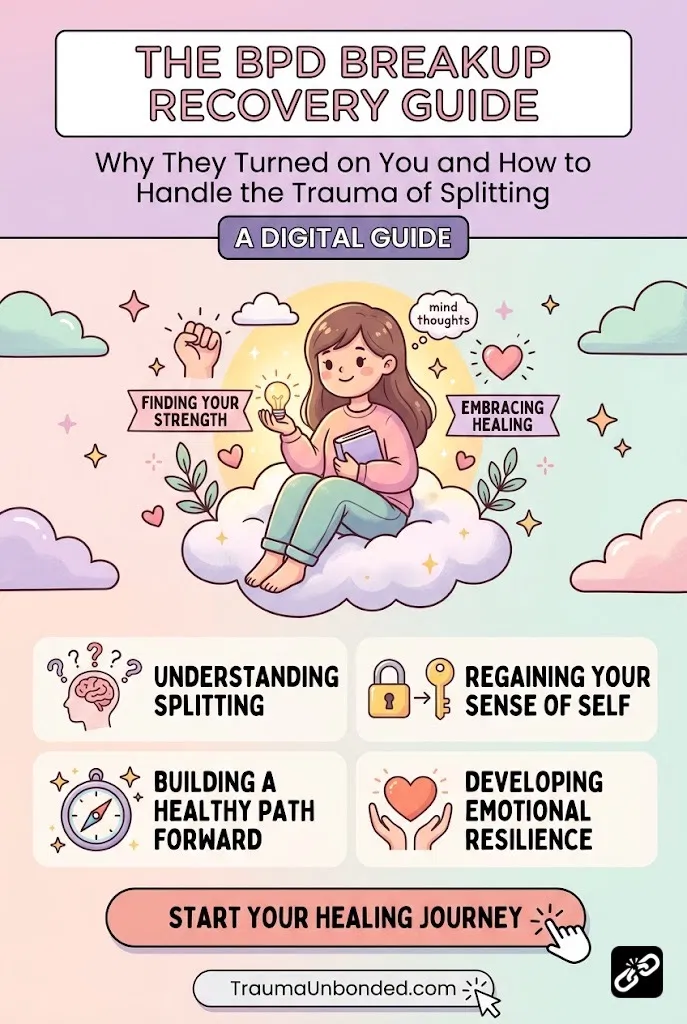
You don’t have to rush this. You just have to keep going. And when you’re ready to go deeper, the BPD Breakup Recovery Guide can walk you through the splitting cycle, the trauma bond, and a practical path forward, step by step.

Meet Your Guide
Helen Brooks
After surviving a 12-year NPD/BPD relationship, I dedicated over a decade to studying trauma bonding and nervous system recovery. My mission is to help you break free from the fog and reclaim your authentic self.
Ready to break the trauma bond and reclaim your life?