
Narcissistic Family Roles: Scapegoat, Golden Child, and Lost Child
Ever felt like you were born into a script you never even auditioned for? During my twelve years in a toxic relationship with a partner who had both narcissistic and borderline traits, I realized my role was always changing to suit their mood. It took me a long time to understand that this dynamic did not start with my ex. It started much earlier, in the house where I grew up. If you feel like you are still playing a part you hate, you are likely stuck in one of the narcissistic family roles. You can begin to untangle these knots by reading The Scapegoat’s Release to find your way back to yourself.
In a healthy family, children are allowed to be individuals. In a narcissistic family, children are used as mirrors to reflect the parent’s ego. The family functions like a theater production where the narcissistic parent is the director, the lead actor, and the only critic. Everyone else has a job to do. Are you the one who gets blamed for every problem? Or are you the one who has to be perfect just to keep the peace? Understanding these labels is the first step toward the narcissistic family roles guide to freedom.
When I was deep in my trauma bond, I could not see how my childhood role made me a perfect target for my toxic partner. I was used to being the one who “fixed” things or the one who took the hit. Healing through therapy helped me see that these roles are just survival strategies. They are not who we really are. By identifying whether you were the scapegoat, the golden child, or the lost child, you can start to break the patterns that keep you stuck in miserable relationships.
The Scapegoat: Carrying the Weight of Family Secrets
The scapegoat child is the person the family chooses to carry all the shame and blame. If the parent is unhappy, it is the scapegoat’s fault. If the house is messy, the scapegoat gets yelled at. I remember feeling like a permanent “problem” that needed to be solved. This role is incredibly painful because you are never allowed to just “be.” You are the designated trash can for the parent’s negative emotions. Why does the parent do this? Because it is easier to point a finger at a child than to look in the mirror.
Scapegoats are often the most honest members of the family. You might have been the one who pointed out that the “emperor has no clothes.” Because you see the truth, you are viewed as a threat to the family’s fake image. This often leads to a family scapegoat healing blueprint where you learn to value your own reality over their lies. In my experience, being the scapegoat in a relationship felt like constantly defending my character against gaslighting, which is when someone makes you doubt your own memory and sanity.
Living as a scapegoat creates a deep sense of toxic shame. You grow up believing you are fundamentally “bad” or “broken.” In my recovery, I had to realize that I was not the problem. I was just the most convenient place for a parent to dump their own self-hatred. Do you find yourself over-explaining your actions to others? That is a leftover habit from being the family target. Reclaiming your life means refusing to carry bags that do not belong to you.
The Golden Child: The Burden of Being the Trophy
The golden child might seem like the lucky one, but this role is its own kind of prison. This child is the extension of the narcissistic parent. They are expected to be perfect in every way to make the parent look good. If you were the golden child, your achievements were never really yours; they were “proof” that your parent was a success. This creates a terrifying amount of pressure. What happens if you fail? You lose the parent’s “love,” which was never love at all, but rather conditional approval.
Golden children often struggle with a lack of identity. They spend so much time being who the parent wants them to be that they forget who they actually are. This often leads to narcissistic sibling golden child dynamics where the golden child is used to make the scapegoat feel even worse. It is a divide-and-conquer strategy. The parent pits siblings against each other so they never team up against the real source of the problem.
If you were the golden child, you might find yourself stuck in perfectionism or people-pleasing today. You might feel like you have to be the best at everything just to feel safe. In my twelve-year relationship, I saw how my partner would switch roles, sometimes treating me like a trophy and other times like a villain. It is exhausting. Breaking free from this role means accepting that you are allowed to be average, messy, and human. You do not exist to be someone else’s highlight reel.
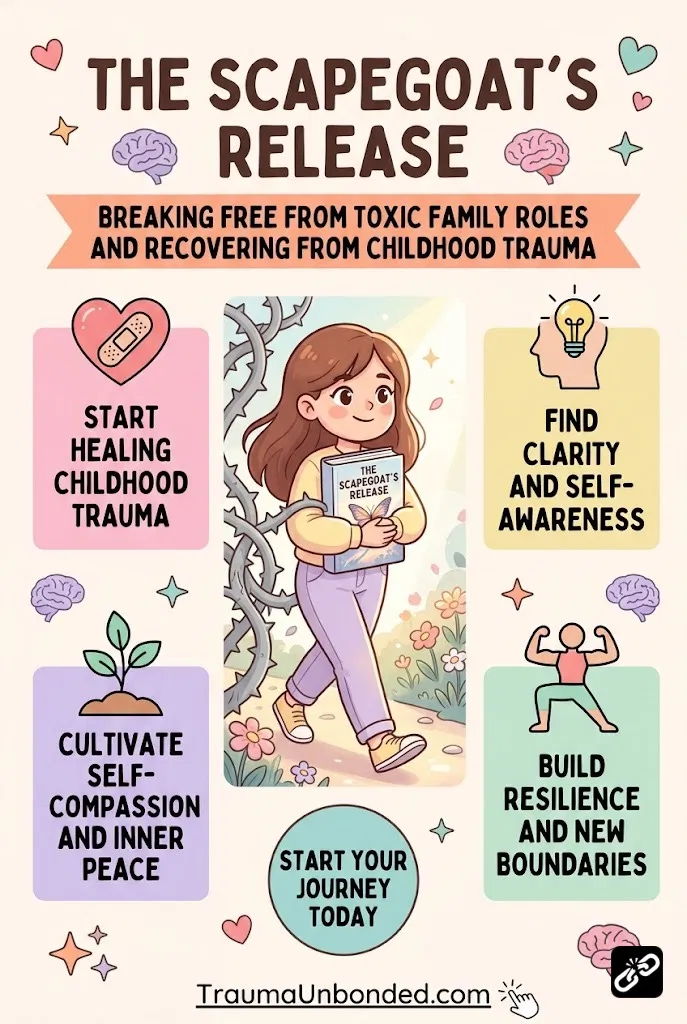
Healing these deep wounds requires more than just understanding the terms. You need a practical way to stop the cycle of blame and perfectionism that has defined your life for so long. If you are tired of being the family’s emotional punching bag or their perfect doll, it is time to take your power back.
Take the first step toward your true self with this guide specifically designed for those ready to leave the family drama behind:
The Lost Child: Staying Invisible to Stay Safe

The lost child is the one who survives by disappearing. While the scapegoat and the golden child are busy dealing with the parent’s direct intensity, the lost child fades into the background. They learn that the safest place to be is invisible. You might have spent your childhood in your room, reading books, or playing video games-anything to avoid the radar of the toxic parent. You became “low maintenance” because you saw that any needs you had would only cause more trouble.
This role often leads to deep loneliness and a feeling that you do not matter. In my recovery, I had to work hard on inner child reparenting guide work because my “inner child” was used to being ignored. As an adult, a lost child might have trouble making decisions or speaking up in groups. You might feel like a ghost in your own life. Have you ever felt like you are watching the world from behind a glass wall?
The danger for the lost child is that they often attract partners who are very “loud” and demanding, like the narcissist I spent twelve years with. Because you are used to being invisible, you might find comfort in someone who takes up all the space. But you deserve to be seen. You deserve to have needs and voices that are heard. Healing means coming out of the shadows and realizing that your presence is a gift, not a burden.
How to Break Free and Reclaim Your Identity
Roles in a narcissistic family are not set in stone, but they are very sticky. The parent will try to pull you back into your role the moment you try to change. If you were the scapegoat and you start setting boundaries, the parent will likely double down on the blame. If you were the golden child and you start living for yourself, they will use guilt to bring you back. This is why low contact or no contact is often the only way to truly heal.
I spent years trying to explain myself to people who were committed to misunderstanding me. It was a waste of energy. You cannot fix a family system that relies on your dysfunction to survive. Instead, you have to focus on your own nervous system regulation. These roles keep us in a state of high alert. Whether you are waiting for the next blow or striving for the next gold star, your body is under constant stress.
The journey back to your “original self” is about shedding these labels. You are not a “problem” to be fixed. You are not a “trophy” to be displayed. You are not a “ghost” to be ignored. You are a human being with the right to peace and joy. After my breakup, I had to learn how to have hobbies again, how to laugh without looking over my shoulder, and how to trust my own gut. It is possible, and it starts with realizing that the role you were given was never your true identity.
Start your journey toward self-discovery today. You do not have to play the part they gave you anymore. By using tools like The Scapegoat’s Release, you can finally put down the heavy burdens of your childhood and walk into a life that is actually yours. You have been through the fire, and now it is time to enjoy the light.
Your Takeaway: You were assigned a role to help a toxic parent survive their own insecurity. Healing is the process of resigning from that position and becoming the person you were always meant to be before the world told you who to be.

Meet Your Guide
Helen Brooks
After surviving a 12-year NPD/BPD relationship, I dedicated over a decade to studying trauma bonding and nervous system recovery. My mission is to help you break free from the fog and reclaim your authentic self.
Ready to break the trauma bond and reclaim your life?