The Link Between Codependency and the Fawn Response: How to Break the Cycle
Codependency and the fawn response are two survival patterns that often grow from the same root, and if you have lived inside a toxic relationship for years, there is a good chance they have been running your life without you even knowing it. I spent 12 years in a relationship with a partner who displayed both narcissistic and borderline personality traits, and for most of that time I believed I was just a “caring person.” I thought my constant people-pleasing, my inability to say no, and my obsession with keeping the peace were signs of love. They were not. They were signs of a deeply ingrained trauma fawn response layered on top of codependent relationship patterns that I had carried since childhood. If you are searching for answers about why you cannot stop over-giving in relationships, this article is for you.
What Is the Fawn Response and Why Does It Connect to Codependency?
The fawn response is a trauma survival mechanism where a person automatically appeases, flatters, or submits to others to avoid conflict or emotional danger. Codependency is the long-term relational pattern that develops when fawning becomes your default way of connecting with people.
Most people know about fight, flight, and freeze. The fawn response is the fourth survival mode, and it is the one that gets overlooked most often because from the outside it looks like kindness. Pete Walker, the therapist who coined the term, described fawning as a response where a person abandons their own needs and boundaries in order to merge with the desires of the threatening person.

Here is how it felt in my relationship. When my partner would rage, I did not fight back. I did not leave the room. I did not freeze. I immediately started scanning their face, choosing my words carefully, apologizing for things I did not do, and trying to figure out what they needed me to say so the explosion would stop. That is fawning. And over 12 years, that pattern became so automatic that I lost myself entirely.
Codependency is what happens when the fawn response becomes your entire personality. You stop knowing what you want. You stop having opinions. Your identity becomes “the person who keeps everyone else okay.” Sound familiar?
How Codependency and the Fawn Response Feed Each Other
These two patterns create a loop that is incredibly difficult to see from the inside. The fawn response teaches your nervous system that safety equals pleasing others. Codependency then builds an entire belief system around that lesson. You start to believe that your value comes from what you do for people, not from who you are.
Here is what that cycle actually looks like in daily life:
- Your partner gets upset and your body floods with anxiety before your brain even processes what happened.
- You immediately shift into caretaker mode, dropping whatever you were doing, whatever you were feeling, to manage their emotions.
- You suppress your own anger or hurt because expressing it feels dangerous, even if they have never been physically violent.
- After the crisis passes, you feel a brief wave of relief that you mistake for love or connection.
- You repeat this hundreds of times until you genuinely cannot identify your own feelings anymore.
I remember a therapist asking me during my recovery, “What do you want?” and I genuinely could not answer. Not because I was being difficult. Because I had spent over a decade filtering every decision through what would keep my partner calm. The question felt foreign. That is the cost of living in a chronic fawn state.
Research published in the Journal of Traumatic Stress has shown that individuals with histories of complex trauma frequently develop habitual appeasement behaviors as a survival strategy, and these behaviors are strongly correlated with codependent relational patterns in adulthood.
Signs You Are Stuck in the Fawn-Codependency Cycle
One of the hardest parts of this work is recognizing the pattern in yourself. When fawning is all you have known, it feels normal. Here are the signs that helped me finally see what was happening:
- You apologize constantly, even when you have done nothing wrong.
- You feel responsible for other people’s moods and emotions.
- You have extreme difficulty saying no, and when you do, you feel crushing guilt.
- You abandon your own plans, hobbies, or friendships to accommodate your partner.
- You feel panicky or anxious when someone is upset with you, even mildly.
- You have lost touch with your own preferences, opinions, or desires.
- You stay in relationships long past the point where you are being mistreated because leaving feels selfish.
If you are nodding along to most of these, please hear me: this is not a character flaw. This is a survival adaptation. Your nervous system learned to fawn because at some point in your life, probably very early, it was the safest option available to you.
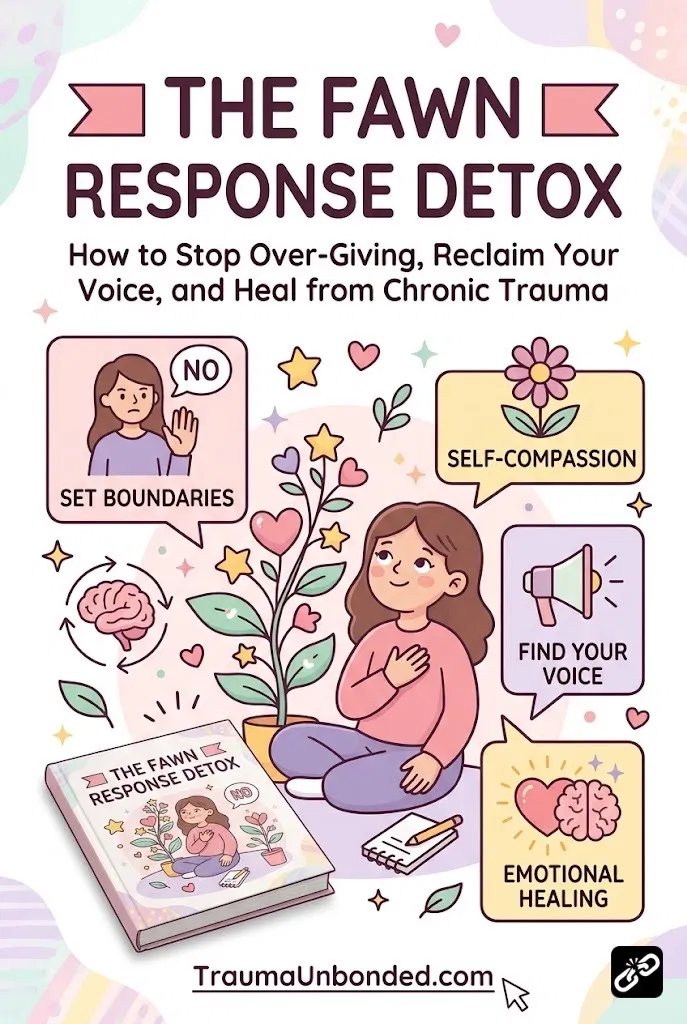
If you are looking for structured support to work through this, the Fawn Response Detox workbook walks you through reclaiming your voice step by step.
Where Does This Pattern Actually Come From?
For many of us, the fawn response did not start with our romantic relationships. It started in childhood. If you grew up with an emotionally volatile parent, a narcissistic caregiver, or in a household where emotional safety depended on reading the room and adjusting yourself accordingly, you learned to fawn before you even had the language for it.
I grew up believing that being “easy” and “no trouble” was my job. So when I entered a relationship with someone who had unpredictable moods and explosive reactions, my nervous system already had the playbook ready. I did not choose codependency. I fell into it the way water follows the path of least resistance.
This is why breaking the codependency fawn response cycle requires more than just leaving the toxic relationship. You have to go back further. You have to look at the original wounds that taught you this pattern in the first place.
How to Break the Codependency and Fawn Response Cycle
Recovery is not a single decision. It is a daily practice of rewiring deeply ingrained nervous system responses. Here is what actually worked for me after I left my 12-year relationship, and what my therapist confirmed was grounded in trauma-informed healing principles.
1. Learn to Recognize Fawning in Real Time
Start paying attention to the moments when you feel that automatic pull to agree, soothe, or accommodate. You do not have to change the behavior right away. Just notice it. Say to yourself, “I am fawning right now.” That awareness alone starts to break the automaticity of the response.
2. Practice Tolerating Discomfort
The fawn response exists to avoid discomfort. Recovery means learning that someone else’s displeasure will not destroy you. This is terrifying at first. Start small. Let a text go unanswered for an hour. Decline one invitation without providing an elaborate excuse. Sit with the anxiety and let it pass.
3. Rebuild Your Relationship With Anger
Codependent fawners are often deeply disconnected from their anger. We learned that anger was dangerous, so we buried it. But anger is actually information. It tells you when a boundary has been crossed. Learning to feel your anger without acting it out or stuffing it down is a critical piece of healing.
4. Work With a Trauma-Informed Therapist
I cannot overstate this. The fawn response lives in the body, not just the mind. Modalities like EMDR, somatic experiencing, and Internal Family Systems (IFS) therapy helped me access parts of this pattern that talk therapy alone could not reach. If therapy is not accessible right now, even journaling with targeted trauma bond prompts can begin to shift your awareness.
5. Set One Boundary Per Week
Boundaries feel impossible when you have been fawning your whole life. So do not try to overhaul everything at once. Pick one small boundary each week. “I will not answer work emails after 8pm.” “I will tell my friend I cannot babysit this Saturday.” Each boundary you hold teaches your nervous system that you can protect yourself without the world falling apart.
What Recovery Actually Feels Like
I want to be honest with you. Breaking codependency and the fawn response does not feel good at first. It feels like you are being selfish. It feels like people will leave you. It feels like you are doing something fundamentally wrong by having needs.
But somewhere around the six-month mark of consistent work, something shifted for me. I started to notice that I had opinions again. I could choose a restaurant without agonizing over what everyone else wanted. I could sit quietly without scanning the room for someone who needed me. I could feel my own feelings without immediately translating them into action items for someone else’s comfort.
That is what healing looks like. Not perfection. Not never fawning again. But catching it faster. Choosing differently more often. And slowly, week by week, finding your way back to the person you were before you learned that love meant disappearing.
You did not develop these patterns because something is broken in you. You developed them because you were trying to survive. And now that you are safe enough to see them, you are also strong enough to change them. If you are ready for a structured path through this work, the Fawn Response Detox guide gives you the daily exercises and journal prompts to start reclaiming your voice today.

Meet Your Guide
Helen Brooks
After surviving a 12-year NPD/BPD relationship, I dedicated over a decade to studying trauma bonding and nervous system recovery. My mission is to help you break free from the fog and reclaim your authentic self.
Ready to break the trauma bond and reclaim your life?