The Narcissistic Stare: Why Their Eyes Change When They Split or Rage
The narcissistic stare is one of the most chilling physical transformations you can witness, leaving many survivors asking why do a narcissist’s eyes turn black during moments of intense hostility. If you have ever sat across from a toxic partner and watched their warm gaze instantly turn cold, dark, and entirely vacant, you are not imagining things. Understanding why their eyes change when they split or enter a state of rage can help you make sense of the profound terror you felt in those moments.
During my 12-year toxic relationship with a partner who showed both narcissistic and borderline traits, I saw this terrifying transformation countless times. I spent years trying to decode that pitch-black, lifeless gaze, eventually realizing that it was a physical manifestation of an emotional shift that is best understood through a BPD breakup recovery guide.
This physical change is closely tied to trauma bond brain chemistry, which locks you into a cycle of seeking safety from the very person who is terrorizing you. Let us explore the biological and psychological realities behind this unsettling phenomenon so you can trust your own reality and begin to heal.
What Is the Narcissistic Stare?
The narcissistic stare is a predatory, deadened gaze characterized by sudden pupil dilation and a complete lack of emotional warmth, occurring when an individual with NPD or BPD splits, rages, or views their partner as an enemy. This physiological shift removes all expression of empathy from the eyes, making them appear completely dark, vacant, or shark-like.
Have you ever looked at someone you love and suddenly felt like there was a complete stranger looking back at you? The stare is not just a standard glare of annoyance or a typical angry look. It is a hyper-focused, unblinking gaze that feels like it is drilling straight through your skin, leaving you feeling exposed and deeply unsafe.
In my decade-long relationship, this look always came right before the verbal storm dropped. It was the silent warning that the person who loved me five minutes ago had completely checked out, replaced by a cold, calculating force that viewed me as a threat.
This empty look serves as a powerful nonverbal weapon, signaling to your brain that you are no longer dealing with a safe partner. The sheer lack of warmth or recognition behind their eyes is enough to make any survivor feel instant panic, triggering a deep survival response.
The Biological Science: Why Do a Narcissist’s Eyes Turn Black?

Why does this happen physically? The answer lies in the autonomic nervous system and how the body handles extreme stress or predatory focus. When a highly narcissistic person feels threatened, loses control, or enters a state of primal rage, their body instantly floods with adrenaline.
This surge of adrenaline triggers the sympathetic nervous system, causing rapid pupil dilation. In physiological terms, this is called mydriasis, which opens the pupil wide to let in as much light as possible to prepare for a fight or a chase.
Because the pupil expands to cover almost the entire iris, the eyes suddenly look pitch-black, regardless of their natural color. You can read about how pupil dilation and autonomic nervous system activity reflect severe physiological arousal in moments of trauma on Psychology Today. This biological reaction strips away the subtle micro-expressions of warmth that we normally rely on to feel safe around another human.
Without those tiny, humanizing movements, the eyes look completely empty, resembling what many survivors describe as “shark eyes” or “dead eyes”. The lack of light reflection makes the gaze look flat and lifeless, as if the person’s humanity has temporarily vanished.
If you are struggling to make sense of the terror you experienced during these episodes, you do not have to carry the confusion alone. I designed a step-by-step roadmap specifically to help survivors decode these intense dynamics, heal their nervous systems, and reclaim their peace of mind.
Splitting vs. Narcissistic Rage: How to Spot the Difference

While the physical presentation of the dark gaze is similar, the underlying emotional states can vary depending on whether the partner is experiencing BPD splitting or narcissistic rage. When someone with borderline personality traits splits, they transition from viewing you as entirely good to entirely bad. Their gaze during this shift is often filled with profound hurt, terror, and absolute detachment, as they have fully disconnected from their affection for you.
On the other hand, a narcissist’s rage is driven by a threat to their ego. When their fragile self-image is bruised, their look becomes intensely predatory, designed to dominate, silence, and punish you for challenging them. This is not a look of hurt; it is a look of pure, calculated malice aimed at regaining control.
Regardless of the label, the result for you is the same: a deep sense of unsafety that triggers your own survival mechanisms. Learning to recognize these patterns is key to navigating the aftermath, and utilizing a BPD breakup recovery guide can provide the validation you need to move forward.
How My Nervous System Reacted to the Stare
During my 12 years in the emotional trenches, I did not understand the biology behind my partner’s pitch-black eyes. I only knew that whenever those pupils dilated, my body went into an immediate, frozen panic. My heart would pound in my throat, my jaw would clench, and I felt an overwhelming urge to shrink myself to avoid further wrath.
This is a natural human response to a biological threat. Your brain’s amygdala registers the deadened, unblinking look as a predator-prey dynamic, immediately pushing you into a fight, flight, or freeze response. It is your body’s way of trying to protect you from impending emotional or verbal assault.
Over time, living with someone who frequently exhibits this look keeps your body in a state of chronic high alert. You begin walking on eggshells, constantly scanning their face for the slightest sign of the next dark shift, which slowly drains your physical and mental energy.
Healing Your Body After Surviving the Terror
When you finally escape the relationship, the trauma of that gaze does not vanish overnight. You might find yourself flinching at sudden movements, feeling intense anxiety when someone makes direct eye contact, or struggling with chronic hypervigilance in normal social settings.
To heal, you must focus on calming your overactive nervous system and showing your body that the danger has passed. Incorporating simple nervous system regulation exercises like deep, diaphragmatic breathing, cold water face dips, or somatic shaking can help release the stored trauma from your muscles.
I spent years feeling like a shell of my former self, but by focusing on nervous system health and professional trauma therapy, I slowly returned to my original, cheerful self. It takes time to convince your body that it is safe to let down its guard, but with patience, the panic will fade.
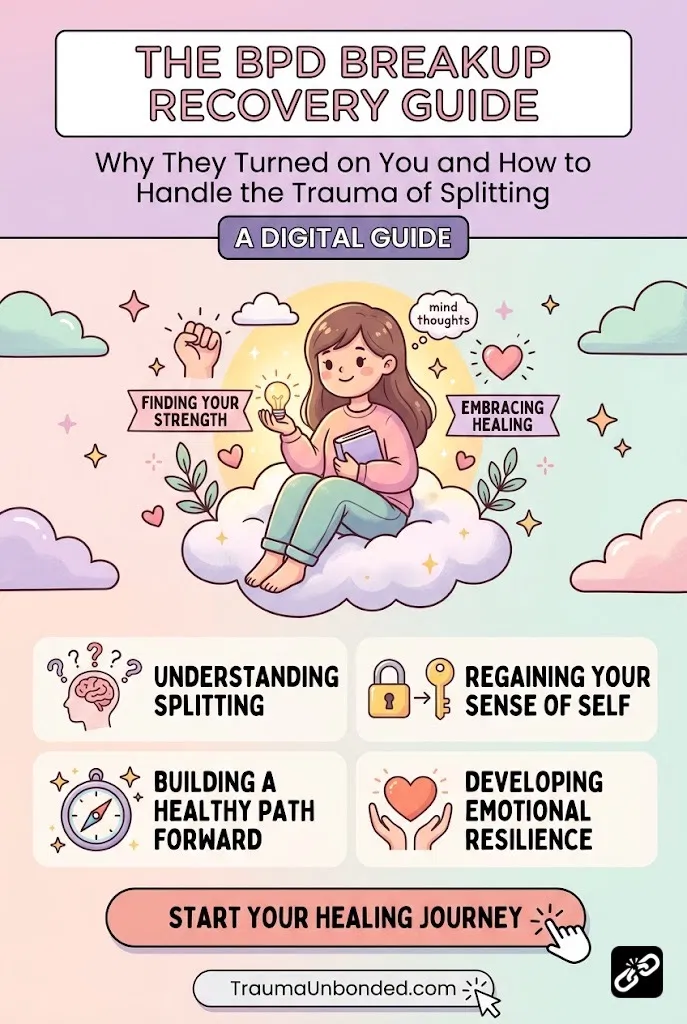
If you have seen the cold, dark gaze of a toxic partner, please know that you are not crazy, and you did not imagine the shift. It was a very real biological reaction to rage and splitting that your body correctly identified as a threat. By stepping away from the chaos and focusing on your own recovery, you can reclaim your peace. If you want a structured plan to understand what you went through and find your way back to yourself, consider using The BPD Breakup Recovery Guide to support your healing journey.

Meet Your Guide
Helen Brooks
After surviving a 12-year NPD/BPD relationship, I dedicated over a decade to studying trauma bonding and nervous system recovery. My mission is to help you break free from the fog and reclaim your authentic self.
Ready to break the trauma bond and reclaim your life?