Trauma Dumping vs. Healthy Venting: How to Share Your Story Without Overwhelming Friends
If you are struggling to find the line between trauma dumping vs healthy venting, you are not alone in this difficult emotional landscape. When we emerge from toxic relationships, figuring out how to share your story without overwhelming friends can feel incredibly confusing. After surviving my own 12-year relationship with a partner showing strong traits of narcissistic and borderline personality disorders, I walked away with zero friends, no hobbies, and a profound sense of isolation. I desperately needed to talk about what had happened to me, but I did not know how to do it without pushing people away.
Sharing our pain is a natural part of healing, but trauma can leave us with a skewed sense of boundaries. During my initial recovery, I realized that my desperate need to be heard was blurring the lines of my friendships, which led me to focus on a structured codependency recovery plan to rebuild my sense of self and learn healthy communication. When you have spent over a decade walking on eggshells, your nervous system is in a constant state of fight-or-flight, making every conversation feel like an emergency. How do we slow down and learn to share our truth without turning our social circle into a makeshift therapy room?
Learning the difference between processing pain and unconsciously dumping it on others was a turning point in my recovery. It allowed me to reconnect with my original, cheerful self while protecting the people who wanted to support me. Let us look at what separates these two communication styles and how you can reclaim your voice safely.
What is the difference between trauma dumping vs healthy venting?
Trauma dumping is the unsolicited, unfiltered sharing of traumatic events without checking if the listener has the emotional capacity to hear it, leaving them feeling drained or overwhelmed. In contrast, healthy venting involves a reciprocal, mindful conversation where you share your frustrations while respecting the boundaries of your friends.

To understand this difference, we have to look at the intention and the dynamics of the conversation. Venting is focused on a specific, recent frustration and aims to release tension so you can find a solution or move forward. When I would vent to my therapist about a bad day, it had a clear endpoint. Trauma dumping, however, is a repetitive cycle that unloads deep wounds onto someone who is unprepared to process them. It often feels like an emotional tsunami where the other person has no room to speak or react.
In a toxic relationship aftermath, you might feel an intense urgency to explain every detail of the emotional abuse you experienced. You want validation, and you want it immediately. But because trauma bonds alter our brain chemistry, we can get trapped in a loop of retelling the same painful stories without actually digesting them. This leaves our friends feeling helpless because they care about us, but they do not have the professional tools to help us heal.
Recognizing the signs you might be trauma dumping on friends
When you are in the thick of healing, it is easy to miss the signals that your conversations have become one-sided. Have you ever noticed a friend growing quiet, looking at their phone, or subtly changing the subject when you start talking about your ex? These are often quiet boundaries being drawn in real-time. Here are a few clear signs that your sharing might have crossed the line into emotional dumping:
- No emotional consent: You start sharing graphic details of abuse or heavy emotional struggles without asking if the other person is in the right headspace to listen.
- The conversation is a monologue: Your friend barely speaks, and when they do, you quickly steer the focus back to your own situation and past relationship.
- You reject any perspective: You are not looking for a way forward or a shift in focus; instead, you find yourself stuck in a loop of repeating the same painful details week after week.
- The listener feels exhausted: Your friend leaves the interaction feeling physically or emotionally drained, rather than connected and supportive.
In my experience, realizing I was doing this was incredibly painful. I was so afraid of being abandoned again that I did not see how my intensity was pushing people away. Learning strategies to overcome codependency helped me see that healthy relationships require mutual care, not just emotional release.
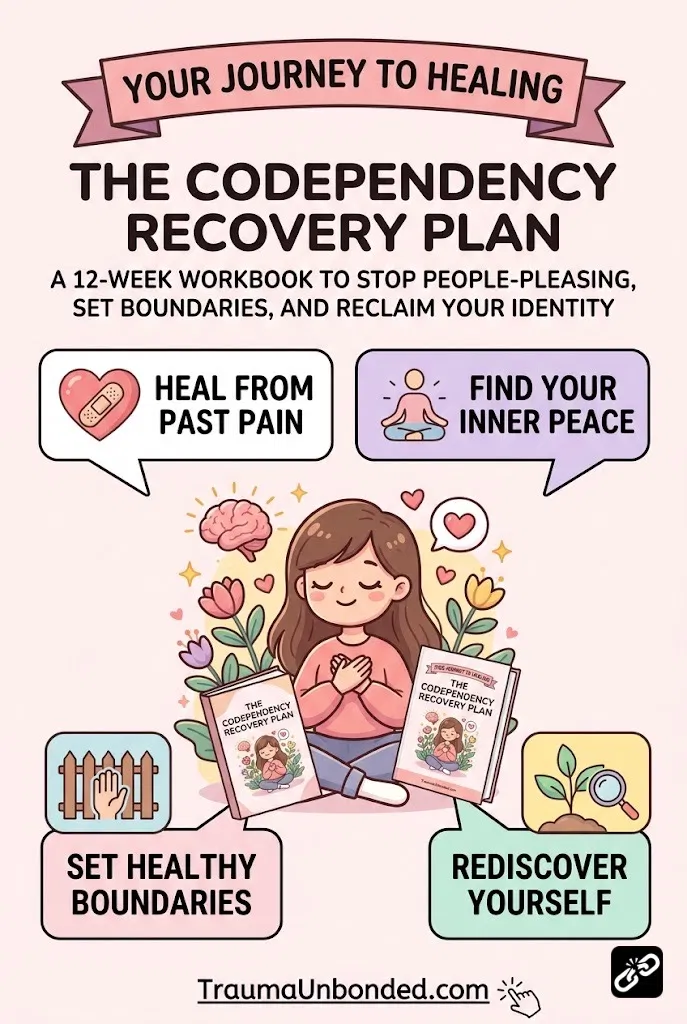
If you find yourself constantly oversharing or feeling like you have lost control of your boundaries, breaking these patterns is the first step toward true healing. To help you navigate this journey, rebuild your sense of self, and establish healthy boundaries with the people in your life, I highly recommend using a structured, step-by-step program.
Practical steps on how to stop trauma dumping and rebuild healthy friendships
Shifting from unfiltered unloading to healthy communication takes practice, especially when you are recovering from chronic stress. When I was rebuilding my life, I had to learn how to actively manage my urge to overshare. You can protect your friendships while still getting the validation you deserve by implementing a few simple shifts in your daily interactions.
First, always ask for consent before opening up about heavy topics. A simple text like, “I am having a really hard day dealing with some of my past relationship stress, do you have the emotional space for a quick chat?” gives your friend an easy out if they are already overwhelmed. It shows that you value their mental well-being as much as your own. If they say they cannot handle it right now, try not to take it as rejection; instead, view it as a sign of a healthy, honest relationship.
Second, set a mental timer for your venting sessions. Give yourself ten or fifteen minutes to talk about what is bothering you, and then consciously transition the conversation to another topic. Ask your friend about their week, their job, or their hobbies. This ensures the relationship remains a two-way street. If you struggle with isolating yourself, focusing on rebuilding your support system can help spread your emotional needs across a wider circle rather than relying on just one person.
Establishing boundaries and finding professional support
We must remember that friends are meant to be a support system, not your therapist. When we expect our loved ones to act as unlicensed counselors, we place a heavy burden on the relationship. A professional therapist is trained to handle the heavy, repetitive aspects of trauma recovery without burning out. They can help you organize your thoughts and process the painful memories that keep you stuck in rumination loops.
A helpful perspective shared by psychiatrist Judith Orloff MD writing for Psychology Today highlights that while venting feels healthy and sticks to a single topic with an openness to solutions, dumping feels toxic, lacks accountability, and repeats the same complaints endlessly. When we take responsibility for our emotional processing, we can move away from the victim role and start actively healing.
If you are currently struggling with the aftermath of a toxic breakup, check out this healing loneliness guide to help manage the quiet moments when the urge to overshare is at its strongest. Writing in a journal, engaging in physical exercise, or practicing nervous system regulation can help ground you before you meet up with friends, allowing your social time to be about connection rather than survival.
Reclaiming your life after long-term emotional abuse is a slow, steady process. By learning to communicate mindfully, you can keep your friendships strong, build deep trust, and protect your own energy. If you are ready to take the next step in establishing clear personal boundaries and rediscovering who you are, the codependency recovery plan offers a clear, structured roadmap to guide you through every stage of this transformation.

Meet Your Guide
Helen Brooks
After surviving a 12-year NPD/BPD relationship, I dedicated over a decade to studying trauma bonding and nervous system recovery. My mission is to help you break free from the fog and reclaim your authentic self.
Ready to break the trauma bond and reclaim your life?