
Somatic Experiencing Exercises You Can Do at Home to Release Stored Trauma
Somatic experiencing exercises can help you release stored trauma from your body without ever leaving your living room. If you have been searching for how to release trauma stored in the body at home or wondering why your muscles feel tight, your stomach churns for no reason, and your chest locks up when you try to relax, you are not imagining things. Your body has been keeping score. After spending 12 years in a relationship with someone who had both narcissistic and borderline personality traits, I can tell you firsthand that the emotional damage did not just live in my head. It lived in my jaw, my hips, my shoulders, and in the shallow breathing I did not even realize had become my default. The Somatic Trauma Reset guide was one of the tools that helped me finally understand what my body had been trying to tell me for over a decade.
When I left that relationship, I thought the hardest part was over. I was wrong. My nervous system was still running on survival mode. I would flinch at loud sounds, clench my fists in my sleep, and feel a wave of nausea before checking my phone. That is what unprocessed somatic trauma looks like. And if you are reading this, there is a good chance your body is doing something similar right now.
What Is Somatic Experiencing and Why Does It Matter for Trauma Recovery?
Somatic experiencing is a body-based therapeutic approach developed by Dr. Peter Levine that focuses on releasing the physical tension and survival energy your body stored during traumatic events, rather than only talking about what happened.
Here is what most people get wrong about trauma. They think it is a memory problem. Something bad happened, and you need to talk it out. But trauma is not just psychological. It is physiological. When you were in danger, whether that danger was a screaming match at 2 AM or the silent treatment that lasted for weeks, your body activated a fight, flight, or freeze response. If that energy never got discharged, it stayed locked in your tissues. Your body literally held onto the emergency.
Research published in Frontiers in Psychology has shown that somatic interventions can significantly reduce PTSD symptoms by addressing the body’s autonomic nervous system responses. This is not some fringe concept. It is grounded in neuroscience.
During my 12 years of walking on eggshells, my body learned to stay small, stay quiet, stay ready. Even after the relationship ended, those patterns did not magically disappear. My therapist explained it simply: your brain got the memo that you are safe now, but your body did not. That gap is exactly what somatic experiencing exercises are designed to close.
5 Somatic Exercises You Can Practice at Home Today
You do not need a fancy studio or expensive equipment. These are beginner somatic exercises for trauma release that you can do in your bedroom, your bathroom, or even sitting at your kitchen table. Start slow. Your nervous system has been overworked for a long time, so gentleness is the point here.
1. The Grounding Shake
Stand with your feet hip-width apart. Bend your knees slightly. Start shaking your hands, then let the shaking move up through your arms, your shoulders, your whole body. Do this for two to three minutes. Animals in the wild do this instinctively after a threat. They literally shake off the stress. We forgot how to do that.
The first time I tried this, I felt ridiculous. By the third time, I cried. Not from sadness, but from something releasing that I could not name. That is normal. Let whatever comes up just come up.
2. The Psoas Release (Hip Flexor Unwinding)
Your psoas muscle, sometimes called the “muscle of the soul,” runs from your lower spine through your pelvis. It tightens when you are in chronic fight or flight. Lie on your back with your knees bent and feet flat on the floor. Let your knees gently fall to one side. Hold for 30 seconds. Bring them back. Let them fall to the other side. Breathe deeply into your belly the entire time.
If you have been dealing with unexplained hip pain and tension related to trauma, this one is especially relevant. My hips were locked for years. I thought it was a fitness issue. It was an emotional storage issue.
3. Pendulation Breathing
This is a core somatic experiencing technique. Notice where in your body you feel discomfort or tension. Now find a spot that feels neutral or calm, maybe your hands or your feet. Slowly move your attention back and forth between the two spots. Breathe as you do this. This teaches your nervous system that it can hold both sensation and safety at the same time.
I used to carry a knot right below my sternum. Constant. Like a fist was sitting there. Pendulation was the first exercise that made it soften. Not disappear overnight, but soften. And that softening was everything.
4. The Voo Breath
Take a deep breath in through your nose. As you exhale, make a low “voooo” sound. Let the vibration travel down into your chest and belly. This activates the vagus nerve, which is the main brake pedal for your fight or flight system. Do five rounds. You might feel warmth spreading through your torso. That is your parasympathetic nervous system waking up.
For more techniques on vagus nerve exercises for anxiety after abuse, that resource covers the science behind why your body responds the way it does.
5. Contained Resourcing
Close your eyes. Think of a place, real or imagined, where you feel completely safe. Notice what you see there. What sounds are present? What does the air feel like? Let your body respond to this image. Place one hand on your chest and one on your belly. Stay here for three to five minutes.
This exercise sounds simple, and it is. But if you spent years in a toxic relationship where safety was never real, your body might resist this at first. That resistance is information. It is not failure.
Why Traditional Talk Therapy Alone Might Not Be Enough
Let me be clear. Therapy saved my life. Cognitive behavioral approaches helped me understand the gaslighting, which is when someone manipulates you into questioning your own reality until you do not trust yourself anymore. Therapy helped me see the intermittent reinforcement cycle, which is that exhausting pattern of random kindness mixed with cruelty that keeps you hooked like a slot machine.
But talking about it did not stop my body from jolting awake at 3 AM. It did not stop the tightness in my throat every time I heard a door close too hard. That is where somatic work filled the gap. My healing did not truly accelerate until I started working with my body, not just my mind.
If you have noticed that you understand your trauma intellectually but still feel stuck physically, you are not broken. You just have not addressed the layer where the trauma actually lives.
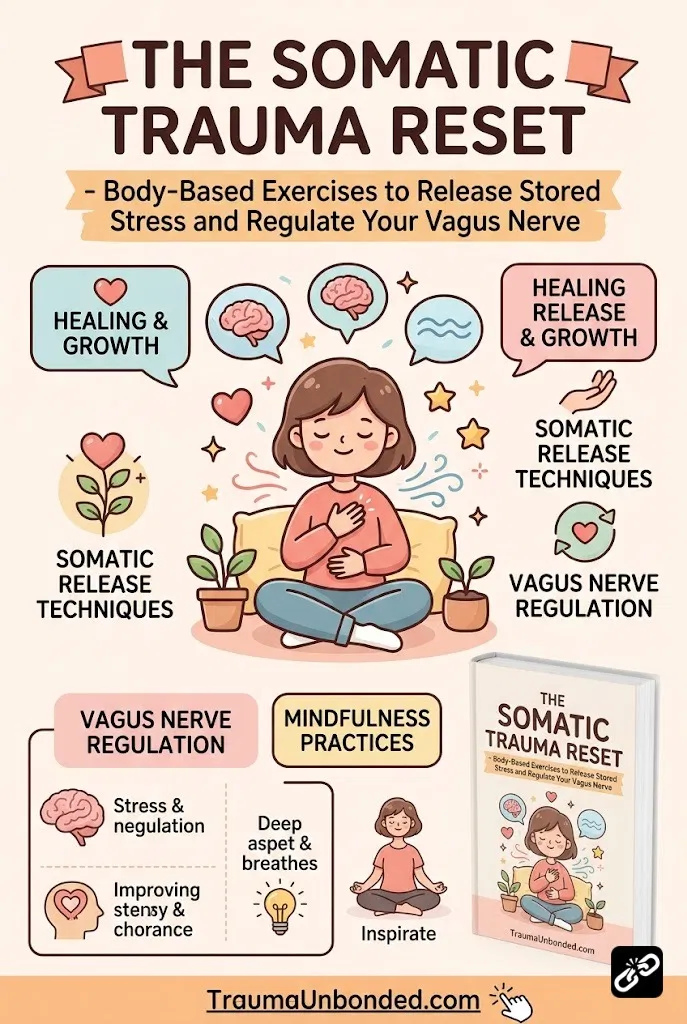
If you are ready to go deeper into structured body-based healing and want a step-by-step system you can follow at your own pace, The Somatic Trauma Reset was built specifically for survivors who are tired of understanding their pain but not being able to move through it.
How to Know If Somatic Exercises Are Working
Progress with somatic work does not look like a dramatic breakthrough every session. It looks quiet. It looks like noticing you took a full breath without thinking about it. Or realizing you slept through the night for the first time in months. Here are some signs that stored trauma is releasing from your body:
- Spontaneous yawning, sighing, or trembling during or after exercises
- Waves of emotion that pass through you without a clear trigger
- Decreased muscle tension in your jaw, shoulders, or hips
- Feeling more present and less “checked out” during daily activities
- Your startle response becomes less intense over time
- Improved digestion and less stomach discomfort
When I first started, I would have involuntary muscle twitches during the psoas release. My therapist told me that was a good sign. The trapped energy was finally finding its way out. It felt strange at first, but over weeks, the twitching turned into calm. Real calm, not the “waiting for the next explosion” calm I had trained myself to live in.
Building a Simple Daily Somatic Practice
You do not need an hour. You need consistency. Here is a basic framework that worked for me:
- Morning (5 minutes): Grounding shake plus three rounds of Voo breath
- Midday (3 minutes): Pendulation breathing whenever tension spikes
- Evening (5 minutes): Psoas release followed by contained resourcing
That is 13 minutes a day. You spent years giving your energy to someone who drained you. Can you give 13 minutes to yourself? I started with five. Some days I only managed the shake. That was still enough to build momentum.
If you are also dealing with the challenge of exiting survival mode after trauma, combining somatic exercises with nervous system education can speed up the process significantly.
Your Body Remembers What Your Mind Tries to Forget
Here is what I wish someone had told me in those first brutal months after leaving. You are not weak because your body is still reacting. You are not crazy because your hands shake or your stomach drops or your chest tightens when nothing visibly threatening is happening. Your body is doing exactly what it was trained to do during years of emotional chaos. The good news? It can be retrained. Slowly, gently, and on your terms.
Somatic experiencing gave me back ownership of a body I had disconnected from. It was not instant. It was not magic. But it was real. And if you are looking for a structured way to begin this work with specific daily exercises, journal prompts, and nervous system regulation techniques designed for abuse survivors, The Somatic Trauma Reset walks you through it one step at a time. You deserve to feel safe in your own skin again. That is not a wish. That is a direction you can start moving in today.

Meet Your Guide
Helen Brooks
After surviving a 12-year NPD/BPD relationship, I dedicated over a decade to studying trauma bonding and nervous system recovery. My mission is to help you break free from the fog and reclaim your authentic self.
Ready to break the trauma bond and reclaim your life?