12 Life-Changing Lessons from Self-Help Literature on Leaving Toxic Relationships
I spent 12 years in a relationship with someone who had both narcissistic and borderline personality traits. During that time, I read exactly zero self-help books. I told myself I didn’t need them. The truth? I was too scared of what they might confirm.
When the relationship finally ended, I was devastated, socially isolated, and genuinely had no idea who I was anymore. That’s when books became my first lifeline — before therapy, before community, before anything else. I started reading compulsively, not to find answers but to find words for what had happened to me.
What I found changed my understanding of myself completely. Not overnight. Not linearly. But deeply and permanently. These are the 12 lessons from self-help literature that I wish I’d had on day one of my recovery — and the ones I still return to when things get hard.
If you’re just starting out, also check out these hard-won lessons from 12 years with a narcissist — they go hand-in-hand with everything I cover below.
1. You Were Not Weak — You Were Trauma Bonded
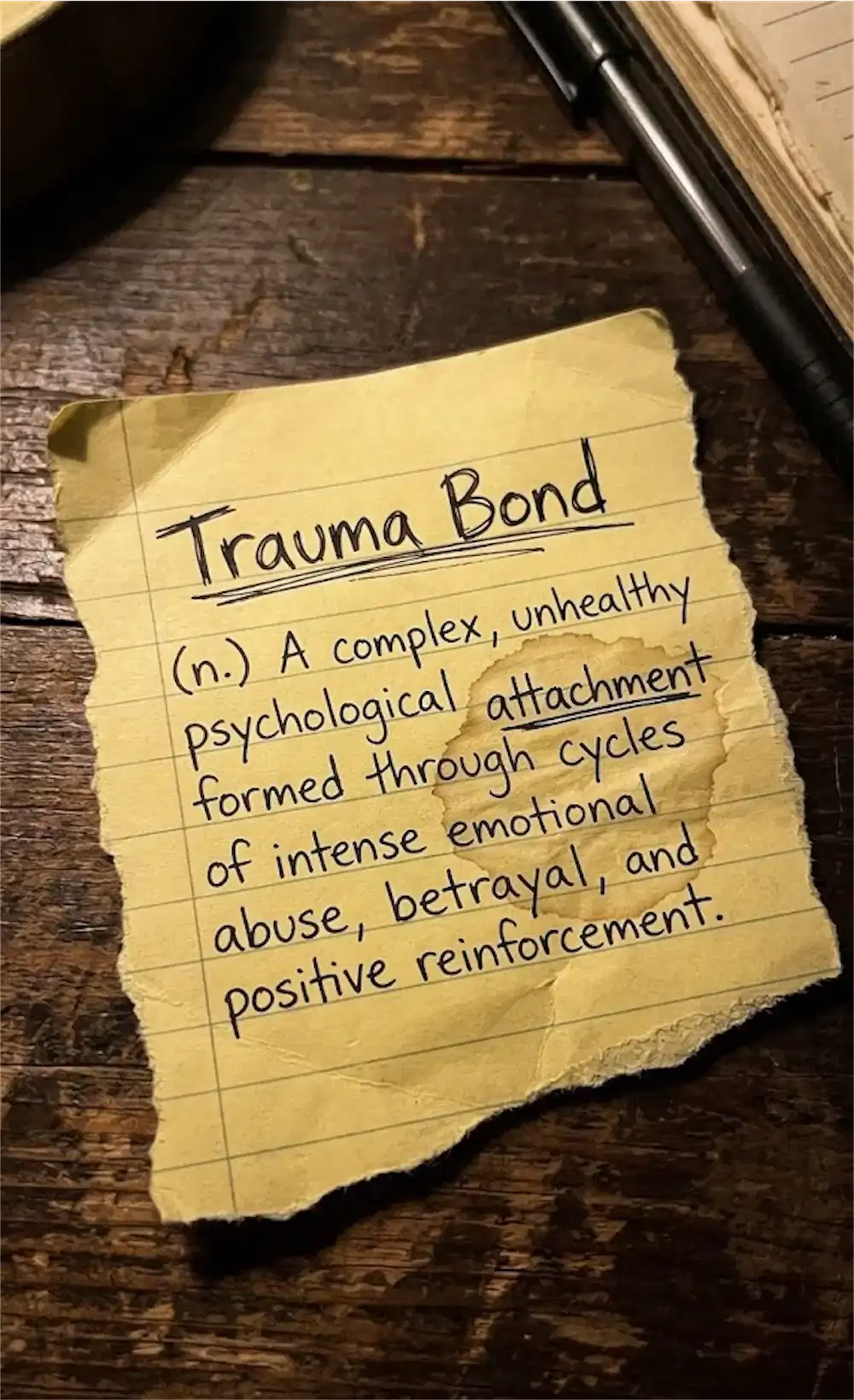
The first and most important thing I learned from self-help literature — specifically from Dr. Patrick Carnes’ work — is that my attachment to this person wasn’t a character flaw. It was a predictable neurobiological response to an impossible situation.
Trauma bonding, as Carnes first described it, is “the misuse of fear, excitement, sexual feelings, and sexual physiology to entangle another person.” In plain terms: your nervous system learned to associate your abuser with both danger and survival at the same time. The hit of warmth after the coldness. The apology after the blow-up. That cycle isn’t love — it’s conditioning.
For years, I thought I was just “too sensitive” or “too attached.” Reading Carnes’ research was the first time I understood that what I felt wasn’t weakness — it was my brain doing exactly what brains do under intermittent reinforcement. The unpredictability itself becomes the bond. When someone is sometimes wonderful and sometimes cruel, your brain locks into trying to predict and control the pattern. It becomes almost impossible to leave.
If this resonates, I’d strongly recommend starting with The Betrayal Bond by Patrick Carnes — it’s the foundational text for understanding trauma bonds from a clinical and lived perspective.
Also read: Long-Term Effects of Narcissistic Abuse and How to Heal
2. Codependency Was the Real Entry Point
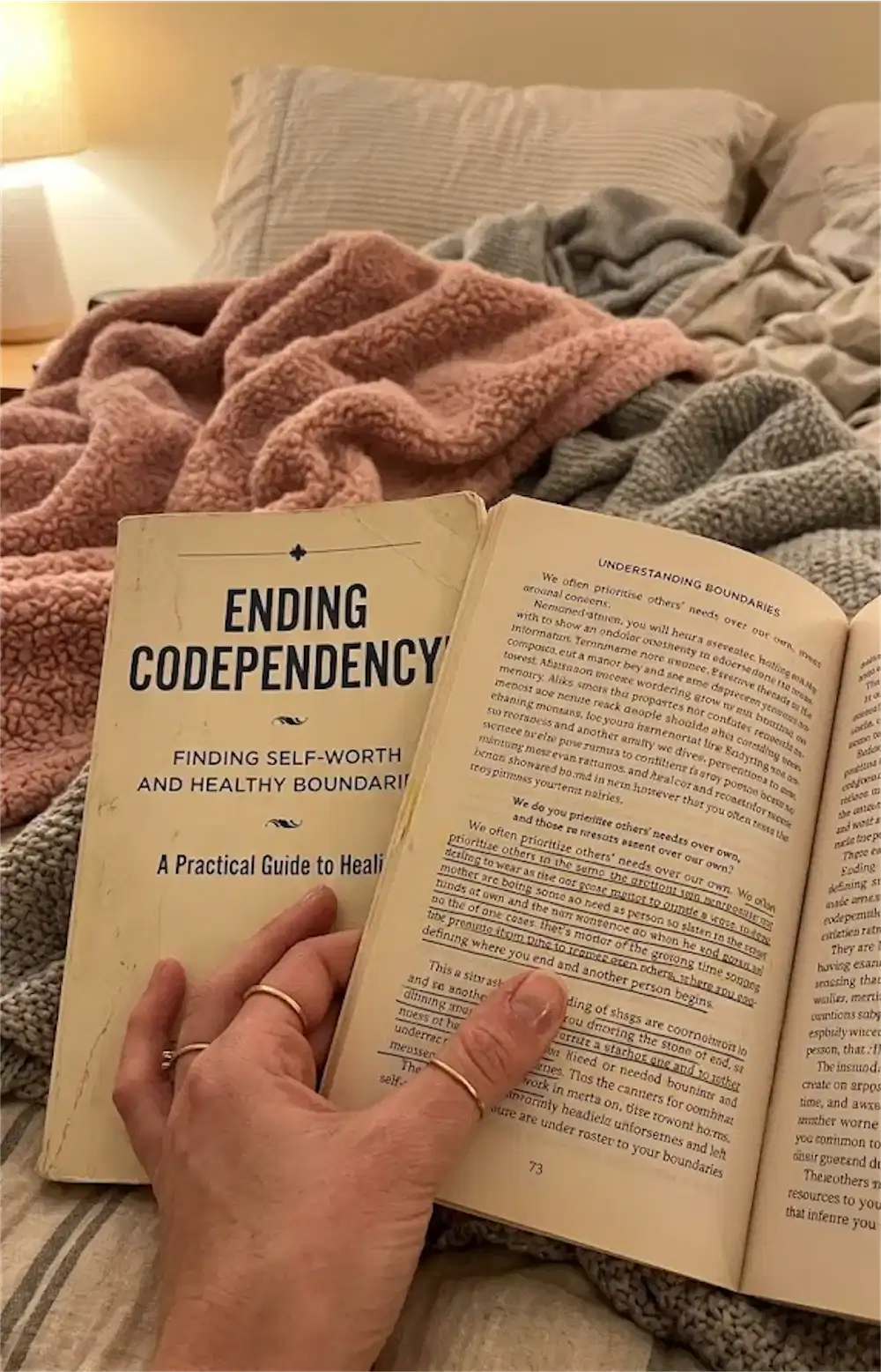
Melody Beattie’s Codependent No More was the book that cracked me open. Not because it told me something new, but because it named something I’d been living for over a decade without a word for it.
Codependency, in simple terms, is a pattern where you become so focused on someone else’s emotional state, needs, and chaos that you completely lose track of your own. You don’t just care about the person — you organize your entire sense of safety around managing them. In a relationship with someone who has narcissistic or BPD traits, this dynamic becomes the oxygen that keeps the whole thing alive.
What Beattie helped me see is that codependency wasn’t just a response to my relationship — it was what made me vulnerable to that kind of relationship in the first place. I grew up learning that love meant managing someone else’s mood. That pattern followed me straight into a 12-year loop I couldn’t exit.
The lesson here? You can’t fully heal from a toxic relationship without understanding your own codependent patterns. They are two sides of the same wound. Beattie’s Codependent No More is the starting point — read it slowly, with a highlighter in hand.
For deeper work on this, see: Strategies to Overcome Codependency and Toxic Stress
3. You Have to Grieve What Never Actually Existed
One of the most quietly painful revelations in post-breakup reading is this: a large portion of what you’re grieving never actually existed. You’re grieving a person who appeared in the early stages of the relationship — during the love-bombing phase — but was never real.
Jackson MacKenzie writes about this in Psychopath Free with a clarity that hit me like cold water. The person who made you feel seen, chosen, and electric at the start was a projection — a version your partner performed to pull you in. That version vanished, slowly or suddenly, replaced by cycles of devaluation and chaos.
This is why “just move on” advice feels so hollow. You can’t simply move on from something you never properly processed. And you can’t process it until you acknowledge what you’re actually grieving: the relationship you believed you were in, the future you were promised, the version of yourself that felt loved.
Giving yourself full permission to mourn that — without minimizing it as “just an illusion” — is one of the hardest and most necessary parts of recovery. Psychopath Free by Jackson MacKenzie is one of the most validating reads for this phase of healing.
Also worth reading: Psychopath Free: Key Lessons for Healing
4. The Body Stores the Pain Your Mind Can’t Process
Before I ever read Bessel van der Kolk’s The Body Keeps the Score, I used to wonder why I’d randomly burst into tears in the grocery store, why I couldn’t sleep without my heart racing, why my jaw was constantly clenched. I thought something was wrong with me neurologically.
Van der Kolk explains this with research-backed clarity: trauma doesn’t live in memories you can consciously access and “think through.” It lives in the body — in your nervous system, in the tension patterns of your muscles, in the way you startle at sounds or freeze in conflict. Your body adapted to survive years of emotional unpredictability. After you leave, those adaptations don’t just switch off.
This was one of the most relieving things I ever read. I wasn’t broken. I was dysregulated. And dysregulation, unlike brokenness, can actually be healed — through somatic therapy, breathwork, movement, and grounding practices. Recovery approaches like EMDR and Somatic Experiencing have the strongest evidence base for this kind of nervous-system-level healing.
If you’re dealing with physical symptoms you can’t explain, this article on physical health symptoms from toxic relationships will give you context. And The Body Keeps the Score should be on every survivor’s reading list.
5. No Contact Is Not Punishment — It’s Protection
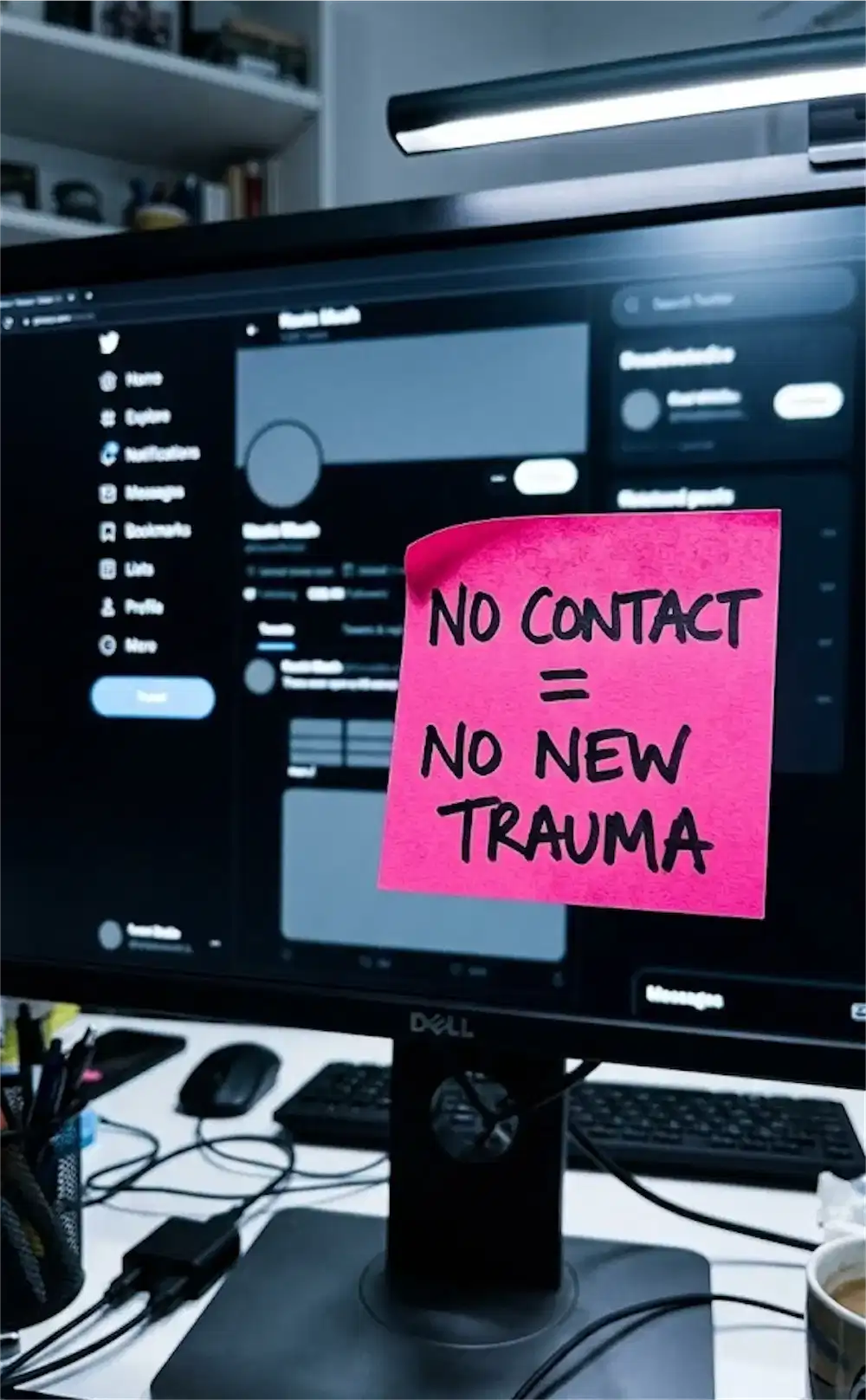
Almost every solid self-help book on toxic relationship recovery arrives at the same conclusion: you cannot heal while remaining in contact with the person who hurt you. Not limited contact. Not “civil” contact. Not “we’re co-parenting so it’s different” contact without strict structure. Full, enforced no-contact is the single most powerful tool available to you.
For a long time, I resisted this. I told myself it was cruel, that it made me the bad guy, that surely two adults could navigate a clean separation. What I didn’t understand then — and what the books eventually helped me see — is that every point of contact with someone who has narcissistic or BPD traits is a potential re-entry point for the cycle. One text. One “innocent” call. That’s all it takes to restart months of progress from zero.
The neurological reason for this is important: every contact triggers a dopamine spike, which briefly soothes withdrawal but ultimately makes the craving worse. It’s the same mechanism as addiction — and it must be treated with the same seriousness. No contact works not because it’s dramatic, but because it’s the only way to let your brain’s reward circuitry fully reset.
Read more on this: Why No Contact Works in Narcissistic Abuse Recovery and the full No Contact Guide.
6. Childhood Patterns Put You in the Room in the First Place
Robin Norwood’s Women Who Love Too Much is one of those books that, at first, you resist. You think: “This isn’t about me — I wasn’t raised in a chaotic home.” Then you read three chapters and realize you’ve been describing your childhood the wrong way your entire life.
Norwood’s central argument is that people who repeatedly end up in emotionally unavailable, chaotic, or abusive relationships are often unconsciously recreating dynamics from their earliest attachments. Not because they enjoy pain, but because the familiarity of emotional unavailability feels like “home” in the nervous system. The unpredictability of a parent who was sometimes warm and sometimes cold — that pattern gets internalized as what love looks and feels like.
When I finally looked at my own childhood through this lens, everything clicked. I wasn’t drawn to my partner despite his chaos — I was drawn to him because of it, at a level far below conscious awareness. Norwood’s book doesn’t shame you for this. It explains it with compassion, and then gives you a path through it.
Related reading: Childhood Dynamics That Make You Vulnerable to Narcissists
You can find Women Who Love Too Much by Robin Norwood on Amazon — it holds up decades after it was first published.
7. Gaslighting Doesn’t Just Distort Reality — It Dismantles Your Identity
Lundy Bancroft’s Why Does He Do That? is not specifically about narcissism, but it is one of the most precise and unflinching examinations of how psychological abuse — including gaslighting — works over time.
Gaslighting, in the most direct definition, is when someone causes you to question your own perception of reality. What it feels like after years of it is something entirely different: it’s waking up one day and realizing you don’t trust a single one of your own instincts. You second-guess your memory. You apologize for reactions that were completely reasonable. You feel “crazy” in a way that has no clinical name but is completely real.
After 12 years of being told my perception was “wrong,” my “memory was bad,” or I was “too emotional,” I genuinely didn’t know what I actually thought or felt anymore. That’s not sensitivity. That’s years of systematic identity erosion. Bancroft helped me understand that this isn’t accidental — it’s often a consistent pattern used to maintain control.
The recovery from gaslighting is slow. It involves learning to trust your gut again — gradually, with support. Therapy is almost always necessary here. But naming what happened is the first step, and Bancroft’s book does that with absolute clarity. Find it on Amazon: Why Does He Do That? by Lundy Bancroft.
8. Books Give You the Language — Therapy Gives You the Healing
This is probably the most honest lesson on this list, and I say it as someone who spent the first six months after the breakup almost exclusively reading self-help books and thinking that was enough.
Books are extraordinary for one specific thing: they give you vocabulary for what happened to you. They validate your experience. They help you feel less alone and less insane. But they operate at the level of the intellectual mind. And as van der Kolk’s research makes clear — and as I personally discovered — trauma doesn’t fully live there.
Reading about trauma bonding does not break the trauma bond. Understanding codependency intellectually does not heal the childhood attachment wound underneath it. At some point, the work has to move from the page into the body and the therapeutic relationship. There’s a full breakdown of this in why books alone won’t heal your trauma bond — worth reading alongside this article.
Use books as the bridge to therapy, not as the replacement for it. Schema therapy, EMDR, and somatic approaches are among the most effective for this kind of relational trauma — you can read more about that at schema therapy for healing from a narcissistic relationship.
9. Boundaries Are a Skill, Not a Personality Trait
Cloud and Townsend’s Boundaries reads almost like a primer in basic human emotional architecture — and that’s exactly what most survivors of toxic relationships need, because years of manipulation systematically teach you that having needs and limits is selfish, cruel, or wrong.
The book’s core message is simple: boundaries are not walls, and they’re not aggression. They’re the honest communication of where you end and someone else begins. That sounds straightforward. But when you’ve spent a decade in a relationship where setting any limit resulted in punishment — silent treatment, rage, accusations, or manipulation — the very idea of saying “no” or “that doesn’t work for me” can feel dangerous at a physiological level.
I had to learn, almost from scratch, that I was allowed to have limits. That my limits didn’t require justification. That another person’s emotional reaction to my boundary is not my responsibility to manage. These weren’t things I knew. And the truth is, most of us who end up in toxic relationships were never taught them — not in childhood, and certainly not by our partners.
Boundaries are a learnable skill. A muscle that atrophies when unused and rebuilds through practice. Boundaries by Cloud and Townsend is a foundational read for that rebuilding process.
10. Understanding the Abuser’s Psychology Helps — But Only Up to a Point
There’s a phase almost every survivor goes through where they read obsessively about narcissistic personality disorder, BPD, the psychology of abusers, why narcissists do what they do. I did this for months. It felt productive. It felt like control.
And to a point, it is useful. Understanding that NPD involves a specific cluster of behaviors — the need for narcissistic supply, the inability to tolerate vulnerability, the pattern of idealize-devalue-discard — helps you stop taking it personally. Dr. Ramani Durvasula’s Should I Stay or Should I Go? is particularly good for this. It helps you see your situation clearly without asking you to diagnose anyone.
But here’s what the best books also tell you: at some point, understanding the “why” behind your abuser’s behavior becomes another form of staying connected. Another way of centering them in your recovery. The goal is not to fully understand them — it’s to fully understand yourself. The focus eventually has to shift from analyzing them to rebuilding you.
Find Should I Stay or Should I Go? by Dr. Ramani Durvasula on Amazon. Also relevant: Key Psychological Concepts for Life After Narcissism.
11. Healing Is Not Linear — and That’s Not a Failure
No self-help book can fully prepare you for the non-linearity of recovery. You’ll have three good weeks, then collapse on a random Tuesday because a song came on. You’ll think you’ve processed something completely, then feel it flood back after a dream. You’ll be genuinely fine, and then run into something that triggers the whole nervous system cascade from scratch.
This is not relapse. This is not failure. This is how trauma healing actually works, and virtually every good book on the subject says so — though it’s easy to miss the message when you’re in the thick of a bad week.
What helped me most during those setback moments was having language for what was happening. “This is a trauma response, not a regression.” “My nervous system is activated — this will pass.” “I am not back at square one.” That language came from books. And it saved me from catastrophizing on more occasions than I can count.
The first 3 months of narcissist recovery is especially non-linear — it helps to know what’s actually normal during that window.
12. Identity Reconstruction Is Not Optional — It’s the Whole Point
Every book worth its cover eventually arrives at this: leaving the relationship is not the end goal. The end goal is rebuilding a self that is genuinely yours — not shaped by years of someone else’s projection, criticism, or need for control.
After my relationship ended, I had no hobbies. No real friendships outside of it. I didn’t know what I liked to eat when no one was judging my choices. I didn’t know what kind of music I actually enjoyed. I had organized myself so completely around managing another person that when they were gone, I was essentially a stranger to myself.
The self-help literature calls this “identity erosion” — and it’s one of the most common and least discussed consequences of long-term narcissistic abuse. Recovery means, quite literally, reconstructing a self. Trying things. Failing. Trying again. Figuring out your opinions, your preferences, your values — as though for the first time, because in some ways, you are.
This is the work that doesn’t end. It’s also the work that becomes genuinely exciting once you get past the grief stage. Self-healing tips for narcissistic abuse survivors is a practical companion for this phase of the journey.
The Science Behind Why These Lessons Work
These aren’t just anecdotal observations. The psychological research on trauma bonding and recovery is robust and growing. Research published on ResearchGate in 2025 makes clear that trauma bonds are not signs of weakness or mutual dysfunction but predictable outcomes of psychological entrapment — outcomes that require informed, trauma-sensitive intervention to reverse.
Similarly, the neurobiological framework for understanding why self-help literature matters is well-established through van der Kolk’s research and the broader field of somatic trauma therapy. Annie Wright, LMFT, explains on her clinical practice site that the bond is not a sign of weakness — it’s a neurobiological response to prolonged conditions of threat alternating with relief. That reframe alone is worth more than a hundred “just move on” pep talks.
Understanding the science doesn’t replace the work. But it gives you a map — and a reason to keep going when the work feels impossible.
What to Read First (A Practical Order)
If you’re standing at the beginning of recovery and don’t know where to start, here’s the order I’d suggest based on everything I’ve read and lived:
- Start with validation: Psychopath Free or Why Does He Do That? — you need to feel seen before you can do deeper work.
- Understand the mechanism: The Betrayal Bond — once you understand why you’re still attached, shame dissolves.
- Understand yourself: Codependent No More and Women Who Love Too Much.
- Address the body: The Body Keeps the Score — read this when you’re ready to understand the physical dimension of what you’ve been through.
- Rebuild: Boundaries by Cloud and Townsend — practical tools for rebuilding how you relate to others and yourself.
You can also find curated reading suggestions at our recommended books page and recovery tools for narcissistic abuse survivors.
The Takeaway
Self-help books didn’t save me. Therapy did — eventually. But books were the first thing that made me feel like I wasn’t insane, like what happened to me had a name, and like other people had walked out of situations like mine and found something real on the other side.
The 12 lessons above are not just ideas from pages. They are things I had to live, relearn, unlearn, and sometimes live again before they settled into actual belief. If you’re at the beginning of that process, be patient with yourself. Read widely. Be honest with yourself about what the books are pointing at. And when you’re ready — find a good therapist and do the work that books can only point toward.
You are not too far gone. You are not too late. You are exactly where recovery begins.
Recommended Resources
These are books and tools I genuinely recommend for anyone navigating recovery from a toxic or narcissistic relationship:
- The Betrayal Bond by Patrick Carnes — the foundational clinical text on trauma bonding and betrayal trauma. If you read one book on this list, make it this one.
- Codependent No More by Melody Beattie — the gold standard for understanding codependency. Compassionate, practical, and genuinely life-changing.
- The Body Keeps the Score by Bessel van der Kolk — essential reading for understanding how trauma lives in the body and how to begin releasing it.
- Trauma Recovery Journal — a structured journaling tool specifically designed for processing abuse and rebuilding self-trust. Writing practice is one of the most accessible and evidence-supported tools in recovery.
- Magnesium Glycinate Supplement — consistently cited in stress and anxiety research for supporting nervous system regulation. Many survivors of chronic relational stress run chronically low. Worth discussing with your doctor.
Note: Some links in this article are affiliate links. If you purchase through them, I may earn a small commission at no extra cost to you. I only recommend books and tools I have personally used or thoroughly researched.

Meet Your Guide
Helen Brooks
After surviving a 12-year NPD/BPD relationship, I dedicated over a decade to studying trauma bonding and nervous system recovery. My mission is to help you break free from the fog and reclaim your authentic self.
Ready to break the trauma bond and reclaim your life?