18 Long-Term Effects of Narcissistic Abuse and Practical Healing Methods
When people talk about recovering from narcissistic abuse, they often focus on the breakup itself. The dramatic ending. The no contact rule. What they talk about less is what comes after, sometimes months or years after, when you are technically “out” but still carrying something heavy that you cannot quite name.
I lived inside a relationship with a partner who had both narcissistic and borderline traits for 12 years. When it ended, I thought the hardest part was behind me. I was wrong. The hardest part was figuring out why I could not sleep, why I flinched at certain tones of voice, why I felt guilty for being happy, and why I still could not trust my own judgment about anything.
The long-term effects of narcissistic abuse are not dramatic in the way movies show trauma. They are quiet. They live in your nervous system, your self-image, your relationship patterns, and sometimes even your body. And most of them have a name, a mechanism, and a path through.
This article covers 18 of the most documented and common long-term effects, with honest reflection on how each one showed up in my own recovery, plus practical methods that actually helped. Not theory. Not platitudes. Real tools.
1. Chronic Anxiety and Hypervigilance
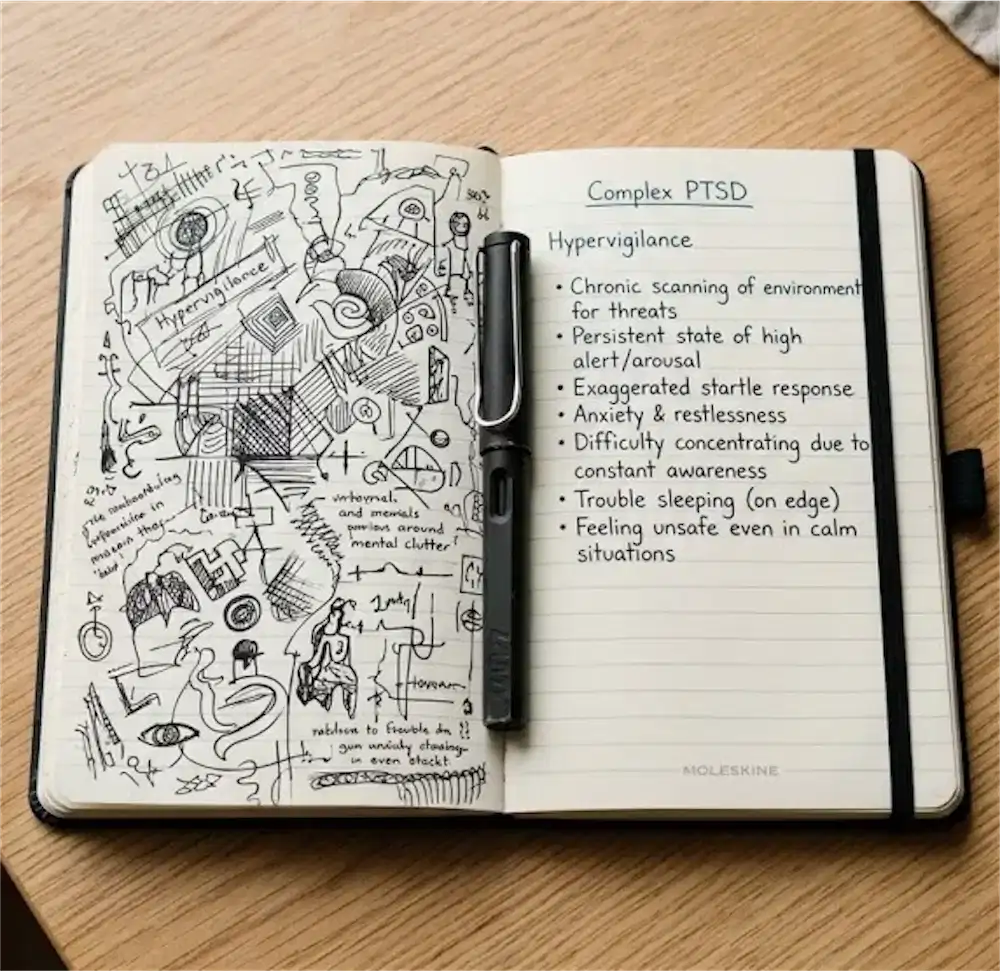
Hypervigilance means your nervous system is stuck in a permanent state of alert. You are always scanning for danger, even when there is none. You notice every shift in someone’s tone. You over-analyze text messages. You read rooms the second you walk into them.
This is not a personality trait. It is a nervous system adaptation. After years of unpredictability, your brain rewired itself to anticipate threats at all times. In a volatile relationship, that kept you safer. Outside of it, it is exhausting and disorienting.
For at least the first year after I left, I could not relax in any room with other people. Even neutral conversations made me brace for impact. I was always waiting for something to go wrong.
Practical method: Somatic (body-based) practices are the most effective tools here because the anxiety lives in the body, not just the mind. Box breathing, cold water exposure, and progressive muscle relaxation all signal safety to the nervous system. Start with five minutes of box breathing: inhale four counts, hold four, exhale four, hold four. Do it before any situation that triggers you.
A copy of Barry McDonagh’s DARE: The New Way to End Anxiety was one of the more practical anxiety resources I found during early recovery. It does not pathologize the anxiety. It teaches you to move through it rather than fight it, which is a significantly different approach.
2. Complex PTSD (C-PTSD)
Complex PTSD is different from standard PTSD in one important way: it develops not from a single traumatic event but from prolonged, repeated trauma, particularly in a relationship where you cannot easily escape. Narcissistic abuse, especially over years, fits that profile precisely.
According to psychiatrist Judith Herman, who first formally described Complex PTSD in her landmark work Trauma and Recovery, the condition involves three core disruptions: alterations in affect regulation (managing emotions), self-perception (how you see yourself), and relations with others. All three are present in most narcissistic abuse survivors I have spoken with, and all three were present in my own recovery.
C-PTSD symptoms include emotional flashbacks (sudden drops into intense feelings of shame or helplessness with no obvious visual trigger), a harsh inner critic that feels like a separate voice, and a deep sense of permanent damage. Research published in the ICD-11 diagnostic framework by the World Health Organization, which formally recognized C-PTSD as a distinct diagnosis in 2018, confirms these as a documented clinical cluster tied specifically to prolonged interpersonal trauma.
Practical method: Trauma-informed therapy, specifically EMDR (Eye Movement Desensitization and Reprocessing) or Internal Family Systems (IFS), showed the most consistent results in my experience. These approaches work with the trauma stored in the body and in subpersonalities, not just the narrative you tell about what happened. Talk therapy alone is often insufficient for C-PTSD.
3. Persistent Depression
This is not just sadness about the relationship ending. It is a flattening of affect, a loss of interest in things that used to bring pleasure, a gray quality to daily life that does not seem to shift. Clinically, prolonged exposure to psychological abuse is directly linked to dysthymia (low-grade chronic depression) and major depressive episodes in survivors.
Part of what drives the depression is grief. Not just grief for the relationship, but grief for the years lost, for the person you were before, for the life you thought you were building. After 12 years, there was a lot of that grief to process. It took longer than I expected, and it did not follow any tidy stages.
Another part is neurobiological. Chronic stress from narcissistic abuse suppresses dopamine and serotonin function over time. Your brain’s reward system genuinely changes under prolonged psychological threat.
Practical method: Movement is the most underrated antidepressant available without a prescription. Not because it is a cure, but because it directly impacts neurochemistry. Even a 20-minute walk daily shows measurable effects on dopamine and serotonin. Exercise combined with therapy significantly outperforms either alone for trauma-related depression. Vitamin D supplementation is also worth discussing with your doctor, particularly if you were isolated during the relationship and spent little time outside. A good D3/K2 combination supplement is a simple, low-risk starting point.

4. Emotional Numbness and Disconnection
This one confuses people because it sits at the opposite end of anxiety and depression on the surface. But it often coexists with both. You stop feeling things clearly. Emotions seem distant or muted. You go through the motions of a day without feeling present in it.
Emotional numbness is a dissociative response. Dissociation, put simply, is when your mind disconnects from your immediate experience as a way of managing something that feels too overwhelming to feel directly. In a volatile relationship, turning the emotions off is protective. It keeps you functional. It lets you survive the unsurvivable.
After leaving, that shutdown can persist. I remember distinctly feeling nothing at what should have been happy moments for at least a year. A friend’s wedding. A promotion. A trip I had been excited about. I was present physically and absent in every other way.
Practical method: Reconnecting with the body is the most direct path through numbness. Not through dramatic experiences but through small, sensory ones. Smell a strong coffee. Hold something cold. Put your bare feet on grass. These are grounding techniques, and they work by pulling your nervous system back into the present moment through physical sensation rather than through thought.
5. Severe Trust Issues in New Relationships
After being systematically deceived, manipulated, and betrayed over years, your brain learns a very rational lesson: people who seem safe are not necessarily safe. The problem is that lesson stays active even with people who genuinely are trustworthy.
You find yourself waiting for new people to show their “real face.” Every kindness feels like potential manipulation. Every healthy relationship feels suspicious precisely because it lacks the chaos you were conditioned to associate with love.
This is not paranoia. This is an adapted threat-detection system that is now miscalibrated for normal life.
Practical method: Trust is rebuilt incrementally, through small acts that are followed by no negative consequence. The goal is not to trust everyone immediately. It is to expand your window of tolerance for vulnerability, one small exposure at a time. Therapy specifically focused on attachment patterns, such as attachment-based therapy or somatic experiencing, can accelerate this work significantly.
6. Loss of Identity
This is possibly the most disorienting long-term effect because it is invisible from the outside. You look like yourself. You sound like yourself. But inside, you genuinely do not know who you are without the relationship. Your preferences, interests, opinions, and sense of humor were slowly shaped, suppressed, or replaced over years to fit what your partner needed you to be.
Narcissistic partners are highly skilled at mirroring in the early stages, reflecting your values and personality back at you in a way that feels like profound recognition. Then, gradually, they replace what they mirrored with something that serves them better. By the time I left, I could not name a single hobby I genuinely did on my own. I had no idea what kind of music I actually liked. Even my opinions on things felt borrowed.
Practical method: Identity reconstruction is not dramatic. It is a series of very small experiments. Try a food you never tried. Watch a genre of film you dismissed. Go somewhere alone for an afternoon with no agenda. The goal is to accumulate small data points about who you actually are, separate from who you were told to be. This takes months. Be patient with the pace.
The article on lessons from 12 years inside a narcissistic relationship covers identity erosion in more depth and from a very personal angle, if you want to understand the mechanics of how it happens over a long period.
7. Codependency Patterns
Codependency, simply put, is a pattern of deriving your sense of self-worth and safety from other people’s emotional states and approval. It often predates the narcissistic relationship, but long-term narcissistic abuse deepens and reinforces it significantly.
You may find yourself, even after leaving, still instinctively taking responsibility for how everyone around you feels. Monitoring moods. Preemptively adjusting your behavior to manage other people’s reactions. Feeling guilty when someone near you is upset, even if you did nothing to cause it.
Practical method: Codependency recovery requires a specific kind of internal work around boundaries, which are not just rules you set with others but a sense of where you end and other people begin. Codependent No More by Melody Beattie is the most direct starting point I found for this. It is practical, compassionate, and completely non-judgmental about how codependency develops. The companion workbook is also worth getting alongside it.
For more structured strategies, see these practical strategies for overcoming codependency after toxic relationship stress.

8. Chronic Shame and Self-Blame
Shame is different from guilt. Guilt says “I did something bad.” Shame says “I am bad.” Narcissistic abuse produces an enormous amount of shame, and it does so deliberately. When someone consistently frames your needs, feelings, and reactions as problems, evidence of your inadequacy, or proof that you are “too much,” shame is the inevitable result.
Long after the relationship ends, that shame keeps running quietly in the background. You apologize for taking up space. You feel like a burden. You assume any conflict must be your fault. You minimize your experience when talking to others because some part of you still wonders if you deserved what happened.
Practical method: Shame loses power when it is named and witnessed by a safe person. This is one of the core reasons therapy specifically works for this particular wound in a way that books and self-work alone cannot replicate. Researcher and author Brene Brown’s work on shame, particularly her book Daring Greatly, provides a solid framework for understanding how shame operates and how vulnerability with safe people begins to dissolve it.
9. People-Pleasing and Fawning
Fawning is a trauma response. You probably know fight, flight, and freeze. Fawn is the fourth response: you appease, comply, flatter, and accommodate potential threats to keep yourself safe. In a narcissistic relationship, fawning is often the most effective short-term survival strategy. You learn to read moods, preemptively soothe, and agree even when you disagree, because the alternative is worse.
After leaving, fawning continues automatically with everyone. Your boss. Your friends. Strangers in line at the grocery store. You twist yourself into accommodation before anyone even asks you to.
Practical method: The antidote to fawning starts with noticing when you are doing it. Not stopping it immediately, just noticing. From there, practice holding a micro-pause before you agree to things. Just a breath. Check in with whether what you are about to say is actually true for you or is a reflex. Over time, the reflex slows down.
10. Difficulty Setting and Holding Boundaries
Boundaries in a narcissistic relationship are not just ignored. They are systematically dismantled. Every time you try to say “this is not okay with me,” the response is punishment, rage, manipulation, or emotional withdrawal. Over years, you learn that having boundaries leads to pain. So you stop having them, or you stop enforcing them, which amounts to the same thing.
Post-relationship, setting a boundary, even a small one, can feel physically frightening. Your body braces for the retaliation that is no longer coming. This is why people often describe knowing what they should do but feeling completely unable to do it.
Practical method: Start with the smallest possible boundary in the safest possible context. Say no to something minor with someone you trust completely. Notice that nothing terrible happens. Your nervous system needs experiential evidence that boundaries are survivable, not just intellectual understanding that they are necessary. Build from there, slowly and deliberately.
11. Isolation and Social Withdrawal
Narcissistic partners frequently isolate their partners from friends and family, sometimes dramatically and sometimes so gradually you barely notice until your entire social world has narrowed to one person. After the relationship ends, you look around and realize the friendships are gone, the habits of socializing are gone, and the skill of being easy around people feels rusty or completely lost.
Even if the isolation was not forced directly, the exhaustion of the relationship leaves you with nothing to give socially. You withdraw because you have no energy and because you no longer know how to be around people without performing.
Practical method: Re-entry into social life works best through low-pressure, structured environments. A class, a running group, a book club. Something with a built-in activity so the pressure is not entirely on conversation. You do not need to explain your history. You just need to be somewhere with other people regularly until it stops feeling so foreign.

12. Fear of Intimacy and Vulnerability
This is one of the more painful long-term effects because it directly interferes with forming the connections that actually support healing. You want closeness. And the moment someone gets close, something in you pulls back, deflects, or shuts down.
What happened was this: intimacy was weaponized in your previous relationship. Everything you shared about yourself, your fears, your history, your vulnerabilities, was eventually used against you. Your nervous system drew the obvious conclusion. Vulnerability equals danger. Being known equals being exploited.
Practical method: Vulnerability is rebuilt in layers, not all at once. Share something small with a safe person. See what happens. Sit with the discomfort of being seen rather than immediately withdrawing. If you feel the pull to push someone away right when things are going well, name that impulse to yourself. “That is the fear response, not a judgment about this person.” There is a significant difference.
13. Negative Self-Talk and an Overpowering Inner Critic
Pete Walker, a psychotherapist specializing in C-PTSD, describes the inner critic in abuse survivors as an “internalized abuser.” That description is almost uncomfortably accurate. The voice that tells you that you are stupid, too much, not enough, ugly, or unlovable? That is not your original voice. That voice was installed through years of hearing similar things, or watching the contempt in someone’s eyes, or being made to feel consistently inadequate.
The inner critic is also often what keeps you stuck. It tells you not to try new things because you will fail. Not to reach out to people because they will reject you. Not to trust your own decisions because they are probably wrong. It is relentless, and it sounds exactly like you, which is why it is so hard to challenge.
Practical method: The first step is externalization. When the inner critic speaks, try responding to it in third person: “That is an interesting thought, but I’m not sure that’s accurate.” Creating even a small psychological distance from the critic allows you to start evaluating its claims rather than automatically accepting them. Internal Family Systems therapy is particularly effective for working with the inner critic as a specific sub-part of your psychology.
14. Difficulty Concentrating and Memory Problems
This one surprises people because it sounds medical rather than psychological. But chronic stress physically changes the brain. The hippocampus, the region responsible for memory consolidation and learning, is directly suppressed by prolonged cortisol elevation. Long-term narcissistic abuse keeps cortisol elevated almost constantly.
After leaving, many survivors describe a brain fog that persists for months. Difficulty focusing on tasks. Forgetting things that would have been automatic before. Struggling to read or retain information. I spent the first six months after leaving unable to finish a single book, which had never been a problem for me before.
Practical method: The hippocampus is one of the few brain regions that can grow new cells through a process called neurogenesis. The most well-supported triggers for that process are aerobic exercise, adequate sleep, and reduced cortisol. Those three things are the physiological foundation of cognitive recovery. Omega-3 fatty acids, particularly EPA, also have solid research behind them for supporting brain structure and function after chronic stress. A high-EPA fish oil supplement is worth discussing with your doctor as a supportive measure.
15. Physical Health Problems
Psychological trauma does not stay in the mind. It moves into the body. Research consistently links prolonged psychological stress with increased rates of autoimmune conditions, chronic pain, gastrointestinal issues, cardiovascular problems, and disrupted sleep architecture. This is not psychosomatic in the dismissive sense. It is a documented physiological response to chronic threat.
Bessel van der Kolk’s research, detailed in his widely referenced work on trauma and the body, demonstrates that traumatic experience is literally stored in the tissues and nervous system, not just in memories or thoughts. This is why so many survivors develop new physical symptoms during or after a narcissistic relationship that resolve, sometimes partially, sometimes significantly, as psychological healing progresses.
Practical method: Tell your doctor about the relationship and its duration. A good primary care physician will take that context seriously when evaluating any new physical symptoms. Inflammation markers, thyroid function, cortisol levels, and sleep quality are all worth assessing. Addressing the physical alongside the psychological is not optional. They are one system.
16. Repetition Compulsion and Attracting Similar Relationships
Repetition compulsion is a psychological tendency to unconsciously recreate familiar relational dynamics, even painful ones. It is not masochism. It is the nervous system seeking what it recognizes as “normal,” even when normal was harmful.
After leaving a narcissistic partner, many survivors find themselves drawn to similar personalities in new relationships, friendships, or workplaces, sometimes before they even consciously register the pattern. The qualities that once felt like chemistry, the intensity, the unpredictability, the highs, trigger the same neurochemical responses that were conditioned over years.
Practical method: Before entering any new significant relationship, take enough time to understand your attraction patterns with a therapist. Specifically, what qualities consistently draw you in, and whether those qualities overlap with traits your previous partner had during the idealization phase. Healthy relationships tend to feel “boring” to someone whose nervous system was calibrated to chaos. Learning to distinguish calm from boring is a specific, learnable skill.
The article on childhood dynamics that attract narcissists goes deeper into why certain attachment histories create this pull toward familiar but harmful relationship patterns.
17. Grief That Does Not Follow a Predictable Timeline
You might expect to grieve hardest immediately after leaving. And you do. But there is a second wave of grief that often hits during recovery, sometimes a year or two out, when you start to understand the full scope of what happened. Not just what you lost, but what was taken from you. Time. Identity. Relationships. Years you cannot get back.
This grief is complicated because it is not about a person exactly. You grieve the relationship you thought you had, which was never quite real. You grieve the version of your partner who existed during idealization, knowing they were a performance. You grieve the years of your life spent trying to earn love from someone who was structurally unable to give it.
That is a particular kind of loss, and it does not get enough acknowledgment in most recovery conversations.
Practical method: Let it be grief. Do not rush it or pathologize it. Crying is not a sign of weakness or regression. It is the nervous system processing what the mind has finally accepted. A guided grief journal can help structure the processing if free-form journaling tends to loop into rumination rather than release.
18. Difficulty Feeling Safe or at Home Anywhere
This one is hard to explain to people who have not experienced it. It is not quite homesickness. It is a persistent sense of not quite belonging in your own life, your own body, your own space. Like you are slightly outside of everything, watching it through glass.
Part of this is dissociation, which we covered earlier. But it is also something more specific: in a narcissistic relationship, your home, your space, and your environment were never truly yours. They were controlled, invaded, or made to feel unsafe. After leaving, the concept of “home” as a place of safety has to be almost completely rebuilt from scratch.
I moved to a new apartment after leaving. It took me eight months before I stopped waiting to hear the key in the lock.
Practical method: Deliberately make your space yours. Not in a decorating sense, though that helps. In a sensory sense. Cook a meal you love. Light a candle with a scent that is yours. Play music that has no association with the previous relationship. Create new sensory associations between your environment and safety. Over time, your nervous system begins to recognize the space as safe, not because nothing bad could happen there, but because nothing bad is happening there now, consistently.
How Long Does It Actually Take to Heal?
Honestly? It depends on how long the abuse lasted, whether you have other compounding trauma in your history, the quality of support you have, and whether you get appropriate professional help. There is no fixed timeline and anyone who gives you one is oversimplifying.
What I can tell you from experience is that the first year is often the most disorienting. The second year is usually when real clarity starts to emerge. By year three, most people who have done the work feel genuinely different. Not fixed. Not finished. But genuinely different.
Progress also does not feel like a straight line going upward. It feels like two steps forward, one step back, forward again, a sudden drop, and then forward again. That non-linear quality is not failure. It is what healing actually looks like from the inside.
For a practical look at the specific habits that support recovery on a day-to-day level, see these habits to quit after a narcissistic breakup, which covers the behavioral side of the healing process in concrete terms.
And if you are still in the earlier stages where self-doubt is the loudest voice, the article on signs of self-doubt after narcissistic abuse recovery covers that specific experience in detail.
The Takeaway
Eighteen effects is a long list. And if you recognized yourself in most of them, that is probably both validating and exhausting. Here is what I want you to hold onto: every single one of these effects has a mechanism, and every mechanism can be worked with. None of them are permanent character traits. None of them are proof that you are damaged beyond repair.
They are the predictable aftermath of prolonged psychological harm. They showed up because you were in something genuinely harmful for a long time. And they can be addressed, systematically, with the right support.
You do not have to tackle all 18 at once. You start where the pain is loudest. You get help. You stay consistent even when it does not feel like it is working. And eventually, one day that feels completely ordinary, you realize the voice is a little quieter and the world feels a little less like a threat.
That day is real. It comes. I am living it.
Recommended Resources
These are the books, tools, and supplements I found most genuinely useful across the different layers of long-term recovery. Affiliate links help keep this site running at no added cost to you.
- Trauma and Recovery by Judith Herman, MD – The foundational clinical text on complex trauma. Dense in places but worth it. Validates what happened to you with the weight of decades of research behind it.
- Complex PTSD: From Surviving to Thriving by Pete Walker – The most compassionate and practical guide for C-PTSD symptoms specifically. Walker writes like someone who has been in the room with you.
- The Body Keeps the Score by Bessel van der Kolk, MD – Essential for understanding why the physical symptoms are real and why healing has to involve the body. One of the most important books in trauma science of the last 30 years.
- Daring Greatly by Brene Brown – For working specifically with shame and the fear of vulnerability. Less clinical than the others, more warm and direct. Pairs well with therapy.
- Narcissistic Abuse Recovery Guided Journal – Structured prompts keep the journaling process productive rather than looping. Particularly useful for working through grief and identity questions systematically.
- Magnesium Glycinate Supplement – Chronically elevated cortisol depletes magnesium. Low magnesium worsens anxiety, sleep disruption, and muscle tension. A well-absorbed form like glycinate is worth discussing with your doctor as a supportive supplement during recovery.

Meet Your Guide
Helen Brooks
After surviving a 12-year NPD/BPD relationship, I dedicated over a decade to studying trauma bonding and nervous system recovery. My mission is to help you break free from the fog and reclaim your authentic self.
Ready to break the trauma bond and reclaim your life?